

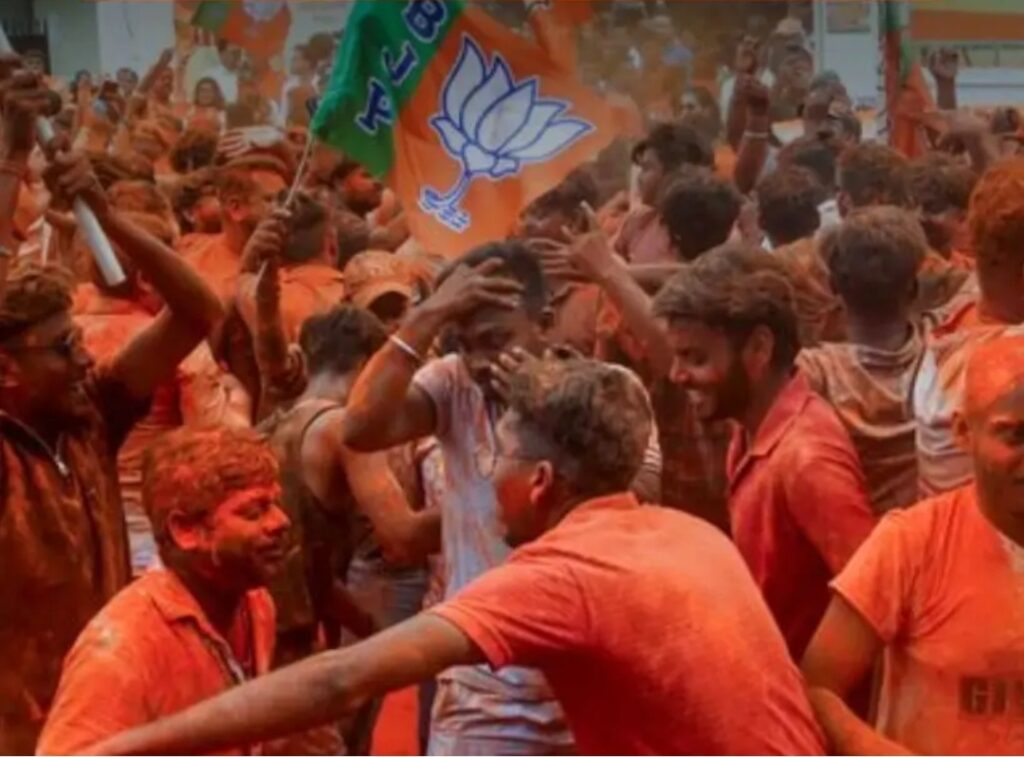
From welfare saturation to booth-level precision, and from narrative control to institutional asymmetry, the anatomy of a dominant electoral force.
In the aftermath of the 2024 Lok Sabha elections, Indian politics has entered a paradoxical phase. While the ruling party faced a more competitive national contest than anticipated, its subsequent victories in key state elections—across Haryana, Maharashtra, Delhi, Bihar, West Bengal, and Assam—have revealed a deeper, more resilient electoral architecture. The scale and consistency of these wins, in several cases translating into commanding or near two-thirds majorities, have left both opposition parties and seasoned psephologists grappling for explanations.
The answer does not lie in a single factor. Rather, it is the result of a layered and meticulously executed political playbook that combines organisational depth, narrative dominance, welfare targeting, financial muscle, and—critics argue—an institutional environment that is not always perceived as level.
*The Welfare–Electoral Feedback Loop*
At the heart of the BJP’s strategy lies what may be called welfare saturation with political attribution. Schemes such as free rations, direct benefit transfers, subsidised housing, and targeted financial assistance to women have created a vast beneficiary class.
Unlike earlier welfare regimes, these benefits are:
*Highly centralised in messaging.
*Digitally tracked and delivered.
*Explicitly branded with leadership identity.
The result is a direct political feedback loop—beneficiaries often associate material improvement with the ruling party, bypassing local intermediaries.
In states like Maharashtra and Bihar, pre-election announcements of cash transfers or enhanced subsidies—particularly aimed at women and economically vulnerable groups—played a decisive role in consolidating voter blocs.
*Booth-Level Precision: The Invisible Machinery*
Perhaps the most underappreciated element of the BJP’s success is its unmatched micro-level organisation.
The party’s booth management system includes:
*Detailed voter segmentation
*Deployment of panna pramukhs (page-level voter managers).
*Real-time feedback loops during campaigns.
*Mobilisation strategies calibrated down to individual households.
This granular approach ensures not just persuasion, but turnout maximisation—often the decisive factor in close contests.
*Narrative Construction and Polarisation*
Electoral politics is as much about perception as policy. The BJP has demonstrated exceptional skill in shaping narratives that resonate across regions.
Recurring themes include:
*National security.
*Cultural identity.
*Welfare delivery.
*The spectre of “infiltrators” or demographic anxiety in border states like Assam and Bengal.
Critics argue that such narratives often sharpen communal or identity-based polarisation. Supporters counter that they reflect legitimate concerns of governance and sovereignty.
Either way, the political impact is undeniable: issue framing shifts from local grievances to broader identity questions, often benefiting the incumbent.
*Financial Asymmetry and Campaign Scale*
The scale of resources deployed in recent elections has been unprecedented in Indian politics.
The now-scrutinised system of electoral funding, including mechanisms like electoral bonds (whose transparency has been debated following judicial scrutiny), enabled massive financial mobilisation. This translated into:
*High-decibel campaigns.
*Ubiquitous advertising across media platforms.
*Extensive ground operations.
Opposition parties have repeatedly argued that this financial asymmetry creates a structurally unequal contest.
*Institutional Questions and Electoral Trust*
A more contentious dimension of the debate concerns the role of constitutional institutions such as the Election Commission of India and the Supreme Court of India.
Opposition parties and sections of civil society have raised concerns regarding:
*Voter roll revisions, including alleged deletions and additions in states like Bihar and West Bengal.
*The timing and transparency of such processes.
*The responsiveness of institutions to complaints and disputes.
The Election Commission has consistently maintained that:
*Voter list updates follow established legal procedures.
*Mechanisms exist for correction and appeal.
*Electoral integrity remains intact.
Similarly, the judiciary has intervened in certain cases—such as scrutinising electoral funding frameworks—while exercising restraint in others.
The broader issue, however, is not merely procedural but perceptual: the credibility of institutions depends as much on public trust as on legal compliance.
*Fragmented Opposition and Strategic Vacuums*
While the BJP’s strengths are significant, they are amplified by the opposition’s weaknesses:
*Lack of cohesive alliances in several states.
*Inconsistent messaging.
*Leadership fragmentation.
*Delayed candidate selection and campaign mobilisation.
In states like Bengal and Delhi, opposition parties often found themselves competing against each other as much as against the BJP—splitting votes and diluting impact.
*The Presidentialisation of Parliamentary Politics*
Another defining feature of recent elections is the shift toward leader-centric campaigns. The BJP has successfully nationalised state elections by projecting a central leadership figure as the primary axis of choice.
This presidential style of campaigning:
*Simplifies voter decision-making.
*Overrides local anti-incumbency.
*Creates a unified national narrative.
*Dominance or Disequilibrium?*
The BJP’s electoral success is neither accidental nor inexplicable. It is the outcome of:
*Organisational discipline.
*Strategic welfare deployment.
*Narrative control.
*Financial capacity.
*And, as critics argue, an uneven institutional playing field.
Whether one views this as political mastery or systemic imbalance depends largely on one’s vantage point.
What is undeniable, however, is that Indian democracy is undergoing a structural transformation. Elections are no longer merely contests of ideology or governance—they are complex operations involving data, perception, resources, and institutional frameworks.
For the opposition, the lesson is stark: countering the BJP requires not just critique, but an equally coherent and technologically adept political model.
For institutions, the challenge is even greater: to preserve not only the integrity of the process but also the confidence of the public in that integrity.
Because in a democracy, victory must not only be achieved—it must also be seen to be fair.

~Hasnain Naqvi is a former member of the history faculty at St. Xavier’s College, Mumbai….
The opinions expressed here are solely those of the author.