
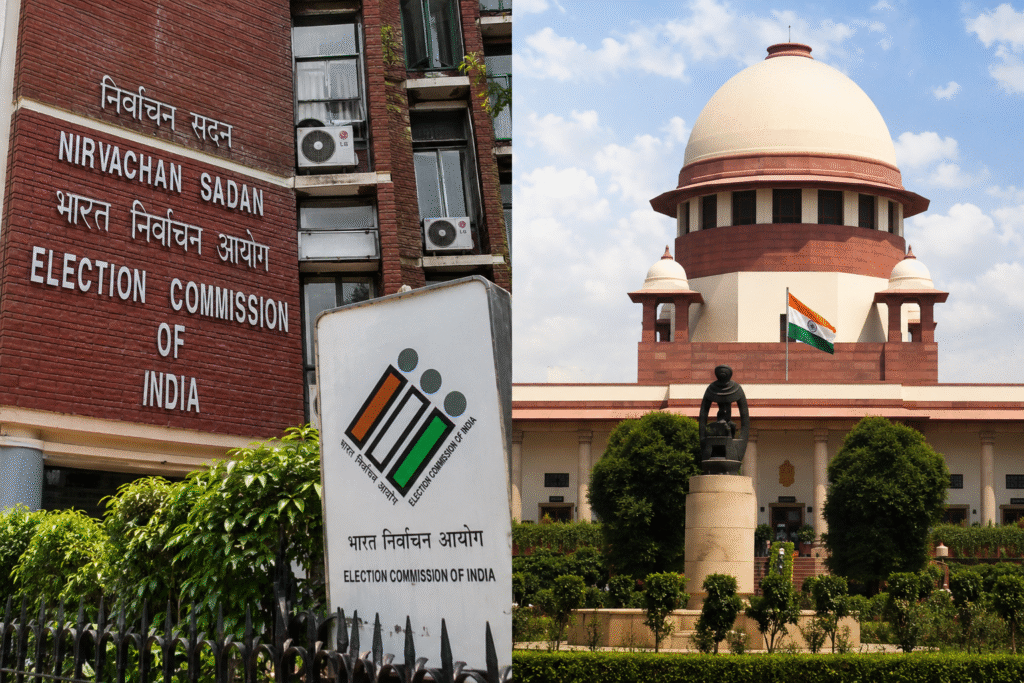
NEW DELHI: The Supreme Court on Wednesday came down fully in support of the Election Commission of India (ECI) and upheld its powers to undertake the highly contentious and highly controversial Special Intensive Revision (SIR).
In a landmark decision that puts rest to a year-long judicial debate over the structural legitimacy of the SIR, a Division Bench led by Chief Justice Surya Kant and Justice Joymalya Bagchi upheld the program in its entirety, terming it as constitutional and statutory.
The Apex Court made a powerful argument for electoral integrity and defended the program on the basis that far from flouting the rules, the program in question serves the very purpose for which the Constitution exists in the first place.
“This Special Intensive Revision process is clearly a definitive attempt at establishing an accurate and inclusive list of voters. The process not only doesn’t violate any of the statutes but rather actively realizes the spirit of the Constitution of India.
“We are further of the opinion that the objective behind the introduction of the said revision exercise bears a direct nexus with the constitutionally defined right to free and fair elections,” the Bench said.
The apex court emphatically upheld the necessity of the exercise, tracing the rationale behind it straight back to the foundational values of the country. According to the bench, the unique process, far from circumventing the system’s requirements, was designed precisely to accomplish the purpose of the representative democracy.
Judicial order: “This court is satisfied that the SIR exercise was not only consistent with Article 324 powers, but the exercise was also constitutionally mandated for maintaining an inclusive and accurate Electoral Roll. In our opinion, it is difficult to say that the exercise bears any violation of statutory mandates of law when the objective of such an exercise is directly linked to free and fair elections under Article 324.”
In order to determine the validity of legal objections to the poll body, the Supreme Court defined the SIR exercise into four constitutional issues, ruling in favor of the election commission on all fronts:
Constitutional compatibility: Was the SIR exercise consistent with the constitutional mandate of the Commission? Yes
Proportionate objectives: Did the exercise bear reasonable relation to the objectives sought? Yes
Necessity for action: Were these measures necessary, and could there have been no other way to solve the roles problem? (Affirmed)
Proportional balance: Was there a reasonable balance struck between the need for electoral integrity and the restrictions on constitutional rights? (Affirmed)
These legal challenges asserted that the SIR procedure was ultra vires (illegal), since the method used was highly unorthodox compared to the usual annual update processes that are conducted.
The Supreme Court effectively rebutted this argument, explaining that the mere fact that a process has an unusual method is not in and of itself reason enough to make it illegal.
The court also made it clear that the process adopted had sufficient procedural protections, both in terms of those adopted by the Commission and through the directions of courts in previous cases. The court stated that “the process, as it eventually developed, offered many opportunities for input, correction, and relief” to ensure that election integrity did not undermine voter rights

Umakant Lakhera is a Senior Journalist and Political Commentator