
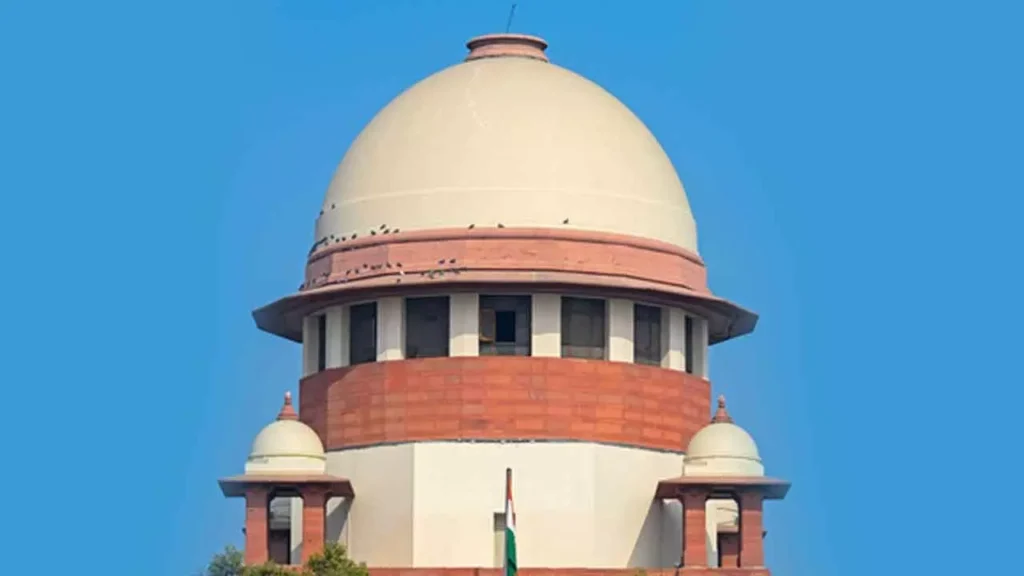
New Delhi, June 8: The Supreme Court on Monday issued notice on a plea challenging the reappointment of Bihar Panchayati Raj Minister Deepak Prakash in the government headed by Chief Minister Samrat Choudhary, contending that his continuation in office for a second successive term without being elected to either House of the State Legislature violates Article 164(4) of the Constitution.
Issuing notice to Bihar Panchayati Raj Minister Deepak Prakash, the Bihar government and the Election Commission of India, Chief Justice Surya Kant, heading a Bench also comprising Justice V. Mohana, asked whether Deepak Prakash was continuing as a Minister in the State government.
Challenging the reappointment of Deepak Prakash as a Minister in the present Bihar government, social activist Rakesh Kumar Singh, in his petition, has sought a declaration that Prakash’s reappointment on May 7, 2026, and his continuance in ministerial office are unconstitutional, illegal and contrary to the mandate of Article 164(4), which provides that a Minister who is not a member of the State Legislature for a period of six consecutive months shall cease to hold office upon the expiry of that period.
The petitioner has also sought directions requiring Prakash to explain the constitutional and legal basis on which he continues to function as Bihar’s Panchayati Raj Minister despite not being elected to either the Bihar Legislative Assembly (Vidhan Sabha) or the Bihar Legislative Council (Vidhan Parishad).
The petition states that Prakash, a leader of the Rashtriya Lok Morcha (RLM), was initially sworn in as a Minister in the Nitish Kumar-led government on November 20, 2025, without being a member of the either Vidhan Sabha or Vidhan Parishad.
The plea states that the six-month constitutional period contemplated under Article 164(4) commenced on November 20, 2025, and was due to expire on May 19, 2026.
The petition further states that political developments in Bihar took a different turn in April 2026 when Chief Minister Nitish Kumar resigned, resulting in the dissolution of the Council of Ministers. Thereafter, Samrat Choudhary was sworn in as Chief Minister on April 15, 2026. During the intervening period of about 22 days, Prakash did not hold ministerial office.
The challenge centres on his subsequent reappointment as Panchayati Raj Minister on May 7, 2026, in the expanded Council of Ministers headed by Chief Minister Choudhary, despite his continued status as a non-legislator.
The petitioner, Rakesh Kumar Singh, has contended that the constitutional limitation under Article 164(4) cannot be circumvented by a brief interruption in a minister’s tenure and the subsequent reappointment of the same individual after a short gap without securing election to the Legislature.
It further contends that such a course amounts to a colourable exercise of constitutional power designed to achieve indirectly what the Constitution does not permit directly.
The petition underscores that the issue transcends the appointment of a single individual and concerns the preservation of parliamentary democracy, constitutional accountability and the limits imposed by the Constitution on executive authority

Pramod kumar is a Senior Journalist, Covering Supreem Court of India