

A War That Ended Differently Than It Began
History often reserves its greatest surprises for moments when power appears most certain of itself.
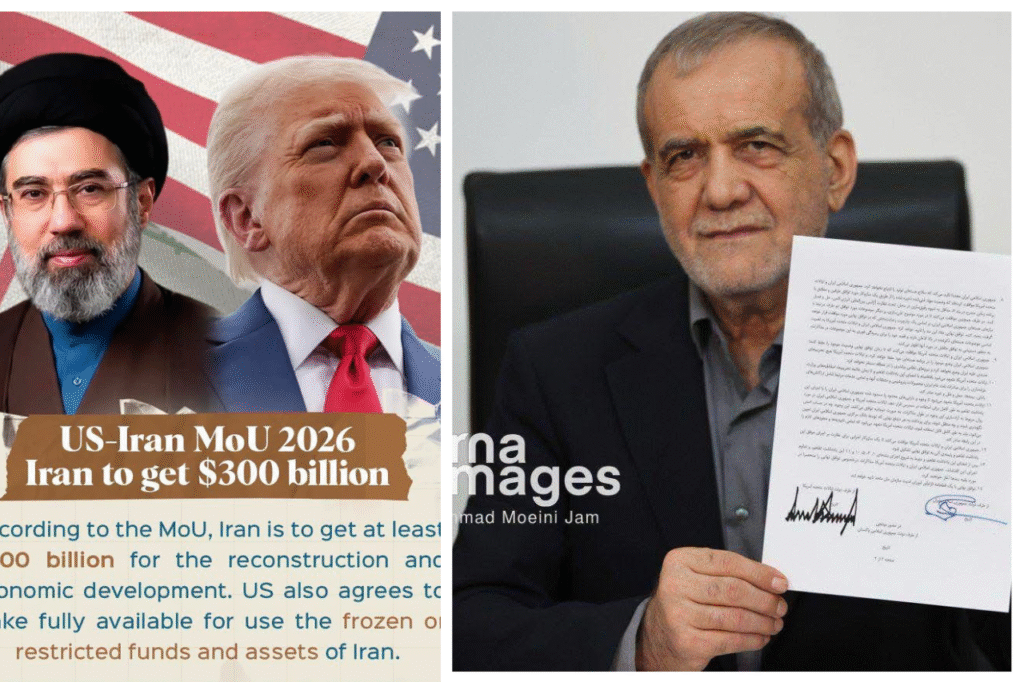
The emerging Memorandum of Understanding between the United States and Iran, reportedly endorsed by President Donald Trump and President Masoud Pezeshkian, has become one of the most debated diplomatic developments in recent years. Celebrated in Tehran as a strategic breakthrough and criticised in parts of Washington as a concessionary peace, the agreement raises larger questions about military power, political endurance and the changing balance of influence in West Asia.
Whatever one’s interpretation, a central reality stands out: after more than one hundred days of conflict, Iran has emerged battered but politically intact. In international politics, survival itself can constitute a form of victory.
Lessons from a Century Ago
The outcome invites comparison with the Russo-Japanese War of 1904–05, when Imperial Japan stunned the world by defeating Tsarist Russia.
In both cases, a major power entered a conflict confident that superior military capabilities would guarantee success. In both cases, assumptions about power were challenged by an adversary that proved more resilient than expected.
The parallels are not exact, but they are striking. Both conflicts began with surprise attacks, revolved around competing spheres of influence, involved significant backing from external powers, and showcased new forms of warfare. Above all, both demonstrated that overwhelming military superiority does not automatically produce political success.
History does not repeat itself, but it frequently echoes.
The Shadow of Karbala
To understand Iran’s perception of the conflict, one must look beyond conventional geopolitics.
Since the 1979 Revolution, the Islamic Republic has drawn heavily on the symbolism of Karbala, where Imam Husain, the grandson of Prophet Muhammad, resisted the forces of Yazid in 680 CE. For generations of Shia Muslims, Karbala has represented steadfastness in the face of overwhelming odds and resistance against perceived injustice.
Iran’s leadership has repeatedly invoked this historical memory during periods of sanctions, isolation and military pressure. The recent war was therefore understood not merely as a strategic contest but as part of a larger narrative of endurance and resistance.
Whether one accepts that narrative or not, it helps explain why Tehran was willing to absorb considerable costs while refusing to compromise on what it regards as fundamental principles of sovereignty and independence.
Has Washington Conceded More Than It Intended?
The most contentious question surrounding the agreement concerns its political balance.
Under the reported framework, the United States would remove its naval blockade, facilitate maritime traffic, release frozen Iranian assets, permit expanded oil exports, negotiate sanctions relief and participate in a reconstruction and development package worth at least $300 billion.
In return, Iran reiterates a position it has maintained for years: that it will not develop nuclear weapons and will preserve the status quo during negotiations.
For critics of the agreement, this imbalance is striking.
The United States entered the conflict seeking to constrain Iran’s regional influence and extract major concessions. Yet the framework appears to acknowledge Iranian sovereignty, restore economic access and effectively abandon longstanding expectations of regime change.
No government would publicly describe such an outcome as capitulation. Yet comparisons between original objectives and current realities have fuelled accusations that Washington has conceded far more than anticipated.
The $300 Billion Question
Perhaps no provision has generated greater discussion than the proposed reconstruction and economic development package worth at least $300 billion.
Officially, it is described as a rehabilitation initiative designed to support economic recovery.
Politically, however, many observers see something deeper. If a country subjected to conflict, sanctions and economic pressure subsequently receives hundreds of billions of dollars in development assistance, the distinction between reconstruction and indirect reparations becomes increasingly blurred.
Washington is unlikely to describe the package as compensation. Tehran may not insist on such language either.
Yet the symbolism remains difficult to ignore.
The Nuclear Issue: Concession or Continuity?
One of the most celebrated provisions of the agreement is Iran’s reaffirmation that it will not develop nuclear weapons.
Yet from Tehran’s perspective, this is hardly a new concession.
Iranian officials have long maintained that the country does not seek nuclear weapons, often citing the religious decree associated with Ayatollah Ali Khamenei prohibiting their development and use.
Whether international actors have found that explanation convincing is another matter. Nevertheless, if Iran has merely restated a longstanding position while obtaining sanctions relief and economic reintegration, the diplomatic balance sheet appears increasingly favourable to Tehran.
Trump’s Prediction Revisited
In January 2020, Donald Trump famously observed:
“Iran never won a war, but never lost a negotiation.”
The current situation has given that statement renewed relevance.
Iran may not have achieved an outright military victory. Yet wars are ultimately judged by political outcomes rather than battlefield statistics alone.
The Islamic Republic remains intact. Its governing system survives. Its economy stands to benefit substantially if the agreement is implemented. And diplomatically, it has compelled direct negotiations with the world’s most powerful state from a position of resilience rather than surrender.
By that measure, Tehran appears to have transformed endurance into leverage.
The agreement has also generated criticism within Washington. Many advocates of maximum pressure now question why a conflict that began with demands for Iranian capitulation appears to be ending with sanctions relief and economic rehabilitation. Ironically, some critics argue that the arrangement resembles, and in certain respects exceeds, the concessions associated with the Obama administration’s 2015 nuclear agreement.
Israel’s Dilemma
No actor is likely to view the agreement with greater concern than Israel.
For years, Israeli policymakers argued that sustained pressure and military action were necessary to contain Iran’s ambitions. Yet the proposed framework leaves Iran politically intact, economically rehabilitated and diplomatically recognised.
From Jerusalem’s perspective, this represents a significant strategic setback.
The critical question is whether Israel ultimately accepts the new reality. Continued military operations, covert actions or attempts to undermine implementation could easily reignite tensions.
Peace agreements often falter not because the principal parties reject them but because other actors remain unconvinced of their benefits.
The Geneva Challenge
If Versailles supplied the symbolism, Geneva was expected to provide the substance.
Yet even before formal negotiations began, difficulties emerged. The planned Geneva meeting was postponed amid disagreements regarding implementation and sequencing.
The delay does not necessarily indicate the collapse of the process. Most major diplomatic agreements encounter obstacles in their early stages.
Nevertheless, it highlights an important reality: reaching a framework agreement is easier than transforming it into a durable political settlement.
The real challenge lies ahead.
Lebanon and the Fragility of Peace
The agreement’s future may depend as much on Lebanon as on Washington or Tehran.
The memorandum explicitly links peace to all fronts of the conflict, including Lebanon. Yet continuing tensions on the Lebanese front threaten to undermine the broader diplomatic process.
This remains the central contradiction facing the agreement.
While Washington and Tehran may have concluded that continued confrontation is unsustainable, other actors may reach different conclusions. A significant escalation in Lebanon could unravel months of diplomacy and push the region back toward war.
A New Regional Balance?
Has Iran emerged as the dominant power in West Asia?
The answer requires caution.
Saudi Arabia, Turkey, Israel and the Gulf monarchies remain influential regional actors. Yet power is measured not only by military strength or economic resources but also by the ability to withstand pressure and shape outcomes.
By that standard, Iran’s position has strengthened considerably.
The conflict demonstrated the limits of military coercion against a state possessing strategic depth, ideological cohesion and influence over critical maritime routes. The agreement further reinforces Tehran’s importance by acknowledging that regional stability cannot be achieved without its participation.
Iran may not be a regional hegemon, but it has become increasingly difficult to ignore.
Survival as Political Victory
The anthropologist Shahram Khosravi has written about “defeat as method”—the idea that communities subjected to repeated setbacks often discover new forms of resilience through survival itself.
Iran’s experience over recent decades reflects a similar dynamic.
Sanctions, isolation, covert operations and military pressure were expected by many to weaken the Islamic Republic. Instead, these challenges often strengthened narratives of resistance and self-reliance.
Like the memory of Karbala, endurance became a source of legitimacy.
The Verdict
The military history of this conflict will remain contested for years.
Its political consequences, however, are already becoming visible.
The United States remains the world’s foremost military and economic power. That reality has not changed. Yet power is ultimately measured by results.
If the agreement proceeds substantially along its reported lines, Washington will have abandoned many of its original objectives while Tehran secures sanctions relief, economic recovery and renewed diplomatic legitimacy.
At the same time, the outcome remains uncertain. The postponement of Geneva talks, tensions in Lebanon and opposition from hardliners across the region demonstrate that the path from ceasefire to lasting peace is far from guaranteed.
Yet one fact remains difficult to dispute.
The United States entered the conflict seeking to constrain Iran’s influence. Iran entered it seeking simply to endure.
As negotiations begin, it is Tehran that appears to be negotiating from a position of renewed confidence.
Iran may not have won every battle.
But it has already altered the political landscape of West Asia—and perhaps the wider conversation about power, resistance and endurance in the twenty-first century.

~Hasnain Naqvi is a former member of the history faculty at St. Xavier’s College, Mumbai….
The opinions expressed here are solely those of the author.