

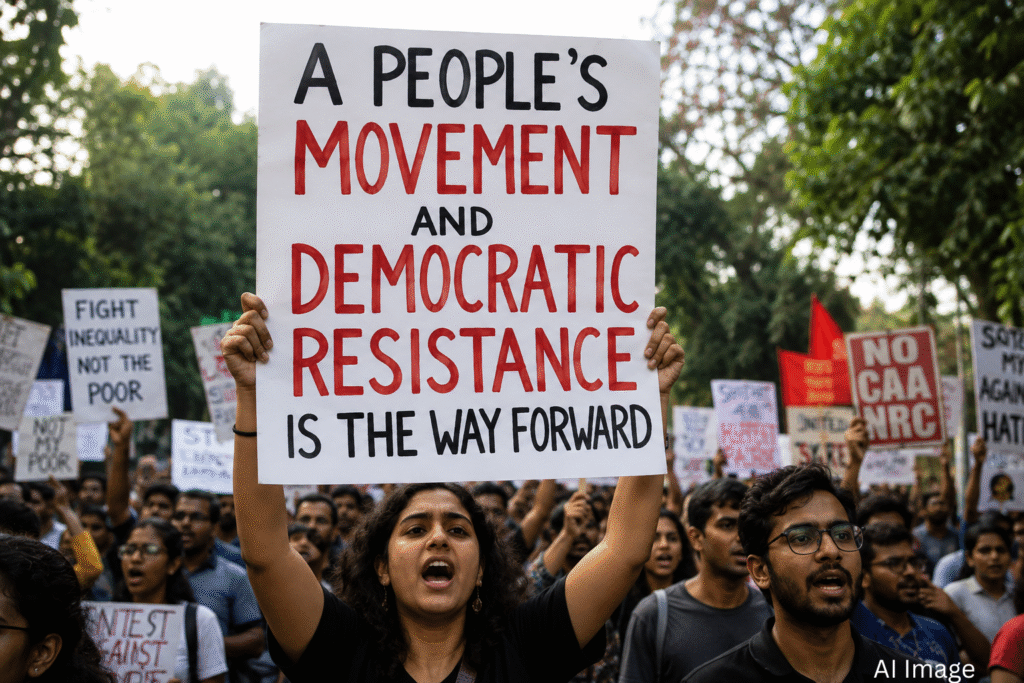
(An Essential Reading for Every Ex-Serviceman, Youth, Women , and Conscious Citizen of Uttarakhand).
Are you concerned about the present condition of Uttarakhand?
Can democracy be safeguarded solely through elections?
Is silence not, in itself, a form of consent?
If you believe that the social, economic, and political challenges confronting Uttarakhand cannot be resolved by remaining passive spectators, then the time has come for—
Public awareness,
People’s organization,
Constitutional, democratic, and non-violent mass movements.
Let us unite to safeguard the identity, dignity, and aspirations of the people of Uttarakhand.
We extend a special appeal to:
Ex-servicemen • Veterans of the Central Armed Police Forces • Youth • Women • Intellectuals • Employees • Farmers • Students • and every conscientious citizen of Uttarakhand.
Democracy is not merely the act of voting. It is sustained through continuous public participation, civic awareness, and peaceful democratic struggle.
The time for neutrality has passed. The time has come to awaken ourselves and awaken others for the future of Uttarakhand.
“Awaken, Uttarakhand—Organize, Engage in Dialogue, and Pave the Way for Change through a Consolidated Peaceful Democratic People’s Movement.”
Preface
This article presents a comprehensive study of Uttarakhand’s history, society, politics, culture, natural resources, challenges, and future prospects. Reading and understanding it is a moral responsibility for every ex-serviceman, young citizen, intellectual, and every individual concerned about the future of Uttarakhand.
Unless we fully understand the true condition of our state—its struggles, achievements, challenges, and opportunities—we cannot make meaningful contributions to its politics, public policy, or public service.
Friends, respected women, young citizens, ex-servicemen, intellectuals, and all those who are deeply connected to the soul of Uttarakhand, Devbhoomi (the Land of the Gods) is far more than a geographical entity. It is the living heritage of our identity, culture, traditions, struggles, and sacrifices. It is therefore imperative that we understand our past, honestly assess our present, and identify the direction of our future.
Superficial knowledge is insufficient. We must cultivate a deep understanding of facts, realities, and the conditions on the ground.
If we wish to preserve the identity, dignity, and fundamental character of Uttarakhand, we must begin with an objective assessment of its present condition. We must ask ourselves what we have gained since the creation of the state, what we have lost, and why many of our fundamental problems continue to remain unresolved even after twenty-five years of statehood.
Equally important, we must decide what kind of Uttarakhand we wish to leave for future generations.
This article is a humble yet earnest attempt in that direction—an invitation to think, reflect, engage in honest introspection, and define our collective role in building a prosperous, just, and sustainable future for Uttarakhand.
1. The Agony of Uttarakhand and the Question of Its Future
Today, I write this to not only present but to raise fundamental questions concerning the suffering, struggles, identity, and future of Uttarakhand.
This is not simply the story of a state. It is the voice of the Himalayas—the mountains that have nourished India’s civilization, culture, rivers, and way of life for centuries.
2. The Purpose Behind the Creation of Uttarakhand
The creation of Uttarakhand was never intended to be merely an exercise in administrative convenience.
It was the culmination of the struggles, sacrifices, tears, and aspirations of millions of people who envisioned a state where development would reflect the geographical realities and cultural sensitivities of the Himalayan region; where the people of Uttarakhand would enjoy the primary rights over their water, forests, and land; and where development would mean not only concrete infrastructure but also the protection of nature, culture, and human dignity.
3. The Reorganisation Act and the Unfinished Struggle for Constitutional Rights
It is a matter of profound concern that even twenty-five years after its formation, Uttarakhand has yet to secure many of its legitimate constitutional and economic rights.
Despite the enactment of the Uttar Pradesh Reorganisation Act, 2000, numerous state assets, revenue rights, water resources, buildings, irrigation systems, power projects, forest resources, transport infrastructure, and institutional properties have still not been fully transferred to Uttarakhand.Even today, the influence of Uttar Pradesh continues in matters relating to the Kumbh and Kawar regions of Haridwar. A substantial share of the revenue generated from hydroelectric projects and dams located within Uttarakhand continues to be divided between Uttar Pradesh and the Government of India, while Uttarakhand bears the environmental, ecological, and social costs associated with these projects.
Section 47(3) of the Reorganisation Act clearly states that ownership of property shall vest in the state within whose territorial jurisdiction the property is situated.
Regrettably, the political leadership at the time of state formation failed to demonstrate the vision, determination, and negotiating strength necessary to secure these rights. In the haste to assume political office, several critical constitutional and economic issues that demanded firm political and legal action were left unresolved.
Even after twenty-five years, vast public assets in Haridwar and Udham Singh Nagar—including approximately 13,800 hectares of land, 4,384 buildings, 88 canals, and numerous lakes and water structures—remain under the administrative control of Uttar Pradesh.
This situation represents not merely an administrative anomaly but a continuing denial of Uttarakhand’s rightful constitutional and economic entitlements.
Major water resources such as the Tehri Dam, Nanak Sagar Dam, Baigul Dam, Dhaura Dam, Tumaria Dam, Sharda Sagar Dam, Baur Dam, and Haripura Reservoir are all located within Uttarakhand. Yet their operational control largely remains with Uttar Pradesh.
Ironically, more than half of the water generated through these projects is utilized by Uttar Pradesh, while Uttarakhand receives virtually no meaningful revenue or equitable resource-sharing in return.
Similarly, nearly two dozen canals in Udham Singh Nagar district have both their headworks and tail ends located entirely within Uttarakhand’s territory. Nevertheless, their administration and revenue collection continue to remain under the jurisdiction of Uttar Pradesh.
This is not merely a question of resources; it is fundamentally a question of constitutional justice, state sovereignty, and the dignity of Uttarakhand.
The Tehri Hydroelectric Project, constructed at an estimated cost of approximately ₹10,000 crore, has an ownership structure of 25 percent Uttar Pradesh and 75 percent Government of India. Uttarakhand—the state that provided the land, water, and bore the environmental and social costs of displacement—receives no direct financial ownership in the project. At present, the state receives only 13 percent free electricity, despite having borne the overwhelming environmental and human consequences of the project.
Likewise, several long-pending disputes remain unresolved, including Housing Development land, approximately ₹600 crore due from the Forest Department and Forest Corporation, interest related to the erstwhile Uttar Pradesh Industrial Development Corporation, 27,000 square feet of land at Dharchula, transport assets worth nearly ₹5,000 crore belonging to the Uttarakhand Transport Department, and liabilities amounting to approximately ₹629 crore relating to the Food and Civil Supplies Department.
4. The Crisis of Land, Domicile, and Identity
Today, Uttarakhand’s greatest struggle is no longer merely economic—it is a struggle for survival and identity.
The issues of land ownership, domicile, and cultural identity stand at the centre of this struggle.
For years, there have been persistent demands for stringent regulation of the purchase and sale of rural agricultural land, the enactment of strong land protection laws, and effective safeguards to preserve the state’s unique social and cultural fabric.
Over the years, land laws have been repeatedly amended. Initially, limited land purchases by non-residents were permitted; subsequently, restrictions were gradually relaxed, making commercial use of agricultural land increasingly easier.
The consequences are now evident. Unregulated colonies have proliferated from the plains to the hills. Public lands have been encroached upon. Properties have been transferred through forged documents, and in some cases, even land belonging to deceased persons has reportedly been sold illegally.
This is not merely the commercialization of land.
It represents the gradual erosion of the very soul of Uttarakhand.
If land becomes nothing more than a market commodity, future generations may find themselves strangers in their own ancestral villages.
5. The Growing Pressure of Commercialization and Unplanned Tourism on Devbhoomi
Uttarakhand is revered as Devbhoomi—the Land of the Gods.
Today, however, even our sacred heritage is groaning under the pressures of commercialization and unregulated tourism.
Pilgrimages to Badrinath, Kedarnath, Gangotri, and Yamunotri are increasingly being transformed from spiritual journeys into consumer-driven tourism.
Within a few days each season, millions of visitors place enormous pressure on fragile Himalayan ecosystems. Unplanned construction, the growing helicopter culture, mounting plastic waste, unmanaged garbage, and chaotic traffic have seriously endangered the sanctity of these sacred pilgrimage sites.
Traffic congestion, road accidents, indiscriminate mountain cutting, river pollution, and the commercialization of religious destinations all indicate that we are gradually losing sight of the distinction between development and destruction.
The sanctity of Devbhoomi is not merely a matter of religious faith; it is a profound cultural, ecological, and civilizational responsibility.
Cont’d…..

BRIG. Sarvesh Dutt Dangwal, The author is a social activist….
The opinions expressed here are solely those of the author.

