
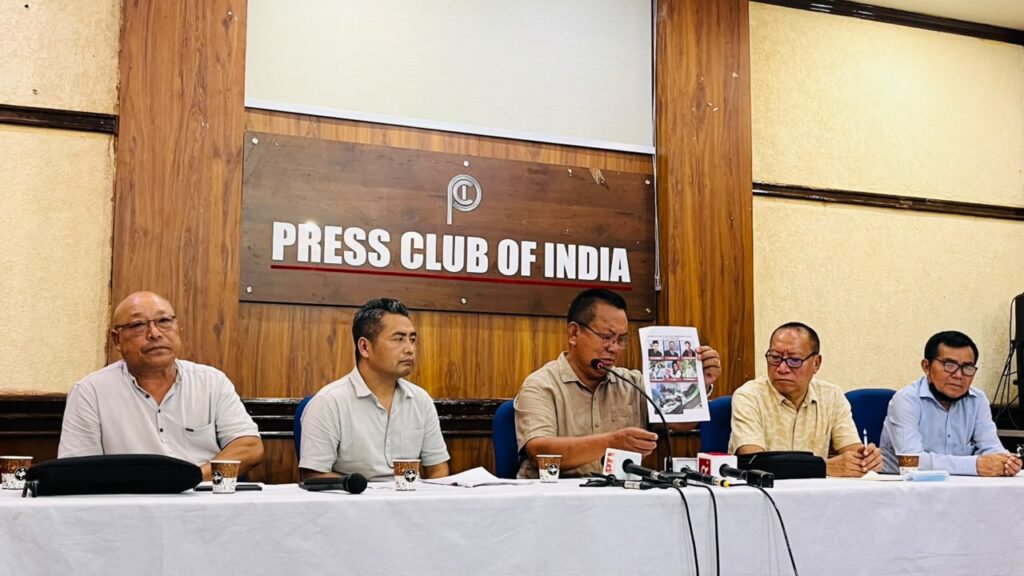
NEW DELHI: The United Naga Council (UNC), the apex civil body representing the 21 Naga tribes of Manipur, on Saturday appealed to Prime Minister Narendra Modi and the Union Government for immediate intervention in the rapidly deteriorating security situation in the state’s Naga-inhabited areas.
The Council alleged that the region is witnessing a “proxy war” against the Naga people, posing a serious threat not only to their safety but also to India’s peace process and frontier security.
Addressing a joint press conference at the Press Club of India in New Delhi, UNC Senior leader Variya Satsang said the violence was being carried out by Kuki militant groups and Myanmar-based KNA(B), describing it as a grave violation of the Indo-Naga Framework Agreement signed on August 3, 2015.
He argued that the ongoing attacks could not be dismissed as routine law-and-order disturbances, but represented a coordinated assault on Naga civilians and their ancestral lands.
Senior UNC leaders Samson Remei, AC Thotso, KS Paul Leo and L. Adani were also present. The delegation said it had been meeting political leaders, civil society organisations, women’s groups, peace activists and concerned citizens in the national capital to present the Naga perspective and seek urgent constitutional and political intervention. The Press meet was solicited by Delhi Solidarity group.
The Council stated that the current violence has drawn the Naga people into a conflict from which they were already struggling to recover following the Meitei-Kuki violence that erupted in May 2023. According to the delegation, the latest developments reflect a deeper conspiracy against the Naga community and have severely eroded public confidence in both the State and Union Governments’ ability to protect innocent civilians.
Highlighting recent incidents, the UNC recalled that on May 13, 2026, following the killing of three Thadou church leaders, 20 Naga civilians were allegedly abducted by Kuki militant groups from Leilon Vaiphei and Sapermaina villages. Fourteen hostages were released two days later, but six remained missing despite repeated appeals by the Council and extensions granted to the Manipur Government to secure their release.
The Council said that on June 9, Naga village guards, facilitated by the UNC and the Naga People’s Organisation, Senapati, released 14 Kuki detainees as a humanitarian gesture despite widespread public anger. However, the following day, the bodies of the six missing Naga civilians were recovered in a mutilated and dismembered condition.
The UNC described the incident as a tragedy that had caused immense trauma to the bereaved families and deeply shaken public trust in the government’s security apparatus.
Demanding accountability, the Council called for a time-bound, independent and court-monitored investigation into the abduction and killing of the six civilians. It also sought concrete security guarantees for all Naga-inhabited areas, particularly vulnerable regions facing armed intimidation, hostage-taking and militant movement.
The UNC reiterated that large parts of present-day Kangpokpi constitute ancestral Zeliangrong Naga land and warned against any attempt to alter the demographic or territorial character of these areas through violence.
Referring to its memorandum submitted to the Prime Minister, the UNC alleged that the attacks on Naga villages in Ukhrul and Kamjong districts on May 7 involved cross-border armed groups using military-grade weapons, drones and rocket launchers. Citing Article 355 of the Constitution, the Council argued that the Union Government has a constitutional obligation to protect states from both.

Umakant Lakhera is a Senior Journalist and Political Commentator