

From Discovery to Colonisation
The story of American independence did not begin on 4 July 1776. Its roots lie in the great maritime explorations of the late fifteenth and early sixteenth centuries, when advances in navigation enabled European powers to venture beyond familiar seas. Portuguese explorers opened the sea route around Africa to India, while Christopher Columbus’s westward voyage in 1492 unexpectedly brought Europe into sustained contact with the Americas. Subsequent expeditions by Amerigo Vespucci confirmed that these lands constituted an entirely “New World.”
The discovery unleashed an age of conquest and colonisation. Spain established vast dominions in Latin America, while England, France and the Netherlands competed for influence across North America. By the early eighteenth century, thirteen English colonies had taken root along the Atlantic coast, laying the foundations of what would eventually become the United States.
The Making of a Distinct Political Identity
The colonies prospered economically through agriculture, trade, fishing, shipbuilding and emerging industries. They also developed representative assemblies that accustomed settlers to local self-government, even while ultimate authority remained with the British Crown and Parliament.
Britain’s victory in the Seven Years’ War (1756–1763) proved a turning point. Burdened by enormous war debts, London sought to raise revenue from the colonies through new taxes and tighter administrative control. The colonists increasingly viewed these measures as infringements on rights they believed belonged to every English subject.
Distance from Britain, economic self-confidence and the experience of self-rule nurtured a distinctly American political identity. The demand was no longer merely for fair administration but increasingly for self-government itself.
The Road to Revolution
Four developments transformed colonial dissatisfaction into open rebellion.
First, a growing sense of nationhood convinced many colonists that their interests no longer coincided with those of Britain.
Second, restrictive mercantilist policies limited colonial commerce and industrial growth while serving British economic interests.
Third, measures such as the *Stamp Act* of 1765 gave rise to the enduring slogan, “No taxation without representation,” asserting that taxation without elected representation violated fundamental constitutional principles.
Finally, Enlightenment thinkers such as John Locke profoundly shaped colonial political thought. Their ideas on natural rights, popular sovereignty and the right to resist tyranny found powerful expression in Thomas Paine’s *Common Sense* and Thomas Jefferson’s political philosophy.
The Birth of a Republic
Events moved rapidly. The *Boston Massacre*, the *Boston Tea Party* and Britain’s punitive response united the colonies. Armed conflict began at Lexington and Concord in 1775.
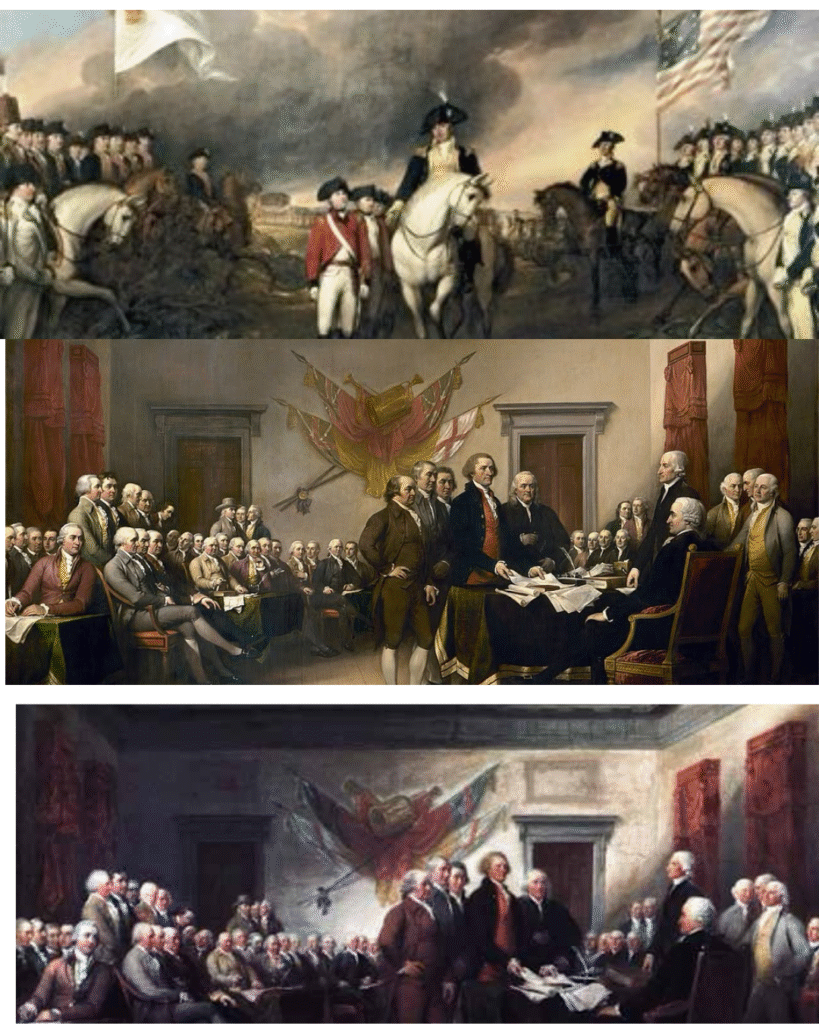
On 4 July 1776, the Continental Congress adopted the *Declaration of Independence*. Drafted principally by *Thomas Jefferson*, it proclaimed that all people possess inherent rights to “life, liberty and the pursuit of happiness,” that governments derive legitimacy from the consent of the governed, and that oppressive governments may rightly be altered or abolished.
These principles transformed a colonial rebellion into one of history’s most influential declarations of political freedom.
A Global War Before Globalisation
The American Revolution quickly became an international conflict. France, Spain and the Netherlands entered the war against Britain, while fighting extended across Europe, the Caribbean and India. *George Washington’s* leadership, combined with decisive French military assistance, culminated in the surrender of *General Cornwallis* at Yorktown in 1781. The *Treaty of Paris* of 1783 formally recognised the independence of the United States.
The new republic adopted the Constitution in 1787 and the *Bill of Rights* soon afterwards, creating the world’s first enduring written republican constitution built upon federalism, constitutional government and civil liberties.
The Promise and the Contradictions
The Revolution profoundly altered political thought by establishing popular sovereignty and constitutional democracy as governing ideals. Yet its promises remained incomplete. Enslaved Africans, Native Americans and women remained excluded from full political participation, reminding later generations that liberty proclaimed is not always liberty realised.
The Revolution nevertheless inspired democratic movements across Europe and Latin America while challenging the legitimacy of colonial rule itself.
America at 250: Power, Principles and Paradox
As the United States marks the 250th anniversary of its independence, it does so amid a rapidly changing international order. The unipolar moment that followed the Cold War has given way to renewed great-power rivalry, the rise of China, Russia’s continuing challenge to the Western security order, and expanding influence of middle powers across Asia, Africa and the Global South.
Recent American military action against Iran’s nuclear facilities, undertaken alongside Israel during the latest Middle East crisis, has once again placed Washington at the centre of global conflict. Simultaneously, the wars in Ukraine and Gaza, growing tensions in the Indo-Pacific, and debates over NATO, tariffs and strategic alliances have reignited questions about the responsibilities and limits of American power.
The irony is striking. The nation born from resistance to imperial authority now finds itself navigating the burdens and dilemmas of global leadership. The republic founded on opposition to distant power has become the world’s most consequential military, economic and diplomatic actor.
Yet the ideals proclaimed in Philadelphia in 1776 continue to shape global political discourse. Liberty, representative government, constitutionalism and the rule of law remain enduring aspirations, even as their interpretation and application continue to be contested within the United States and beyond.
A Revolution Still Unfinished
The American Revolution was not merely the birth of a new nation; it marked a profound shift in humanity’s understanding of political legitimacy. It asserted that governments exist to serve their people, not the other way around.
Two hundred and fifty years later, that revolution remains unfinished—not because its principles have failed, but because every generation must decide how faithfully it will uphold them.
In an era of shifting alliances, technological disruption and geopolitical uncertainty, the United States enters its third century not simply as the world’s most influential democracy, but as a nation continually measured against the ideals it first proclaimed in 1776. Its greatest challenge today is not merely preserving its power, but ensuring that power remains anchored to the constitutional values that gave birth to the American republic.

~Hasnain Naqvi is a former member of the history faculty at St. Xavier’s College, Mumbai….
The opinions expressed here are solely those of the author.