

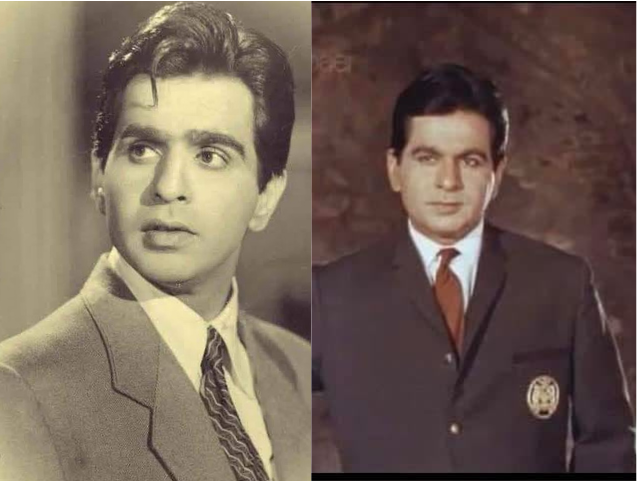
“Hamare baad mehfil mein afsaane bayaan honge,
Baharein humko dhoondhegi na jaane hum kahaan honge…”
(In our absence, stories will be told in the gathering; spring will search for us, knowing not where we have gone…)Five years ago, on July 7, India lost its true cinematic Kohinoor. The passing of Mohammed Yusuf Khan—immortalized forever as Dilip Kumar—marked the end of a golden epoch in Indian cinema. Today, on his fifth death anniversary, the mehfil (gathering) of Indian cinema continues to echo with his legends, just as the couplet predicted.
As the Shahenshah-e-Adakari (the Emperor of Acting), Dilip Kumar did not merely occupy the screen; he redefined the very grammar of Hindi cinema. He proved that stardom did not require theatrical over-exuberance, but could instead be forged through quiet, internal intensity.
Crafting the Blueprint of Stardom
Alongside Raj Kapoor and Dev Anand, Dilip Kumar formed the legendary triumvirate that shaped the identity of post-independence Indian cinema. Entering the silver screen with Jwar Bhata in 1944, his career spanned over six decades and 60 seminal films. He was a master of restraint—an unparalleled capability that led the legendary filmmaker Satyajit Ray to rightly pronounce him “the ultimate method actor.” His artistic trajectory across the mid-20th century highlights a staggering range that few could match. During the 1940s and 1950s, he defined the archetype of the tragic hero, delivering hauntingly melancholic performances in masterpieces like Devdas, Madhumati, and Naya Daur. This era earned him the enduring moniker of the “Tragedy King,” as he captured the angst, yearning, and romantic disillusionment of a young, developing nation.
However, he refused to be confined by a single label. As the 1960s dawned, he transitioned effortlessly into an epic statesman of the screen, anchoring monumental productions such as the timeless, regal Mughal-e-Azam and the gritty, rustic Ganga Jamuna. He then completely subverted audience expectations in 1967 with the double-role blockbuster Ram Aur Shyam, showcasing an effervescent comic genius and impeccable timing that proved his versatility was absolute. Decades later, generations of actors still consciously or subconsciously mimic his cadence, his pauses, and his expressive gaze.
The Twilight Resurgence: A Masterclass in Adaptability
While his early decades cemented his legendary status, the 1970s brought a period of creative stagnation, where the maestro found himself constrained by mediocre scripts. Contemplating retirement, a pivotal shift occurred in 1981 with Manoj Kumar’s historical epic, Kranti.
Driven by personal gratitude—as Manoj Kumar had stood steadfastly by him during Saira Bano’s severe health crisis during an earlier production—Dilip Kumar accepted the role of a freedom fighter without even reading the script. It was an uncharacteristic move for a perfectionist, yet it sparked a spectacular second innings.
Rather than clinging to conventional, youthful protagonist roles, he gracefully transitioned into commanding, pivotal characters that anchored entire plots. Through a string of multi-generational blockbusters, he introduced his genius to a brand-new generation of cinephiles. In Vidhaata and Shakti, he captured the profound friction of morality, duty, and family; in Mashaal and Mazdoor, he channeled the righteous indignation of the common man; and in Karma and Saudagar, he exhibited the fiery screen presence of an aging titan. As he later reflected in his memoir, The “Substance & The Shadow”, these films were chosen because they offered deeply satisfying, pivotal roles that drove the narrative engine forward.
The Renaissance Man Behind the Persona
Beyond the arc lights, Yusuf Khan was a man of profound intellect and varied passions. He was highly literate, possessing an elegant command over Urdu, Hindi, and English, and was deeply well-versed in both Western and Eastern poetry.
Interestingly, his cinematic path was entirely accidental. In his youth, his father had envisioned him as a chess master. Defying those quiet expectations, young Yusuf chose the athletic rigor of the football field, excelling as an accomplished soccer player before destiny beckoned him to Bombay Talkies.
His personal life, much like his films, was touched by profound romance and human vulnerability. His early, unfulfilled love stories with contemporaries Kamini Kaushal and Madhubala remain etched in Bollywood lore. However, it was his marriage to actress Saira Bano in 1966 that became his life’s anchor—an enduring partnership that withstood the test of time, personal health crises, and a brief, turbulent second marriage in 1980.
An Enduring Legacy
Dilip Kumar’s contributions extended far beyond entertainment, earning him a place as a cultural diplomat and statesman. The Government of India recognized his monumental legacy with the Padma Bhushan (1991), the Dadasaheb Phalke Award (1994), and the Padma Vibhushan (2015), alongside a prestigious nomination to the Rajya Sabha. In a rare testament to his cross-border cultural impact, he was also awarded Pakistan’s highest civilian honour, the Nishan-e-Imtiaz, in 1997.
Five years after his departure, the void he left behind remains unfilled. As Indian cinema continuously evolves, it does so on the foundation that he helped build. On this poignant anniversary, as we look back at the cinematic monument that was Mohammed Yusuf Khan, it would be a fitting tribute if the nation bestows upon him its highest honour—the Bharat Ratna—posthumously. He remains, for now and all time, the emotional conscience of Indian cinema.

~Hasnain Naqvi is a former member of the history faculty at St. Xavier’s College, Mumbai….
The opinions expressed here are solely those of the author.

