

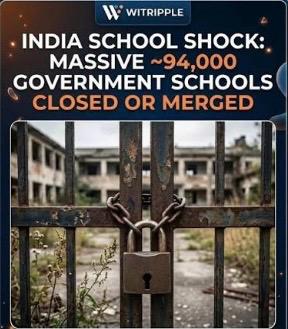
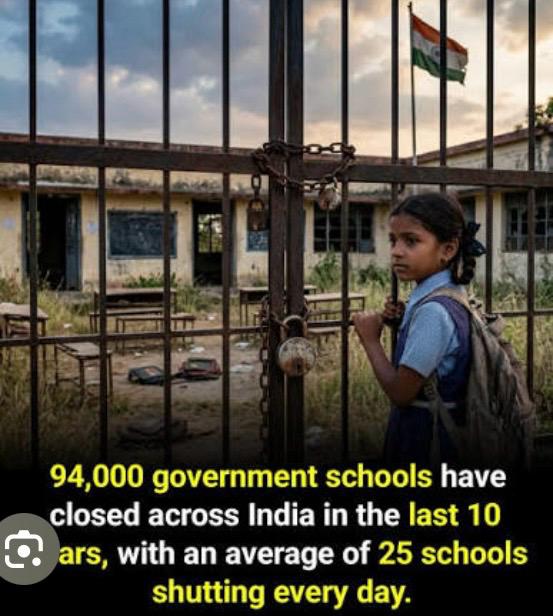
In the quiet hamlets of rural India, the closure of nearly 94,000 government schools over the past decade is not merely a statistic—it is a silent unraveling of a foundational promise. From 11.07 lakh public schools in 2014–15 to 10.13 lakh in 2024–25, the system has shed institutions at an average rate of about 25 per day, according to data corroborated by NITI Aayog and UDISE+ statistics. This rationalization, framed as efficiency, masks a deeper crisis in primary education that threatens the futures of millions of young children, particularly in underserved regions.
The Numbers Behind the Exodus
The decline in government schools coincides with a staggering drop in enrollment: nearly 2.26 crore fewer students in public institutions over the same period. While private schools have proliferated—adding over 51,000 institutions and now educating more than half of India’s students—public systems, the backbone for the poorest and most marginalized, are hollowing out.
States like West Bengal, Uttar Pradesh, and Maharashtra bear the brunt, with tens of thousands of schools operating with fewer than 10 students, and thousands more standing empty. Infrastructure gaps compound the issue: over a lakh schools without electricity and nearly a lakh lacking proper girls’ toilets. Teacher deployment remains inefficient, with over 1.44 lakh educators assigned to near-deserted institutions.
These closures stem from deliberate policies of school consolidation, where small, “sub-viable” primary schools are merged into larger cluster facilities to optimize resources. Demographic shifts, including lower fertility rates and rural-to-urban migration, play a role, but the parental flight to private options signals profound dissatisfaction with quality and outcomes in the government sector.
The Daily Toll on Children
For a six-year-old in a tribal hamlet or remote village, the nearest “cluster school” may now lie several kilometers away. The journey—often on foot, across unsafe paths—disproportionately burdens girls, heightening risks of absenteeism, harassment, and dropout. While primary enrollment remains relatively robust, an 11.5% transition dropout rate to secondary levels reveals fractures in retention that begin early.
Studies on school rationalization, including analyses predating the latest wave, warn of adverse effects on access without commensurate gains in learning. Children lose the convenience of neighbourhood schools, where community ties and familiar environments fostered attendance. In their place: overcrowded hubs that struggle to provide personalized attention, especially in the critical foundational years.
The human stories are poignant. Parents in affected areas report increased fatigue among young learners, higher rates of illness from travel, and families reconsidering education altogether when safety or costs intervene. This is particularly acute for first-generation learners from Dalit, Adivasi, and economically weaker sections, for whom government schools were the primary ladder out of intergenerational poverty.
NEP 2020: Vision Versus Ground Reality
The National Education Policy 2020 offers an ambitious blueprint to address these very challenges. Its 5+3+3+4 structure reimagines early education: a Foundational Stage (ages 3-8) integrating preschool with Grades 1-2 through play-based learning, followed by a Preparatory Stage (Grades 3-5). It prioritizes Foundational Literacy and Numeracy (FLN) via the NIPUN Bharat mission, mandates mother-tongue instruction up to at least Grade 5, and envisions “School Complexes” where primary satellites share resources, faculty, and facilities with hub secondary schools.
In theory, these clusters could mitigate isolation, bringing specialized teachers, libraries, and labs within reach. Activity-based pedagogy aims to replace rote learning with cognitive development, potentially stemming learning deficits that plague Indian classrooms.
Yet implementation reveals stark disconnects. Integrating over 14 lakh Anganwadis into formal preschool structures demands massive upgrades in infrastructure, training, and coordination—areas where rural India lags. Many consolidation-driven closures predate or parallel NEP rollout, but the policy’s emphasis on larger complexes accelerates the trend, sometimes without adequate transitional support.
Digital divides, erratic electricity, and teacher shortages undermine ambitious elements like technology integration. Language policies face hurdles in diverse or migrant classrooms. Budgetary constraints and uneven state-level adoption further complicate progress. Recent UDISE+ data shows incremental gains in connectivity and facilities, but these remain insufficient against the scale of need.
A Call for Course Correction
The plight of primary education underscores a fundamental tension: efficiency metrics versus equitable access. While consolidation and NEP reforms seek sustainability and quality, they risk exacerbating exclusion if not paired with safeguards—transport facilities, community oversight, strengthened local primary outposts, and targeted investments in teacher training and infrastructure.
Authentic progress requires listening to grassroots realities. Strengthening public schools through better governance, outcome-focused funding, and community involvement could reverse parental migration to private options. NEP’s holistic vision—emphasizing equity, inclusion, and foundational strength—must move beyond policy papers to tangible delivery in the remotest villages.
India’s demographic dividend hinges on educating every child effectively from the earliest years. The vanishing schools are a warning: without bridging the gap between ambition and execution, the promise of equitable primary education—and with it, a more just society—will remain unfulfilled. The time for half-measures is over; the children walking those extra kilometers deserve better.

~Hasnain Naqvi is a former member of the history faculty at St. Xavier’s College, Mumbai….
The opinions expressed here are solely those of the author.