

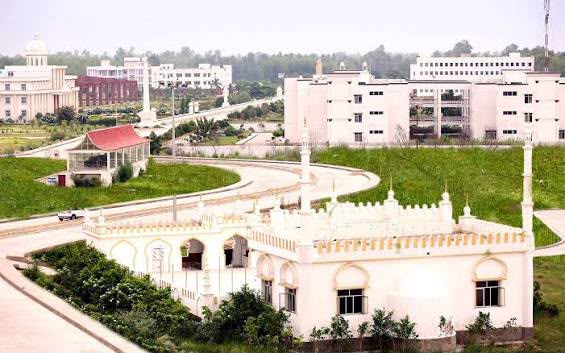
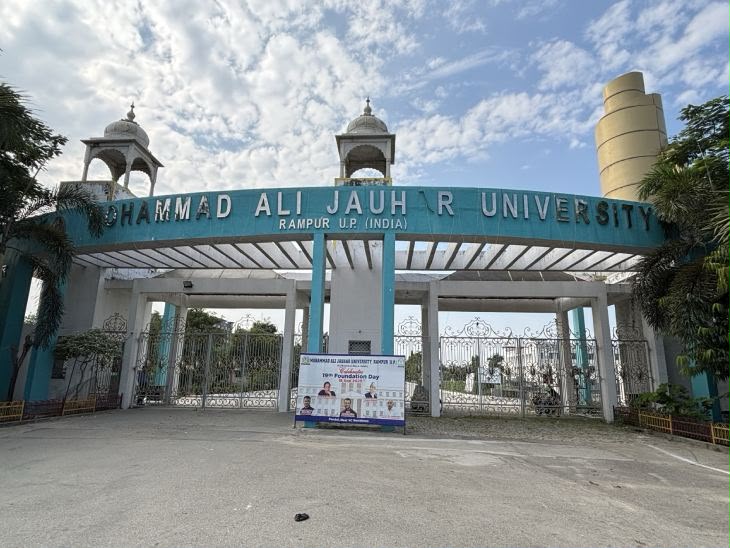
The demolition order against Mohammad Ali Jauhar University raises uncomfortable questions about selective enforcement, constitutional guarantees, and the future of educational institutions in India
The Uttar Pradesh government’s decision to order the demolition of 38 out of 40 buildings at Mohammad Ali Jauhar University in Rampur is far more consequential than a routine urban-planning dispute. It represents one of the most sweeping demolition orders ever directed against a functioning university in independent India. While the authorities insist that the action is a lawful response to unauthorised construction, the scale, timing and context of the decision inevitably invite a deeper constitutional and political examination.
The Rampur Development Authority (RDA), acting under Section 27(1) of the Uttar Pradesh Urban Planning and Development Act, 1973, has held that only the medical college building and one academic block were constructed with valid approval and has directed that the remaining 38 structures be removed within fifteen days, failing which the authority will undertake the demolition itself. The university has maintained that much of the construction predates the extension of the RDA’s jurisdiction over the area and has questioned the legality of the order.
Whether these competing claims ultimately withstand judicial scrutiny is a matter for the courts. Yet the constitutional questions raised by the order transcend the technical issue of sanctioned building plans.
From Planning Enforcement to Political Theatre
If buildings have indeed been erected without mandatory permissions, the law must unquestionably take its course. No institution—public or private, secular or religious, politically connected or otherwise—can claim immunity from statutory regulation.
The problem, however, lies elsewhere.
Across India, planning violations are neither exceptional nor rare. Educational institutions, hospitals, commercial complexes and even government establishments frequently face allegations of deviations from approved plans, additional floors, altered land use or delayed statutory clearances. In the overwhelming majority of cases, authorities issue notices, impose penalties, permit rectification or consider regularisation where legally permissible. Wholesale demolition is generally regarded as the last constitutional resort rather than the first administrative instinct.
That distinction becomes crucial in the present case.
If similar irregularities elsewhere have routinely been addressed through corrective mechanisms, why should one university face the destruction of nearly its entire physical infrastructure? Equality before law under Article 14 of the Constitution demands not merely that laws exist, but that they be enforced uniformly and without political discrimination.
Selective enforcement corrodes the legitimacy of the law far more seriously than the original regulatory violation.
The Shadow of ‘Bulldozer Justice’
The controversy also cannot be separated from the wider phenomenon that has come to be known as “bulldozer justice.”
Over the past several years, demolition has increasingly evolved from an urban-planning measure into an unmistakable political spectacle. Bulldozers have acquired symbolic value, frequently deployed against individuals, neighbourhoods and institutions already associated with political controversy or public disapproval. Executive action often appears to precede judicial determination, creating an impression that demolition itself has become a form of punishment.
Recognising this disturbing trend, the Supreme Court has repeatedly emphasised that demolition cannot be used as an extra-judicial penalty. In its landmark observations on arbitrary demolitions, the Court underscored that authorities must adhere to due process by issuing proper notices, granting adequate opportunity to be heard and ensuring that coercive action follows established legal procedures rather than executive expediency. These safeguards are not procedural formalities; they constitute the very essence of constitutional governance.
The real strength of the rule of law lies not in the state’s capacity to demolish quickly but in its willingness to act fairly.
Education Should Never Become Collateral Damage
Universities occupy a distinctive constitutional space.
They are not merely collections of buildings owned by their promoters. They are living institutions serving students, teachers, researchers, non-teaching staff and surrounding communities. Their social purpose extends well beyond the political fortunes or personal conduct of those who established them.
Mohammad Ali Jauhar University was founded under the Maulana Mohammad Ali Jauhar Trust and named after one of India’s foremost freedom fighters, journalists and advocates of composite nationalism. Whatever controversies surround its founder, the university itself has educated thousands of students across communities and contributed to higher education in a region where such opportunities remain limited.
Destroying classrooms, hostels, libraries, laboratories and academic infrastructure would inflict immediate harm not upon politicians but upon students whose education and futures depend upon the institution.
Even where planning violations are established, constitutional governance requires that compliance be secured with the least possible injury to innocent stakeholders.
Demolition should never become an administrative reflex.
Law Must Be Blind to Politics
Support for due process should never be mistaken for endorsement of any individual.
Azam Khan remains one of Uttar Pradesh’s most controversial political figures and has faced numerous criminal prosecutions and legal disputes. Those proceedings must continue independently and in accordance with law. Equally, any illegal land acquisition or construction attributable to him deserves impartial investigation and adjudication.
But constitutional principles do not fluctuate according to the popularity or unpopularity of those affected.
The test of democracy is whether legal safeguards survive precisely when applied to those who evoke little public sympathy.
If planning laws are to be enforced with uncompromising rigour, then every institution found in comparable violation—governmental, private, corporate or religious—must face identical standards. Anything less transforms law from an impartial instrument of justice into a selective instrument of political power.
The Judiciary’s Constitutional Responsibility
The episode also highlights the indispensable role of constitutional courts.
The judiciary exists not merely to review executive action after irreversible consequences have occurred but to prevent arbitrary exercises of state authority before they become fait accompli. Judicial intervention delayed until after educational infrastructure has been demolished offers little consolation to students or faculty whose institution has already been dismantled.
Courts have repeatedly described themselves as guardians of constitutional liberties. That responsibility necessarily includes scrutinising whether executive action satisfies the constitutional tests of proportionality, fairness, equality and procedural reasonableness.
Justice postponed until after demolition is often justice denied.
A Republic Cannot Be Built with Bulldozers
The controversy surrounding Mohammad Ali Jauhar University ultimately reaches beyond Rampur and beyond Azam Khan.
It concerns the character of constitutional governance itself.
A democratic republic is not judged by how swiftly it can flatten buildings but by how scrupulously it restrains the exercise of executive power. Governments earn legitimacy not through displays of coercive strength but through consistency, impartiality and fidelity to the Constitution.
If the university violated planning laws, those violations must undoubtedly be addressed. Yet the remedy adopted must itself remain faithful to constitutional values. Equal treatment, proportionality, procedural fairness and judicial oversight are not obstacles to governance; they are the very foundations upon which legitimate governance rests.
When bulldozers become symbols of political resolve rather than instruments of lawful regulation, democracy enters dangerous terrain. Universities are meant to nurture inquiry, debate and intellectual freedom—not become theatres where political power demonstrates its capacity to destroy.
The measure of constitutional democracy is therefore not how many buildings the state can demolish, but whether, even in the most contentious cases, it remains bound by the discipline of law rather than the temptations of power.

~Hasnain Naqvi is a former member of the history faculty at St. Xavier’s College, Mumbai….
The opinions expressed here are solely those of the author.

