


Spain’s Triumph Was the Tournament’s Most Convincing Answer
Spain’s 1-0 extra-time victory over Argentina in the 2026 FIFA World Cup final will be remembered not merely for the quality of football it produced but for the wider questions it left behind. While the tournament was marketed as a celebration of the world’s most popular sport, it also generated sustained debate over FIFA’s governance, the growing influence of commercial interests, the political context of the host nations and concerns raised by players, supporters and commentators about consistency in officiating and competitive fairness.
Against this backdrop, Spain’s triumph acquired a significance that extended beyond the trophy. For many observers, it represented the victory of disciplined football over a tournament increasingly shaped by narratives larger than the game itself.
A Final Defined by Complete Footballing Authority
The final at MetLife Stadium demonstrated Spain’s tactical superiority from the opening whistle. Their trademark possession football, relentless pressing and positional discipline left the defending champions chasing shadows for long periods.
The statistics reflected that dominance. Spain attempted 20 shots, 13 of them on target, while Argentina managed only three attempts and failed to register a single shot on goal. Spain also earned nine corner kicks compared with Argentina’s one, underlining their territorial control.
Argentina’s task became even more difficult after Enzo Fernández received a straight red card following his challenge on Pau Cubarsí. Reduced to ten players, the defending champions survived largely because of goalkeeper Emiliano Martínez, whose remarkable 12 saves established a World Cup final record and prevented the scoreline from becoming considerably heavier.
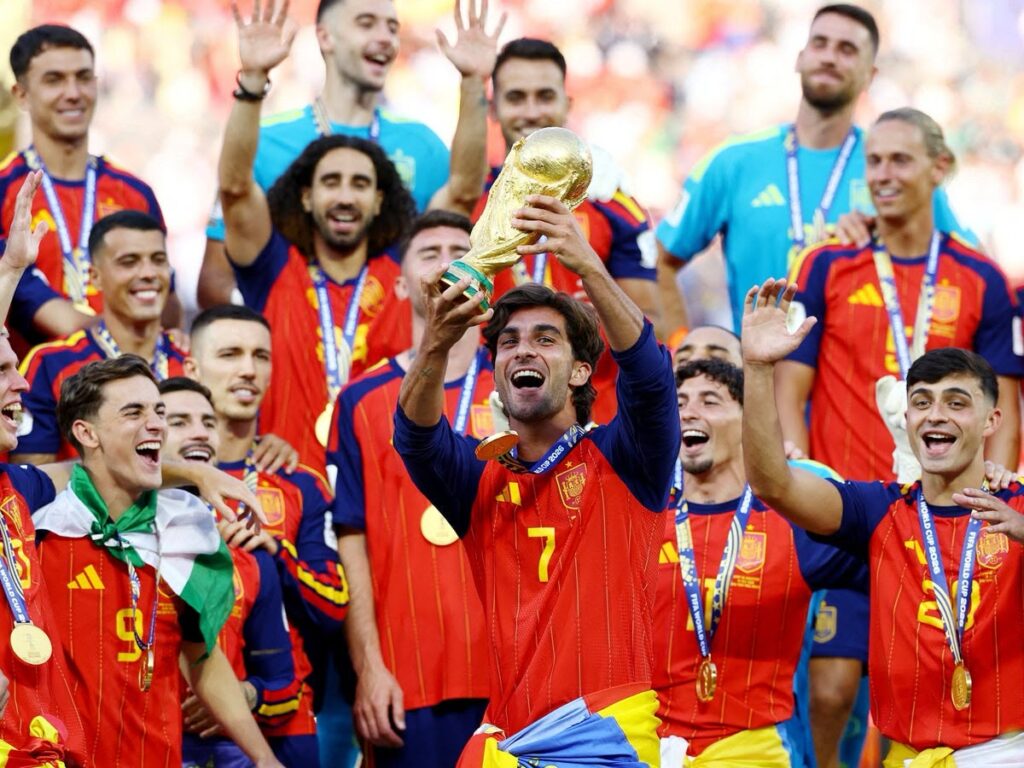
The decisive breakthrough finally came in the 106th minute when Pedro Porro’s cross found Nico Williams, whose headed pass fell perfectly for substitute Ferran Torres. His powerful finish into the roof of the net secured Spain’s fourth World Cup title. Torres later described it as “a goal scored by 47 million people,” capturing the collective emotion of a nation reclaiming football’s highest prize.
The Expanding Debate Over FIFA’s Governance
Beyond the football itself, the tournament intensified long-running criticism of FIFA’s administration.
Human rights organisations, governance experts and sections of the football community have for years questioned whether commercial priorities increasingly overshadow the sport’s traditional values. Critics argue that FIFA has become an extraordinarily powerful global institution whose decision-making is often perceived as lacking transparency and accountability, particularly on issues involving player expression, sponsorship obligations and political messaging.
Whether one agrees with these criticisms or not, the 2026 World Cup demonstrated once again that football’s governing structures are no longer judged solely by sporting standards. They are increasingly evaluated through the broader lenses of governance, ethics and human rights.
Hosting Football Amid Political Contradictions
The tournament also unfolded against a politically charged backdrop.
As millions gathered to celebrate football’s universal appeal, public debate in the United States remained deeply divided over immigration, border security and deportation policies. That contrast was impossible to ignore. A competition built on ideals of international unity was staged amid continuing arguments over migration and national identity.
For many observers, this juxtaposition illustrated the growing tension between the inclusive language surrounding global sporting events and the political realities of the societies that host them.
Questions Raised Over Competitive Fairness
Another recurring source of controversy involved allegations about refereeing standards and administrative decisions affecting several participating nations.
Supporters, commentators and sections of the international media questioned a number of officiating decisions involving teams such as Egypt, Iran and Iraq, arguing that crucial moments did not receive consistent treatment. Complaints also emerged regarding visa issues, security arrangements affecting some delegations and the hostile online environment encountered by several teams.
Egypt’s match against Argentina became a particular flashpoint, with many analysts believing that controversial decisions significantly influenced the outcome. Similar concerns were expressed regarding matches involving Iran and Iraq.
It is important to note that FIFA consistently maintains that officiating decisions are made independently under established protocols, and no conclusive evidence has emerged demonstrating deliberate institutional bias. Nevertheless, the persistence of these controversies illustrates the importance of transparency and consistency in preserving confidence in the integrity of elite competition.
Football Cannot Escape Geopolitics
The tournament also reflected the increasingly close relationship between international sport and global politics.
Spain entered the World Cup after taking high-profile diplomatic positions on the humanitarian crisis in Gaza, including recognition of Palestinian statehood and criticism of Israel’s military operations. Argentina’s political leadership, by contrast, publicly aligned itself with the Israeli government.
Although national teams compete independently of government policy, many supporters inevitably interpreted the final through this wider geopolitical context. Social media rapidly transformed Spain’s victory into a platform for broader political expression, with pro-Palestinian hashtags trending across multiple platforms immediately after Ferran Torres’ winning goal.
Such reactions demonstrated once again that modern football no longer exists in political isolation. International tournaments increasingly become arenas where global conflicts, diplomatic positions and public opinion intersect with sport

A Reminder of Football’s Enduring Spirit
The 2026 FIFA World Cup will undoubtedly remain one of the most debated tournaments in recent memory. Questions surrounding governance, commercial influence, political symbolism and officiating will continue to shape discussions long after the final whistle.
Yet amid those controversies, Spain’s football provided an undeniable sporting conclusion. Through technical excellence, tactical intelligence and sustained attacking ambition, they outplayed the defending champions and secured their place in history.
Ultimately, Spain’s victory offered an important reminder. Whatever debates surround football’s administrators, broadcasters, sponsors or political environment, the game retains a remarkable capacity to produce outcomes determined by courage, preparation and excellence on the pitch. That enduring quality remains football’s greatest strength—and perhaps its most powerful safeguard against the forces that too often seek to shape the sport beyond the boundaries of the field.

~Hasnain Naqvi is a former member of the history faculty at St. Xavier’s College, Mumbai….
The opinions expressed here are solely those of the author.