
Photo:Umakant Lakhera
No discussion on issues of geopolitics. The sentiment this weekend has got to be about what has happened in India, its capital and scores of cities.
For many years, I have reported public protests, even participated in those about media freedom. I have had my share of sweating it out in the open, being pushed around and smelling the tear gas. Mercifully, pellet guns had not arrived then.
The target mostly was India’s Parliament – it remains so.
Some were just causes, others not. Some succeeded, some failed. Opposing the state power is never easy.
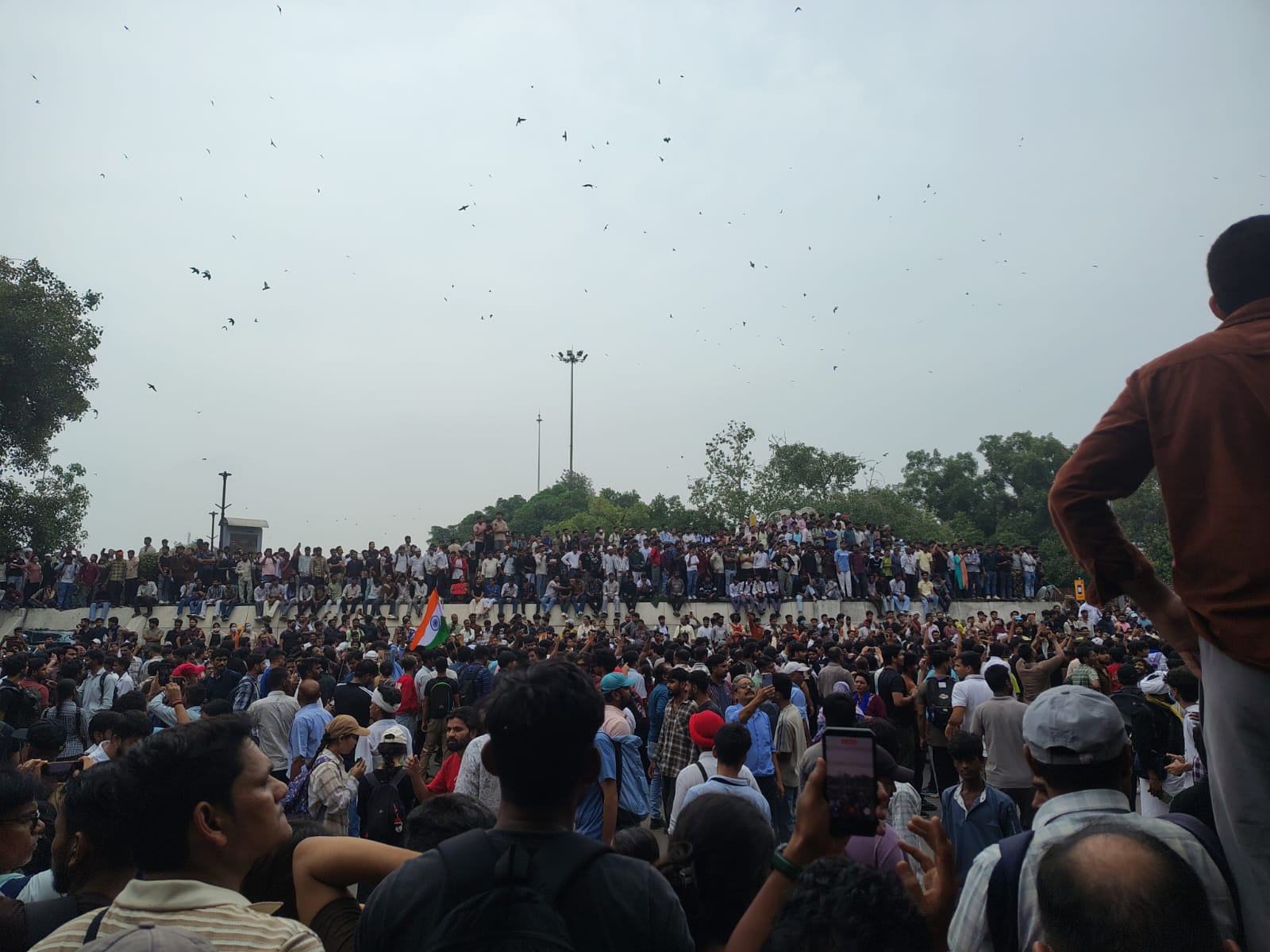
The one that has just ended was different. Watching it from afar now, I feel it worked because of its spontaneity. Without political prodding, thousands took to the streets in dozens of cities.
Handling them with the heavy hand of the police and the para-military forces was a government that did not read the public mood. It thought that force would push people away from the streets. This did not happen.
The waves of young people, including schoolgirls carrying school bags, and some who persuaded their parents to accompany them to the protest site, marked a departure from other protest movements that India has seen.
The Cockroach Janata Party (CJP) began as satire, taken as a joke, but took on a life of its own. Educator-activist Sonam Wangchuk’s joining the protest added life to it. On hunger strike but keeping the spirit high, he proved to be the catalyst.
He did not wear a Gandhi cap, unlike leaders of earlier protest movements. With him in the vanguard, the ‘cockroaches’ achieved what the political opposition had failed to do for a dozen years.
Protests have ended for now, called off “in good faith” as CJP leader Dipke said. No timeline has been fixed to fulfil promises. Anger and frustration can return to the streets. They could take another form, at another time.
Critics have accused Modi and his party of polarising society along religious and caste lines. This movement has de-polarised society.
The participants were from all communities and classes. Muslims and Sikhs threw open their shrines near the protest sites to provide shelter from teargas shells and police batons, even medical treatment to those wounded.
The Muslims who protested National Citizens Registration (NCR) and Sikhs from Punjab and Haryana, who were pushed out of the national capital under the guise of sanitising the national capital from the Covid-19 pandemic, were back in Delhi.
The Sikhs did what they are best at – feeding the protesters. Where cooking is not possible, app-based service providers supplied — no one knows who paid the suppliers.
Lumpen elements were bound to infiltrate such a public event. But the police seemed more interested in bullying school and college kids. A middle-level police officer was caught on camera slapping a girl who was merely standing, doing nothing.
The arrival of more police and paramilitary units, armed with tear gas and pellet guns, only incensed the protesters more. The sight of youths in civvies, carrying sticks and signalling to the police to act, added to the grimness of the ground situation. Cellphone cameras clicked it all.
This is the triumph of social media. Often viewed as addictive and prone to misuse, it filled a wide and deep vacuum left on the information front. Large sections of the mainstream media are seen as pro-government, and they wear that proximity on their shirt-sleeves.
Their projection of the events was selective. But when their reporters and cameramen were chased out of the protest sites, their counter-attack began. They decried the ‘apamaan’, the insults, heaped on their personnel.
Anxious to stay on the right side of a vindictive government, they are conducting ‘debates’, by now a known ploy, to convince the already convinced and idlers looking for entertainment.
The ‘cockroaches’ posed the biggest challenge to Modi. It came close on the heels of allegations, acknowledged and already under probe, of misappropriation of funds and precious gifts offered to the Ram temple in Ayodhya, which Modi had himself consecrated in January 2024.
So hurt and upset is the large constituency Modi enjoys, that some feel genuinely let down by his ‘surrender’ and want someone ‘strong’. Sacking the first minister since he took office 12 years ago, Modi is their God that failed.
His self-created image, assiduously nurtured at home and abroad, and the aura of invincibility are gone. The jokes on him – the cartoons, the memes, the slogans – showed that people have lost fear. His gestures, pauses and mannerisms turned his own words into political jokes. In this lampooning were added Trump, Macron and Putin — and Georgia Meloni with ‘Melody’ jokes. And these jokes were landing.
But Modi is a quick learner. He has displayed readiness to retreat, as in the case of farm laws and NCR, to return at an opportune time. He has only replaced one RSS worker with another as minister. He needs to retain a tough exterior and the whip in hand.
The corporate sector and the huge middle classes that support him may feel unnerved. Modi will retain their support unless he makes more mistakes, or the monsoon and the economy falter. He still holds the aces.
What next? There is no going back now for India, where key institutions established under its Constitution are seen as having compromised. They are seen as partisan, tilting towards the government of the day. That, at least, is a perception, and at the end of the day, public perception matters.
The schism between an upbeat but weak and divided opposition and a still-powerful BJP with numbers of those elected, control of most states and with the ‘Ms’ – money, muscle power and media — will now widen.
Also, within mainstream media that were outdone by social media. Long-term, unless they change and innovate, circulations and ad revenues could fall.
The threat of dividing the people, but posing to be rallying them, remains. Whether a multi-cultural, multi-faith India, with its diversity, wants it, needs it, or can sustain it is the moot point.
The trend is clear – not that one is making predictions. When the moderates falter, the right gains and when the right falters, it is the far right. It is happening in many countries across the world. India cannot be an exception. This warning needs to be heeded.

Mahendra Ved is a veteran Journalist and an Expert on international affairs.

