

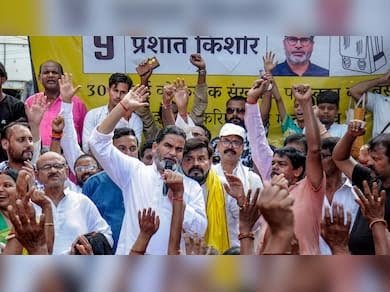
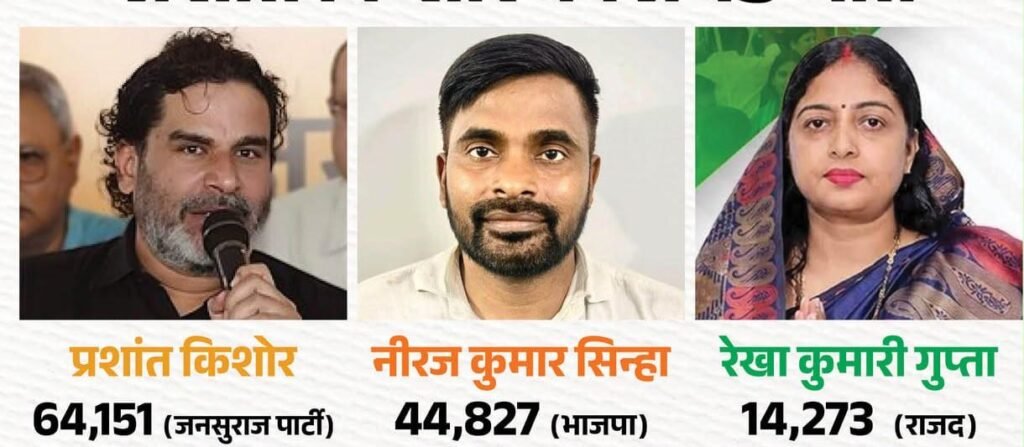
In the heart of Patna, a seat that had remained impregnable for more than three decades has changed hands. Bankipur, long regarded as one of the Bharatiya Janata Party’s safest urban strongholds in Bihar, has elected Jan Suraaj Party founder Prashant Kishor by a margin of nearly 19,000 votes. Kishor polled around 64,000 votes to the BJP’s roughly 45,000, with the Rashtriya Janata Dal finishing a distant third. The by-election, held after BJP national president Nitin Nabin vacated the seat upon his elevation to the Rajya Sabha, has ended a continuous run that stretched back to 1995. Turnout was notably low at just over 34 per cent, yet the outcome has sent ripples far beyond the constituency.
Why the BJP Lost Its Own Stronghold
Bankipur was never an ordinary seat for the BJP. It was a family citadel, held first by Nabin Kishore Prasad Sinha and then by his son Nitin Nabin across multiple terms, often with margins exceeding 50,000 votes. In the November 2025 Assembly election, Nabin secured more than 62 per cent of the vote. The party’s organisational muscle, upper-caste consolidation and urban appeal had long appeared unassailable.
Several factors combined to reverse that advantage. The BJP’s candidate selection process faltered early. Its initial nominee withdrew amid controversy linked to family history in the fodder scam, forcing a last-minute replacement with a relatively low-profile youth wing leader. The change disrupted campaign continuity and invited charges of arrogance and poor judgment. Local discontent over governance under Chief Minister Samrat Choudhary, particularly on law and order and higher education, found expression. Youth anger, amplified by protests over examination irregularities and related issues, appears to have tilted a decisive section of voters. Kishor’s focused, single-seat campaign, contrasting with his party’s blank performance across 238 seats only months earlier, allowed him to project a narrative of change beyond caste arithmetic and free rations. The result was less a sudden collapse of organisational strength than a failure to transfer personal goodwill and to read shifting local moods.
Has the Political Wind of the Country Changed?
A single by-election does not rewrite national politics. The BJP continues to govern Bihar and retains substantial organisational depth across the country. Yet Bankipur’s outcome cannot be dismissed as a local aberration. It comes at a moment when youth-led protests over education, employment and institutional credibility have gained visibility. In an urban seat with a significant concentration of young voters and educational institutions, the verdict suggests that traditional loyalties are more contingent than assumed. The sharp drop in the BJP’s vote share, from over 60 per cent to around 34 per cent, points to a temporary but real erosion of confidence among sections of its core support. Whether this reflects a broader national undercurrent or remains confined to Bihar’s specific post-Nitish dynamics will become clearer only in subsequent contests. For now, it registers as a cautionary signal rather than a decisive turn of the wind.
Is This the Defeat of BJP National President Nitin Nabin?
It is a personal and political setback for Nitin Nabin, but not a definitive defeat of his leadership. The seat had become synonymous with his name and that of his father. His elevation to the national presidency and subsequent move to the Rajya Sabha removed the personal brand that had repeatedly delivered large margins. The inability of the party’s organisational machinery to retain the constituency without him raises questions about the transferability of local goodwill. Nabin campaigned actively and sought to reassure voters that the bond remained intact. The result shows the limits of that appeal once the familiar face is no longer on the ballot. At the same time, a national president’s stature is not defined solely by one Assembly seat. The loss is a blow to prestige and a reminder that even the safest of strongholds require continuous nurturing.
Should This Be Considered a Personal Defeat for Modi and Shah?
National leadership cannot be insulated from high-profile state reverses, yet framing Bankipur as a direct personal defeat for Prime Minister Narendra Modi or Home Minister Amit Shah stretches the evidence. The BJP’s central leadership selected Samrat Choudhary as Bihar’s first BJP chief minister and elevated Nabin. The by-election outcome will inevitably form part of internal assessments of those choices. Local factors—candidate discontinuity, youth discontent and the focused challenge from Kishor—played a larger immediate role than any national narrative. Treating every state setback as a referendum on the top leadership risks both overstatement and complacency. The more useful reading is that organisational and political management at the state level still matters, even when the central brand remains powerful.
Did Chief Minister Samrat Choudhary Lose in His First Test?
Yes, this was the first electoral test under Choudhary’s chief ministership, and the party lost a seat it had every reason to expect to hold. Kishor had explicitly framed the contest as a referendum on the new government. Choudhary campaigned, asserted confidence and later congratulated the winner while respecting the people’s decision. The result does not automatically threaten his position, but it exposes vulnerabilities. Sections of traditional support appear unsettled by the transition after Nitish Kumar, by perceptions of governance on law and order and education, and by the broader climate of youth restiveness. A chief minister’s first by-election loss in a prestige seat carries political cost. How the party and the central leadership interpret and respond to that cost will shape the next phase of Bihar politics.
Will Prashant Kishor’s Victory Change Bihar’s Politics?
It has already altered the immediate landscape. Jan Suraaj has secured its first Assembly seat after a comprehensive failure in the 2025 elections. Kishor enters the House as a solitary but highly visible MLA with a platform to sustain criticism of the government and to position his party as an alternative beyond the traditional BJP–RJD binary. The RJD’s distant third place underlines its current organisational and political difficulties. For the BJP, the loss of Bankipur forces a review of candidate selection, booth management and the management of upper-caste and youth sentiment in urban Bihar.
Whether this becomes a lasting realignment depends on what follows. One seat does not create a statewide alternative. Sustained organisational expansion, coherent policy messaging and the ability to convert symbolic success into broader electoral gains will determine if Kishor’s breakthrough proves transformative or remains an isolated upset. In Bihar’s fluid politics, symbolic victories have often preceded larger shifts—but only when followed by consistent work on the ground.
Bankipur’s verdict is a reminder that no stronghold is permanent and that voters, even in traditionally loyal constituencies, can recalibrate when local grievances, leadership transitions and emerging issues converge. The BJP retains the capacity to recover. Kishor has earned a foothold and a louder voice. The real test for all sides begins now, beyond the counting tables of one Patna constituency.

~Hasnain Naqvi is a former member of the history faculty at St. Xavier’s College, Mumbai….
The opinions expressed here are solely those of the author.