

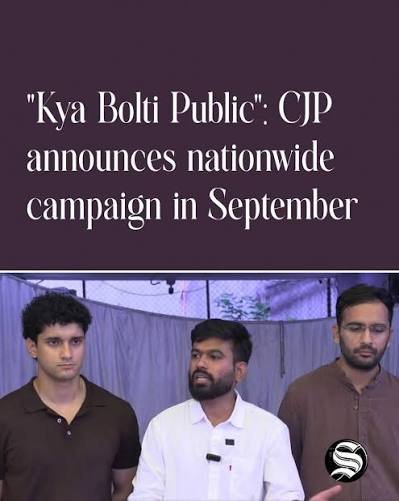
New Delhi, 06 August—Encouraged by the response to its Jantar Mantar protest leading to the resignation of Union Minister for Education Dharmendra Pradhan, Cockroach Janta Party (CJP) founder Abhijeet Dipke on today announced that the party will launch its nationwide ‘Kya Bolti Public’ campaign next month to engage with people across the country, while asserting that unemployment would be taken up as a major national issue alongside education reforms.
Dipke made the announcement at a press conference after the conclusion of the CJP’s two-day core team meeting at his residence in Chhatrapati Sambhajinagar, Maharashtra. CJP chief spokesperson Saurav Das, spokesperson Ashutosh Ranka and other party representatives were also present.
“During the ‘kya bolti public’ campaign, we will get to know what people think of the present situation in the country and what the issues they face are,” he said.
Highlighting the party’s priorities, Dipke said, “Unemployment is a major problem, we will make it a nationwide issue. We will work on education reforms. Education has remained unaffordable since schooling. Education is used for making profits. But we want to change it.”
On RSS chief Mohan Bhagwat’s interaction with students in Mumbai, Dipke said, “I think it’s a little too late, don’t you? They should have interacted with those students on July 20, when they were beaten up. Mohan Bhagwat, who I believe is the ideological mentor of the BJP, should have come forward. He should have met those students.”
He further added, “If this movement hadn’t happened, if so many young people across the country hadn’t come out onto the streets, when was the last time these people actually spoke to Gen Z? They used to dismiss them, saying, ‘What do these people even do? They’re not serious. They just dance on Instagram.’ Well, yes, they dance. At least they don’t riot on the streets like you do.”
Referring to the protests led by the CJP at Jantar Mantar in New Delhi last month over the NEET paper leak and other examination irregularities, Dipke claimed they resulted in Union education minister Dharmendra Pradhan’s resignation.
“Dharmendra Pradhan’s resignation is the biggest achievement of the students’ agitation,” he said, adding that the protests saw participation not only from students but also from unemployed youth.
Describing the protests as a turning point, Dipke said, “The fear which this government created in the last 10-12 years in the minds of people has now ended.”
“People will now come onto the streets. Today, they have sought resignation of one person; tomorrow they will demand resignations of others,” he added.
Dipke said nearly 60 per cent of India’s population is below the age of 35 and noted that the protesters at Jantar Mantar largely belonged to this demographic.
Outlining the party’s ideological framework, he said, “CJP will operate as per Babasaheb Ambedkar, Mahatma Gandhi and Pandit Nehru’s vision for a developed India.” He added, “Our ideology is the same as the Constitution of India.”
The CJP founder also stressed the need to restore public trust in the media, saying there was a need to bring back its credibility.
Meanwhile, the Modi government’s and the BJP’s think tanks are grappling to evolve an effective strategy to strike a dialogue with the Gen Z to turn the tide in its electoral favour.
Prime Minister Narendra Modi took to Instagram recently with selfie-style videos shot after hours in a bid to win over young voters following Gen-Z protests that highlighted growing frustration over a lack of job and education opportunities.
From clips showing the prime minister in a biker jacket and sunglasses against a rap soundtrack, to others that borrow the theme song from the sitcom Friends to signal his dependability, the messaging of Modi’s party has pivoted towards the young.
A vertically shot clip posted on July 31 featuring Modi uttering a casual greeting, “Hi, friends” was the latest in his digital charm offensive that aims to win over 400 million Gen-Z voters ahead of Lok Sabha elections in 2029.
While Modi’s videos are yet to evoke a positive response, his cabinet ministers and other government departments taking the cue from the Prime Minister’s Office have begun to issue a stream of short, lightly edited clips online over the past 10 days, with the Ministry of External Affairs becoming the latest on Thursday, saying it will take to Snapchat.
Since sweeping to power in 2014, Modi has been credited with transforming political communication in India, using digital platforms to build a direct connection with voters.
Analysts say his ruling BJP also developed a highly effective communications network across television news channels and social media platforms such as WhatsApp and X (formerly Twitter).
But platforms such as Instagram were overlooked.
That is where the protesters scored, amplifying their message with Instagram reels and short videos that challenged Modi’s carefully cultivated image of political invincibility and his government’s command of the public narrative.
The government summoned Meta officials this week and the reasons cited were child sexual abuse material on the social media giant’s platforms and the temporary deletion from Facebook of a Modi video, but social media chatter among government critics claimed the real reason was the reels and posts by the young protesters getting such enormous reach.
Experts say the BJP’s renewed outreach reflects the growing political importance of younger voters.
More than half of India’s population of 1.4 billion consists of those younger than 35, and Gen Z is expected to form one of the largest voting blocs by the time the Lok Sabha elections are held in 2029, which could give Modi a fourth term in office.
Veteran Journalist and Political Commentator