

In the days following the BJP’s loss of its long-held Bankipur assembly seat in Bihar, journalist Umakant Lakhera interviewed Professor Jagdishwar Chaturvedi who served as president of the Jawaharlal Nehru University Students’ Union in the mid-1980s and later retired as a professor from Calcutta University about the political situation facing Prime Minister Narendra Modi and the Rashtriya Swayamsevak Sangh (RSS), the ideological parent organisation of the BJP. Chaturvedi is also a prolific author.
The conversation covered the Bankipur result, alleged EVM manipulation, caste politics ahead of the Uttar Pradesh elections, internal RSS matters, Rahul Gandhi’s involvement in the ongoing student protests, and divisions among protest leaders. Below is a section-by-section summary, along with relevant background where independently available.
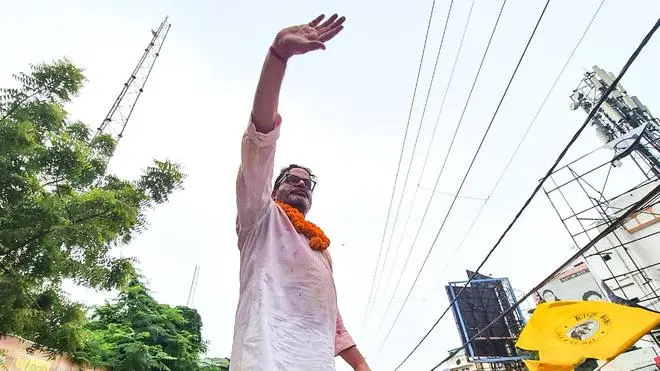
The interview opens with a discussion of the Bankipur bypoll. Jan Suraaj Party founder Prashant Kishor won the seat by nearly 19,000 votes on August 3, 2026, unseating a constituency the BJP had held since at least 2015, when it won by a 27.6-point margin. The seat became vacant after sitting MLA Nitin Nabin moved to the Rajya Sabha. Kishor’s campaign his party’s electoral debut turned an expected easy BJP hold into a closely watched contest; Jan Suraaj also alleged that Patna police detained dozens of its workers ahead of polling.
Chaturvedi connects this result to the nationwide student protest movement that has affected Indian campuses in recent months, while also cautioning that the result alone cannot be used to fully assess Bihar’s political mood, since Modi’s candidate might have lost regardless given broader public discontent.
Chaturvedi says electronic voting machines are being manipulated and describes the Election Commission of India’s conduct as “manipulative,” pointing to what he calls a recurring pattern in Delhi, West Bengal, and Haryana elections. No supporting evidence is presented in the interview itself. EVM-tampering allegations have been raised periodically in Indian opposition politics for over a decade; no court ruling or independent technical audit has confirmed systemic manipulation to date.
Chaturvedi discusses Uttar Pradesh, where assembly elections are expected within roughly eight months of the interview. He argues that the BJP’s upper-caste base particularly Vaishya (trader-caste) shopkeepers such as Agarwals and Khandelwals forms the RSS’s core support and is under economic strain, struggling to cover even monthly shop expenses. He predicts that if traders visibly shifted away from the BJP, the effect would extend beyond their own households, since each shopkeeper interacts with many customers daily. This is offered as his own political analysis and forecast.
Chaturvedi makes several claims regarding the RSS. He says RSS-affiliated organisations including the Swadeshi Jagran Manch (its economic-policy wing) and the Akhil Bharatiya Vidyarthi Parishad (its student wing) previously issued public statements criticising government decisions even during the Vajpayee era, but have since stopped doing so, which he characterises as “ideological corruption.” He also references demands, which he attributes to the Karnataka state government, for accountability over RSS building construction and financing across the country; this claim could not be independently verified from the interview alone. In addition, he describes what he calls a “mass-scale” placement-agency system, illustrated by an account from young men at a facility in Delhi’s Rohini area who told him they were hired through a private agency that retains a share of their wages. He generalises this account to a broader, nationwide network he associates with RSS-linked agents, though the interview does not present additional supporting data for this broader claim.
Chaturvedi credits Congress leader Rahul Gandhi’s series of student meetings in Kota, Dehradun, and Allahabad, with Patna planned with helping build what he calls a “national flow of opinion” behind the protest movement, and describes this as part of a deliberate strategy to build support before concentrating agitation in specific locations. This assessment reflects Chaturvedi’s own view of Gandhi’s role.
A significant part of the interview addresses tensions within the protest movement. Chaturvedi discusses Abhijeet Deepak of the “Cockroach Janta Party” (CJP), a non-party pressure group active in the Jantar Mantar protests, and notes that established left-aligned student organisations including AISA (All India Students’ Association), SFI (Students’ Federation of India), and NSUI (National Students’ Union of India, Congress’s student wing) have declined to formally align with Deepak’s group, agreeing at most to a loose “common minimum programme.”
Chaturvedi argues that non-party, NGO-style movements tend to overestimate their own centrality, citing the earlier anti-corruption movements associated with Arvind Kejriwal and Anna Hazare as a comparison, noting that neither translated into sustained pan-India electoral success. He concludes that pressure groups can help build public opinion but cannot convert that pressure into political outcomes without established opposition parties, and he encourages CJP-aligned student activists to continue working within party-based opposition structures.
The interview closes with Chaturvedi’s prediction that Modi’s eventual political exit will differ from the BJP’s 2004 defeat under Vajpayee, after which the party regrouped. He predicts that the current period which he describes in terms of unprecedented centralisation of power, alleged corruption, and aggressive Hindu-nationalist politics will instead result in a decline of both the BJP and the RSS together, drawing a comparison to a broader pattern in which parties associated with authoritarian leadership have historically declined alongside their leaders.

Aspiring multimedia journalist. Dedicated to uncovering underreported community issues and transforming complex data into compelling human stories.

