
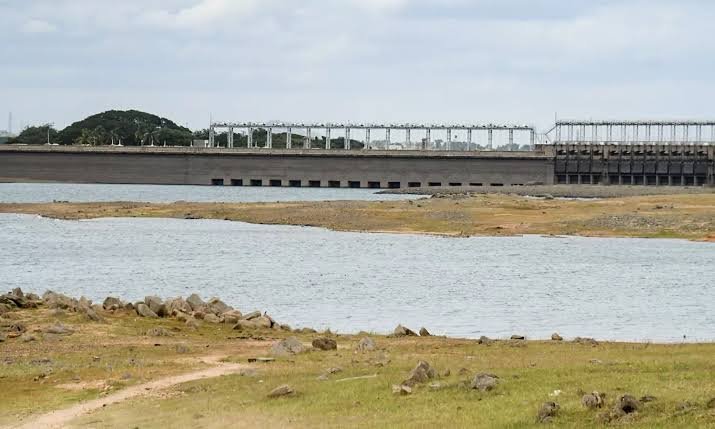
NEW DELHI: The Supreme Court agreed on Monday to hear on 13 August a plea by the Tamil Nadu government seeking directions to Karnataka for the immediate release of its share of Cauvery water.
A bench comprising Chief Justice Surya Kant and justices Joymalya Bagchi and V Mohana took note of submissions that in a rain-deficient year Tamil Nadu was not getting its due share of Cauvery water.
The Joseph Vijay-led state government approached the apex court on 3 August seeking implementation of a 30 July decision by the Cauvery Water Management Authority.
The CWMA decision mandates Karnataka to release 3,500 cusecs of water daily from its Kabini and Krishna Raja Sagara reservoirs for 15 days. Tamil Nadu has sought the release of 4.536 TMC of water, calculated at the rate of 3,500 cusecs per day for 15 days, on or before 12 August.
The CWMA had rejected Karnataka’s appeal and upheld the Cauvery Water Regulation Committee’s order on 30 July. Chaired by S K Haldar, the CWMA endorsed CWRC’s decision mandating Karnataka to ensure a daily flow of 3,500 cusecs at Biligundlu, the water flow measurement point.
Tamil Nadu has argued that Karnataka has repeatedly failed to meet previous tribunal orders for water allocation, despite having sufficient storage capacity.
The opposition DMK party has also filed a similar application in the Supreme Court. The party has submitted that Karnataka must strictly follow the apex court’s final 2018 verdict and comply with the directions issued by the CWMA.
The DMK sought a direction to Karnataka to ensure a flow of 3,500 cusecs per day at Biligundlu for 15 days and to make good the shortfall in compliance from 29 July onwards.
The decades-old water-sharing dispute between the two states has intensified in 2026 amid below-normal monsoon rainfall.
The 53rd meeting of the CWMA was held in New Delhi on 22 July 2026 to assess water availability in the Cauvery basin, with the meeting assuming significance due to below-normal southwest monsoon rainfall and declining reservoir storage.
The CWMA upheld the order despite Karnataka’s objection that a severe monsoon shortfall left it unable to comply.

We are a multimedia news network. Website : www.7xnews.com Based in New Delhi (India)
Youtube : umakantlakheraspeaks@gmail.com

