

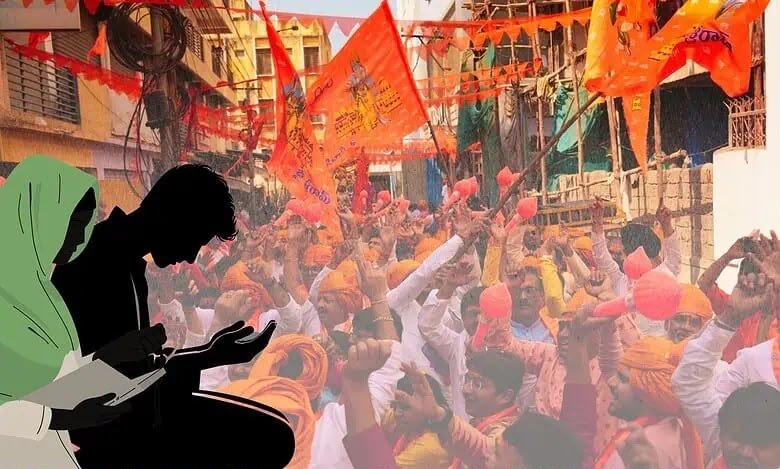
Ibn Khaldun Bharati’s recent column in The Print frames the so-called Cockroach (CJP) protests as a turning point that should persuade Indian Muslims to embrace political quietude. He calls this the “Minority Dharma”: depoliticisation, disbanding the vote bank, accepting permanent minority status without collective political assertion, and earning the majority’s goodwill by staying out of its “mess.” The argument is presented as pragmatic realism. In truth, it is a counsel of surrender dressed up as ethical advice. It rests on selective history, a misreading of electoral data, and a fundamental misunderstanding of the Indian Constitution.
The Myth of the Monolithic Muslim Vote Bank
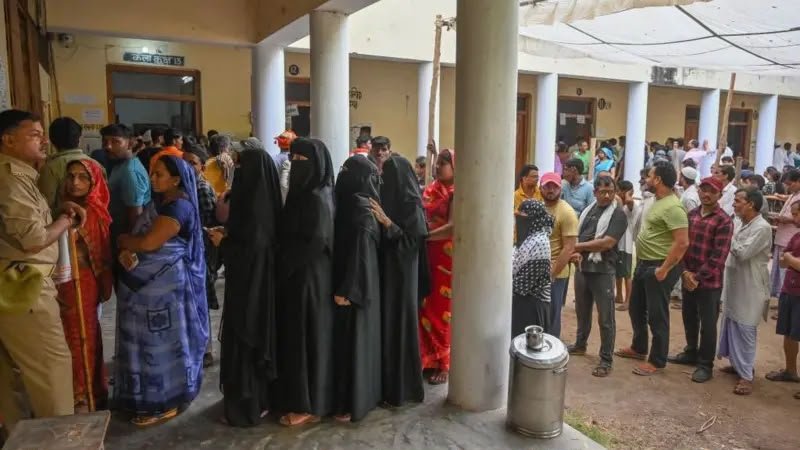
Bharati treats the Muslim vote bank as a sinister mercenary militia that divides Hindu society. Empirical evidence does not support this caricature. Studies based on CSDS-Lokniti National Election Studies and constituency-level analysis (Rahul Verma and Pranav Gupta’s work on Uttar Pradesh, Carnegie Endowment mapping of Muslim voting, and post-poll data from 2014–2024) consistently show that Muslim voters are not more politically mobilised than the average citizen, are not disproportionately influenced by clerics, and do not display uniquely rigid party loyalty. Turnout among Muslims has often been lower or comparable to the national average (around 60–62 per cent in recent Lok Sabha elections against 66 per cent overall). Their votes are fragmented across parties and, within states, across social groups.
Where consolidation occurs, it is usually tactical and reactive—precisely the behaviour expected of any community facing perceived existential threat or systematic under-representation. Upper-caste Hindus, Yadavs, Dalits, and other groups have long practised similar bloc voting when their interests are at stake. To single out Muslims for disbanding collective electoral behaviour while ignoring parallel patterns elsewhere is selective moralising, not principle.
Moreover, the political returns on this supposed “militia” have been meagre. Muslims constitute roughly 14.2 per cent of the population (2011 Census). Their share of Lok Sabha MPs has hovered between 4 and 5 per cent in recent decades, hitting a low of 4.2 per cent in 2014 and remaining around that level. Representation in many state assemblies shows similar chronic under-representation. If a vote bank existed with the potency Bharati claims, the outcomes would look very different.
Constitutional Equality is Not Conditional Quietude
The Indian Constitution does not prescribe political quietude for any group. Articles 14, 15, 16, 19 and 25 guarantee equality before the law, non-discrimination, equal opportunity in public employment, freedom of speech and association, and freedom of religion. Articles 29 and 30 protect cultural and educational rights of minorities precisely because the framers recognised that formal equality alone is insufficient in a diverse society. Political participation is the mechanism through which these rights are defended and realised.
To argue that a minority’s primary dharma is to remain friends with the majority by avoiding conflict is to invert the constitutional logic. The majority, by definition of democratic numbers, already controls the state, the legislature and the government. The minority’s protection lies in the Constitution’s counter-majoritarian safeguards and in the active exercise of citizenship rights, not in self-imposed political silence. Historical experience from across democracies shows that groups that voluntarily withdraw from assertive politics rarely retain their rights for long.
Bharati’s invocation of the medieval past and the Two-Nation Theory is equally misplaced. The overwhelming majority of India’s Muslims stayed after Partition and accepted the republican Constitution. Their political behaviour since 1947 has largely been within the framework of electoral democracy, not separatist mobilisation. To treat collective voting as a revival of the Muslim League is an anachronistic smear that ignores both the constitutional settlement and the actual record of Muslim political organisations in independent India.
Depoliticisation Deepens Marginalisation
Bharati claims that hyper-politicisation has reduced Muslims to an “angry, volatile and inflammable” community and that quietude is the path to de-communalisation. The opposite is closer to reality. Socio-economic indicators (Sachar Committee and subsequent analyses) already place large sections of Indian Muslims near the bottom on education, employment and access to public services. Political under-representation compounds this. When parties of every ideological hue hesitate to field Muslim candidates for fear of polarisation, and when community-specific grievances are dismissed as “communal,” the result is not integration but further exclusion.
The Cockroach protests themselves illustrate the point. A youth-led movement focused on examination integrity and employment was able to extract concessions precisely because it mobilised as citizens with shared material interests. Muslims who joined as individuals did so within that frame. The idea that the community’s “distance” from the protests signals a healthy climbdown from politicisation is speculative at best. More plausibly, it reflects the well-founded caution of a community that has repeatedly paid a higher price for visible political assertion.
Fraternity Cuts Both Ways
Bharati correctly notes that the Preamble speaks of fraternity. He omits that fraternity is a two-way obligation. Demanding that minorities earn the majority’s goodwill by political self-effacement while remaining silent on the majority’s own responsibilities—fair representation, protection from majoritarian excesses, equal application of law—is one-sided. India’s civilisational capacity for accommodation is real, but it has never been sustained by one side unilaterally disarming.
Every community in a democracy has the right to organise around its interests. Caste associations, linguistic groups, farmer unions and regional parties do so routinely. Singling out religious minorities for a special ethic of quietude converts citizenship into a hierarchical status. That is the opposite of the republican ideal.
Indian Muslims do not need a “Minority Dharma” of political self-abnegation. They need the same rights, the same space for collective interest articulation, and the same accountability from political parties that every other Indian citizen enjoys. Depoliticisation is not the path to dignity; equal, assertive citizenship is. The Constitution already provides the framework. What is required is the will to use it, not the advice to abandon it.

~Hasnain Naqvi is a former member of the history faculty at St. Xavier’s College, Mumbai….
The opinions expressed here are solely those of the author.

