

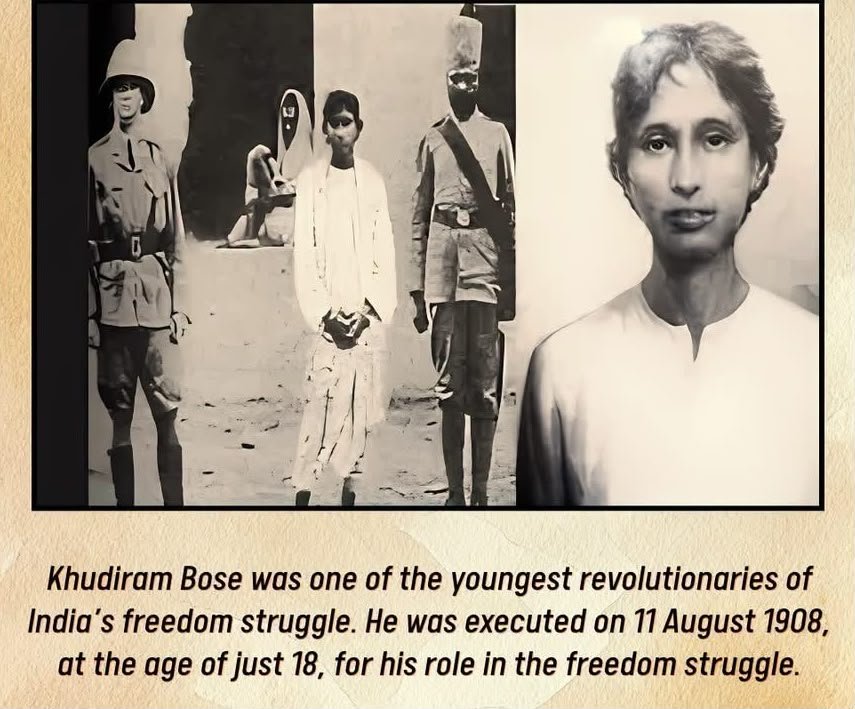
On this day each year, the nation pauses to remember a boy who became a legend before he had lived long enough to grow a full beard. Khudiram Bose, executed on 11 August 1908 at the age of eighteen years, eight months and a handful of days, remains one of the purest emblems of courage in India’s long struggle for freedom. In an age when most young men still sought the safety of books and family hearths, he chose the perilous path of armed resistance against the mightiest empire the world had known. His brief life and serene death lit a fire that no amount of colonial repression could extinguish.
The Making of a Revolutionary
Born on 3 December 1889 in a modest household in Habibpur village in the Midnapore district of undivided Bengal, Khudiram lost his parents early and was raised by his eldest sister. The quiet rhythms of rural life might have claimed him entirely had history not intervened. The Partition of Bengal in 1905, that calculated stroke of imperial policy designed to divide and weaken, awakened something fierce in the young. Across the province, secret societies such as the Anushilan Samiti trained earnest youths in physical discipline, the use of arms, and the higher duty of serving the motherland. Khudiram joined their ranks while still in his mid-teens. Under the influence of figures associated with the revolutionary network linked to Barindra Kumar Ghosh and the idealistic currents flowing from Aurobindo Ghose, he absorbed the conviction that passive suffering would never liberate India. Action, even at the cost of life, was the only language the Raj understood.
He distributed forbidden literature, participated in early attempts to strike at symbols of authority, and steadily prepared himself for greater tasks. The revolutionaries of those years did not romanticise violence; they saw it as the necessary response to a system that had reduced a great civilisation to a subject race. Khudiram’s commitment was total. At an age when contemporaries calculated examination scores and career prospects, he calculated the risks of bombs and the certainty of the gallows.
The Night in Muzaffarpur
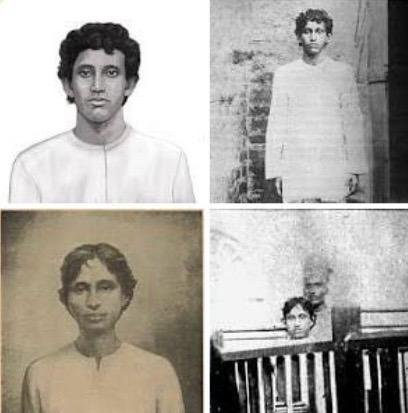
By early 1908, the attention of the Anushilan Samiti and its allied Jugantar circle had fixed upon Douglas Kingsford, the former Chief Presidency Magistrate of Calcutta, whose harsh sentences against nationalists had earned him deep enmity. Transferred to Muzaffarpur as District Judge, Kingsford remained a marked man. Two young volunteers—Khudiram Bose and the slightly older Prafulla Chaki—were chosen for the mission. They travelled under assumed names, lived frugally, studied their target’s movements with patient care, and waited.
On the evening of 30 April 1908, as carriages left the European Club, the two revolutionaries acted. The bomb they threw struck the wrong vehicle. Instead of Kingsford, it killed the wife and daughter of a British barrister. The tragedy was immediate and unintended. History records Khudiram’s later expression of regret for the innocent lives lost, yet it also records his unbroken resolve. The two companions separated. Prafulla Chaki, cornered at a railway station, chose death by his own hand rather than capture. Khudiram walked through the night and was arrested the next morning near Waini station. Handcuffed and surrounded by armed police, the slender youth still found the strength to cry “Vande Mataram” as crowds gathered to see him.
The Smile That Defied an Empire
What followed was less a trial than a demonstration of imperial power and of a boy’s unyielding spirit. On 13 June 1908 the judge pronounced the death sentence. Khudiram smiled. When asked whether he understood the meaning of the verdict, he replied that he did—and, with the same calm smile, offered that if given a little time he could teach the judge the art of making bombs. Appeals failed. The Calcutta High Court confirmed the sentence. The date was set for 11 August.
Contemporary accounts leave no room for doubt about his final hours. The Amrita Bazar Patrika reported that he walked to the gallows firmly and cheerfully and even smiled when the cap was drawn over his head. The Anglo-Indian paper “The Empire” noted that he mounted the scaffold with body erect, cheerful and smiling. Some traditions hold that he carried a copy of the Bhagavad Gita and uttered “Vande Mataram” one last time. At six o’clock on that August morning, the British extinguished a life of eighteen years. In doing so they created a martyr whose radiance only grew.
Crowds thronged the streets of Muzaffarpur. Flowers were flung upon the funeral carriage. Mothers preserved ashes as sacred relics. Students across Bengal wore mourning. Photographs of the smiling youth sold in great numbers. In distant Poona, Bal Gangadhar Tilak used the columns of his newspaper “Kesari” to defend the spirit of these young men and to demand Swaraj. For that defence he himself faced prosecution. The chain of inspiration had begun.
An Immortal Fragrance
More than a century later, Khudiram Bose’s sacrifice continues to speak with undiminished clarity. He proved that courage is not the monopoly of age or rank. He showed that a single life, freely offered, can outweigh the calculations of an empire.
The Urdu couplet often associated with his memory captures the essence:
“Dil se niklegi na mar kar bhi watan ki ulfat,
Meri mitti se bhi khushbu-e-wafa aayegi.”
~Lal Chand Falak
(Even after death, love for the motherland will not leave the heart; even from the dust of the grave, the fragrance of loyalty will rise.)
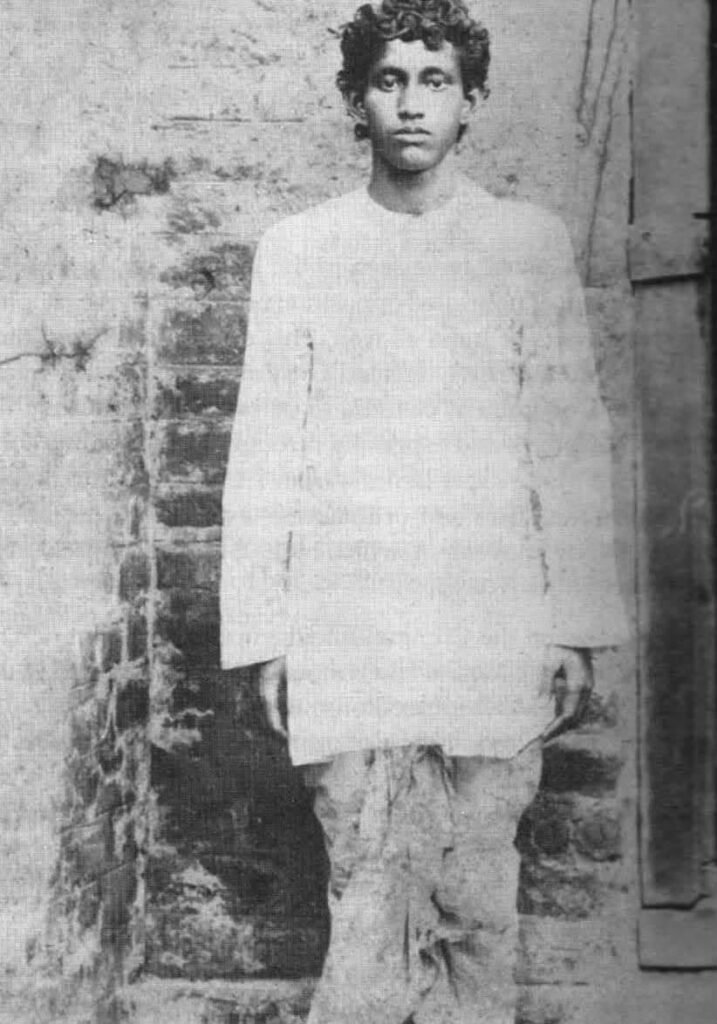
“mitti-mitti ho kar bhi woh aankhon mein bhar aate hain
koh-e-nida ko jaane wale log palat kar aate hain”
~Abbas Tabish
Another poetic voice reminds us that those who have turned to dust still well up in the eyes of the living; those who journey to the mountain of the nation’s call return in the hearts of successive generations.
Khudiram did not live to see the tricolour rise over a free India. Yet every young person who later chose the hard road of resistance—whether in the revolutionary underground, in the Non-Cooperation Movement, or in the final years of the Quit India struggle—walked, in some measure, in the footprints of that smiling boy from Midnapore. His story remains a living rebuke to cynicism and a permanent invitation to moral courage.
On this anniversary we do not merely commemorate a death. We renew an allegiance. We remember that freedom was purchased not only by the speeches of the great but by the quiet, cheerful steps of an eighteen-year-old who walked to the scaffold as though it were the threshold of a greater life. In the dust of Muzaffarpur and in the memory of a nation, the fragrance of that loyalty still blooms.

~Hasnain Naqvi is a former member of the history faculty at St. Xavier’s College, Mumbai….
The opinions expressed here are solely those of the author.

