

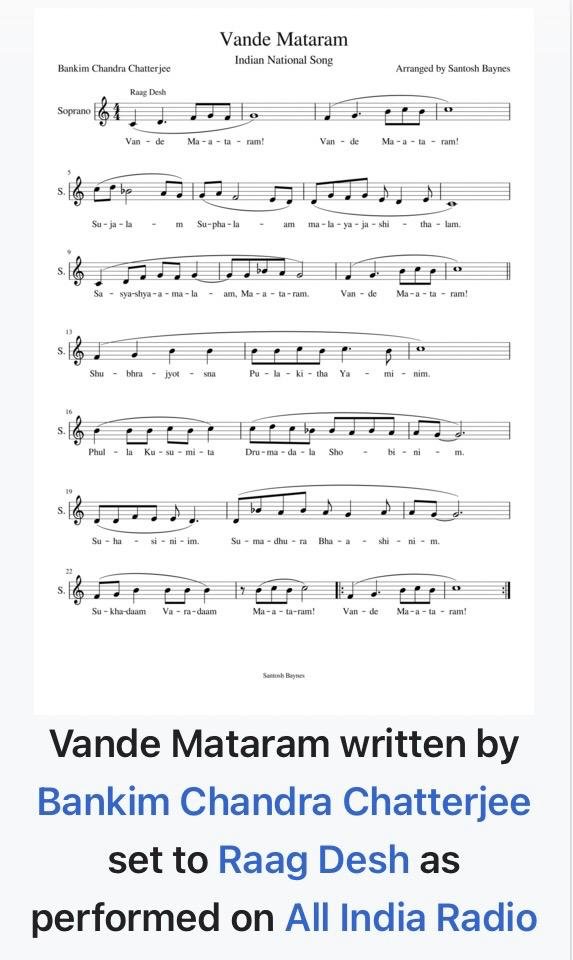
By reaffirming its 1937 position on “Vande Mataram”, the Congress has taken a calculated political risk. The immediate controversy may deepen the country’s cultural polarisation, but the larger question is whether nationalism can remain the exclusive property of one political party.
A Song, Not a Property Deed
The Congress Working Committee’s decision to retain the first-two-stanza version of Vande Mataram at party programmes came amid the Centre’s new protocol requiring the six-stanza rendition at specified official functions. The Ministry of Home Affairs has prescribed a version lasting roughly three minutes and ten seconds for formal occasions, including the unfurling of the national flag and the arrival of the President.
This distinction matters. The Congress has not rejected Vande Mataram. It has reaffirmed the version adopted for national gatherings by the Congress in 1937. That decision followed debates over the later stanzas, which contain explicit references to Hindu deities. The first two stanzas, by contrast, evoke the beauty, fertility and abundance of the motherland and had acquired wider national acceptance.
The political argument, therefore, is not simply about how many stanzas should be sung. It is about who gets to define patriotism, which historical interpretation should prevail, and whether national symbols belong to the constitutional republic or to the ruling party of the day.
The BJP’s intervention seeks to convert a question of historical interpretation into a test of national loyalty. If singing all six stanzas becomes the measure of patriotism, then the political battlefield is no longer merely the song itself. It becomes a mechanism for labelling dissenters as suspect citizens.
That is precisely where the debate becomes dangerous. National symbols unite only when citizens are allowed to approach them without fear. Once they are transformed into instruments of political discipline, reverence gives way to compulsion.
The Myth of a Single Nationalism
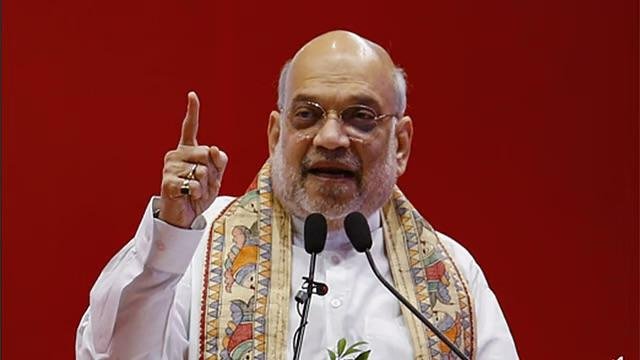
Amit Shah’s claim that the 1937 decision helped create the conditions for Partition is politically dramatic but historically reductive. Partition emerged from a complex interaction of colonial policy, competing nationalisms, communal mobilisation, constitutional deadlock, elite negotiations and the failures of political accommodation. To attribute that catastrophe to the decision to sing two stanzas of a song is to replace history with a convenient political morality tale.
The 1937 Congress decision was not made by an isolated group of “appeasers”. It emerged from deliberations involving leading figures of the national movement, including Gandhi, Tagore, Nehru and Bose. Whatever one’s assessment of the decision today, it cannot honestly be described as a surrender to an anti-national agenda without also indicting the political tradition that produced modern India’s inclusive nationalism.
The BJP’s larger objective is clear: to position itself as the sole authentic representative of the nation. Its opponents are then cast as derivatives—soft on terrorism, soft on minorities, soft on history and, finally, soft on India itself. This strategy has electoral value because it compresses complicated questions into a simple binary: complete patriotism versus compromised patriotism.
But nationalism is not a competitive examination in which the BJP alone controls the answer key. The freedom movement produced multiple vocabularies of patriotism: revolutionary, constitutional, religious, socialist, federal and pluralist. India’s national identity was not forged by one organisation or one ideology. It was built through disagreement, sacrifice and negotiation among political traditions that often sharply opposed one another.
The attempt to erase that plurality is not patriotic. It is an appropriation of the nation.
Congress Finds Its Voice
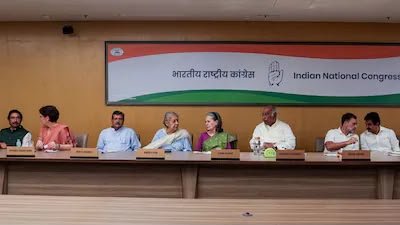
The Congress decision is significant because it suggests that the party may finally be abandoning its instinctive defensiveness on cultural and national questions. For years, the BJP has succeeded in forcing the Congress into a position where it appears embarrassed by its own history. The Congress has often responded with silence, qualification or symbolic gestures that satisfied neither its critics nor its supporters.
This time, it has chosen confrontation.
By invoking the 1937 resolution, the Congress is asserting that its own historical legacy remains a source of legitimacy. It is also challenging the BJP’s attempt to portray the Congress as permanently apologetic before the majority community and permanently dependent on minority approval.
That is a necessary political correction.
A secular party cannot survive by treating secularism as a private embarrassment. Nor can it defend pluralism by appearing afraid of patriotic symbols. The Congress must be able to say, without hesitation, that it respects Vande Mataram, honours its role in the freedom movement and nevertheless supports a version that does not make religious imagery a condition of national belonging.
The decision could help the party recover ideological clarity. It may allow the Congress to occupy a position between majoritarian nationalism and defensive identity politics: patriotic, constitutional and resistant to coercion.
But the opportunity carries serious risks. If the party presents the decision merely as a tactical blow against the BJP, it will remain trapped within the BJP’s political frame. It must explain the historical and constitutional reasoning behind its position, not merely trade accusations about who betrayed the freedom struggle.
The Immediate Fallout
In the short term, the row will intensify political polarisation. The BJP will likely use the dispute to consolidate its core electorate and depict the Congress as unwilling to accept the “full” national song. The Congress, in turn, will use the controversy to expose what it sees as the coercive and exclusionary tendencies of the BJP’s nationalism.
The debate may also spread beyond party platforms into schools, government offices and public ceremonies, especially if the Centre’s six-stanza protocol is implemented rigidly. The distinction between an official state function and a political party programme will become crucial. A party may claim the freedom to follow its historical practice, while the government may insist that official events follow the notified protocol. The legal boundaries of that distinction will likely invite further litigation and public controversy.
The danger is that ordinary citizens, particularly Muslims and other minorities, will once again be compelled to prove that their constitutional citizenship is not conditional. They may be asked not merely whether they respect the nation, but whether they express that respect in an officially approved form.
A democracy should not make minorities audition for belonging.
The Long-Term Test
The long-term consequences will depend less on the number of stanzas sung than on the political language that follows. If the controversy establishes a precedent whereby every national symbol must be performed in its most expansive and religiously charged form, India’s public culture will become narrower. The republic will gradually be redefined not as a common political home, but as a test of cultural conformity.
If, however, the Congress uses this moment to articulate a confident pluralist nationalism, the row could mark an important shift. It could remind voters that patriotism is compatible with disagreement, that historical figures cannot be selectively conscripted into present-day campaigns, and that national unity does not require cultural uniformity.
The Congress should therefore do three things. First, it must explain the 1937 decision with historical precision rather than partisan rhetoric. Second, it must affirm unequivocally that Vande Mataram is an honoured national song and that its first two stanzas hold a legitimate place in India’s national tradition. Third, it must oppose any attempt to convert a song into a loyalty test while defending the right of the state to prescribe ceremonial protocols for official functions, subject to constitutional scrutiny.
The BJP, too, should ask whether its nationalism has become so insecure that it requires legal enforcement and political denunciation. A nation confident in its history does not need to treat every variation in rendition as an act of treason.
The Vande Mataram controversy is ultimately a contest over the meaning of India. One side wants the nation to be inherited as an ideological possession; the other is being forced to decide whether it can defend the nation without surrendering its plural character.
The Congress has made a gamble. It may not immediately dismantle the BJP’s nationalist dominance. But by refusing to accept that nationalism has a single owner, it has reopened a question the ruling party would prefer to keep closed: who speaks for India—and who gave them the right to decide?

~Hasnain Naqvi is a former member of the history faculty at St. Xavier’s College, Mumbai….
The opinions expressed here are solely those of the author.

