

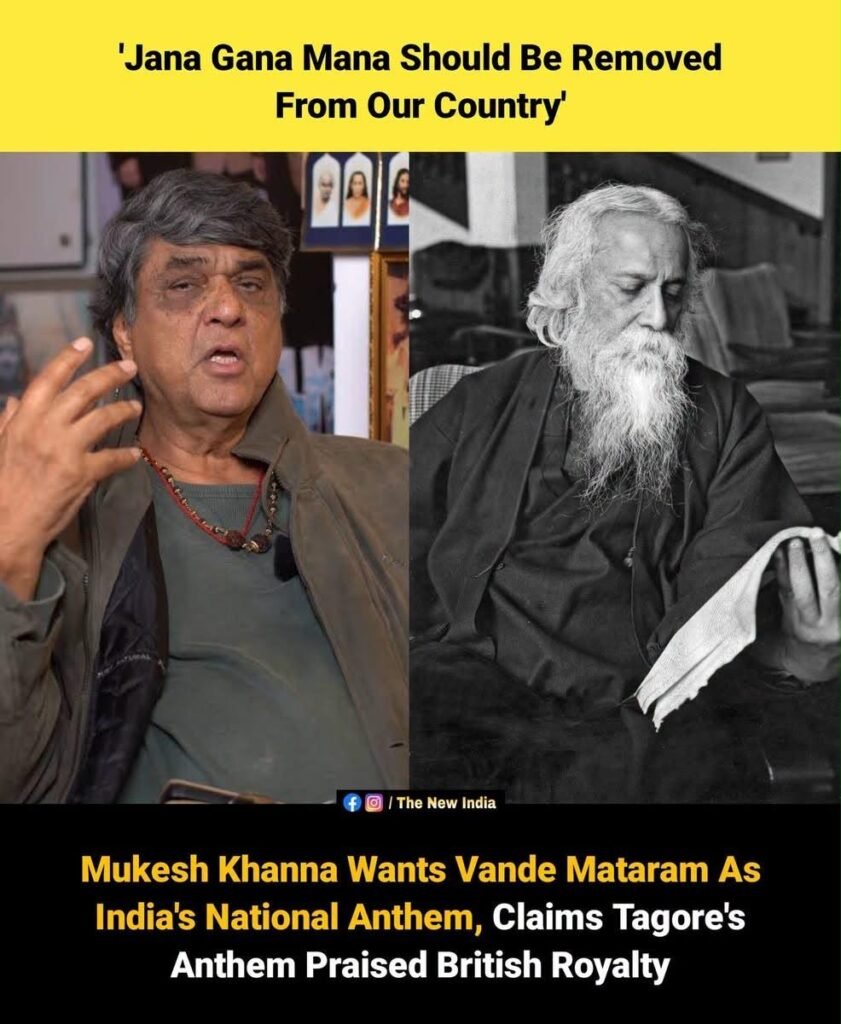
A recent public remark by actor Mukesh Khanna has revived one of India’s longest-running cultural and historical debates. Khanna argued that the country’s national anthem should be Vande Mataram rather than Jana Gana Mana, claiming the latter was originally composed as a tribute to British royalty. The statement quickly divided social media into familiar camps of support and opposition. Yet the controversy itself is neither new nor purely contemporary. Its roots stretch back more than a century, to the final decades of colonial rule, and any serious examination requires returning to the historical record rather than contemporary soundbites.
The 1911 Origins and the Birth of a Misunderstanding
The song that would become Jana Gana Mana first entered the public domain in December 1911. That month, King George V was visiting India. Shortly afterward, the Indian National Congress held its annual session in Calcutta. On 27 December 1911, the composition Bharoto Bhagyo Bidhata was sung publicly for the first time. Its opening stanza later became the national anthem known as Jana Gana Mana.
Because the royal visit and the song’s debut occurred in close succession, a handful of contemporary English-language newspapers reported that the piece had been written to welcome the British monarch. In an era when sections of the press often sought official favour, such claims circulated with little scrutiny. At the time, however, the allegation attracted limited attention. The real controversy would surface decades later, when political power and cultural symbolism collided more sharply.
The 1930s Contest: Vande Mataram Versus Jana Gana Mana
By the 1930s the political climate had transformed. After the 1937 provincial elections, Congress ministries assumed office in several provinces. Questions arose about which song should be performed at official functions. Two powerful compositions stood in competition: Vande Mataram and Jana Gana Mana.
Vande Mataram, written by Bankim Chandra Chatterjee and later incorporated into his novel Anandamath, had already become the anthem of the freedom struggle. During the 1905 Swadeshi movement against the partition of Bengal, revolutionaries and protesters sang it in processions and meetings. Its emotional force and association with resistance made it inseparable from the nationalist imagination.
Yet later stanzas of the song depicted the motherland in the forms of Hindu goddesses—Durga, Lakshmi and Saraswati. These religious images prompted objections from the Muslim League and certain other organisations, who argued that the song’s imagery was not inclusive of all communities. In the ensuing debate, some voices countered that if Vande Mataram could be questioned on communal grounds, then Jana Gana Mana should likewise be examined for alleged loyalty to the British crown.
Tagore’s Own Clarifications
The charge that Rabindranath Tagore had composed the song in praise of King George V eventually required a direct response from the poet himself. In 1937 Tagore wrote to his friend Pulin Behari Sen, stating clearly that he had been approached to write a song honouring the king but had declined. The “Dispenser of India’s destiny” invoked in the song, he insisted, was not George V but the guiding spirit of the Indian people. Two years later, in 1939, Tagore issued a sharper rebuttal. He declared that any suggestion he would write a song glorifying a British monarch was an insult to his intelligence and integrity.
These statements were made while India remained under British rule. They form the most authoritative contemporary evidence on the question of intent. Tagore’s broader record reinforces the same point. After the Jallianwala Bagh massacre of 1919, he renounced the knighthood conferred by the British government, writing to Viceroy Lord Chelmsford that it would be shameful to retain an official honour while his countrymen suffered humiliation and violence.
Constitutional Resolution and Equal Honour
The debate reached a formal conclusion on 24 January 1950. Addressing the Constituent Assembly, its president Dr Rajendra Prasad announced that Jana Gana Mana would be India’s national anthem. At the same time, he affirmed that Vande Mataram, by virtue of its historic role in the freedom movement, would receive equal honour and status as the national song. The dual recognition was a deliberate act of balance, acknowledging both artistic excellence and political history.
Tagore’s Place in the National Imagination
Any claim that Tagore wrote the anthem as an act of colonial flattery sits uneasily with the esteem in which he was held by leading figures of the independence movement and beyond. Mahatma Gandhi addressed him as Gurudev. The Nobel Prize in Literature awarded for Gitanjali made him the first Asian poet to receive the honour. W.B. Yeats wrote the introduction to the English edition, describing the work as literature that stirred the soul. In 1930 Tagore met Albert Einstein in Germany; the scientist later recalled their conversation on science, truth and human consciousness as memorable. C.V. Raman regarded Tagore as the foremost representative of Indian culture, one who demonstrated that India’s wealth was intellectual as well as spiritual.
Subhas Chandra Bose held Tagore in particular regard, treating him as a guide. When Bose resigned as Congress president in 1939 amid political attacks, Tagore publicly addressed him as Deshnayak—leader of the nation—and congratulated him on behalf of Bengal. Upon Tagore’s death on 7 August 1941, Bose paid tribute, declaring that India had lost its greatest poet and sage.
Even more telling is the practice of Bose’s own provisional government. In 1943 the Azad Hind administration adopted Subh Sukh Chain as its anthem. The melody was derived from Tagore’s Bharoto Bhagyo Bidhata. A leader who had dedicated his life to armed struggle against British rule found no trace of servility in the composition. That judgment carries considerable weight when set against later attempts to portray the song as colonial homage.
A Debate That Refuses to Fade
More than a century after its first public performance, Jana Gana Mana continues to provoke argument. The latest remarks by a public figure have simply returned an old dispute to the surface. Yet the documentary record—Tagore’s letters of 1937 and 1939, his renunciation of knighthood, the Constituent Assembly’s careful decision in 1950, and the respect shown by Gandhi, Bose and others—offers a coherent account that does not support the charge of imperial sycophancy.
Vande Mataram retains its rightful place as the national song and as a powerful symbol of the freedom struggle. Jana Gana Mana stands as the national anthem, its opening stanza chosen for its universal address to the Indian people rather than to any temporal ruler. Both compositions form part of the country’s cultural inheritance. Treating either as a weapon in contemporary political contests risks diminishing the historical complexity that produced them and the careful constitutional settlement that sought to honour both.
The debate will likely surface again. When it does, the most useful response remains a return to the primary sources: the poet’s own words, the decisions of the Constituent Assembly, and the judgments of those who fought for independence. Those sources do not portray Jana Gana Mana as a hymn to empire. They present it as a song of the nation’s destiny, composed by a writer who rejected imperial titles and whose work inspired successive generations of nationalists.

~Hasnain Naqvi is a former member of the history faculty at St. Xavier’s College, Mumbai….
The opinions expressed here are solely those of the author.

