

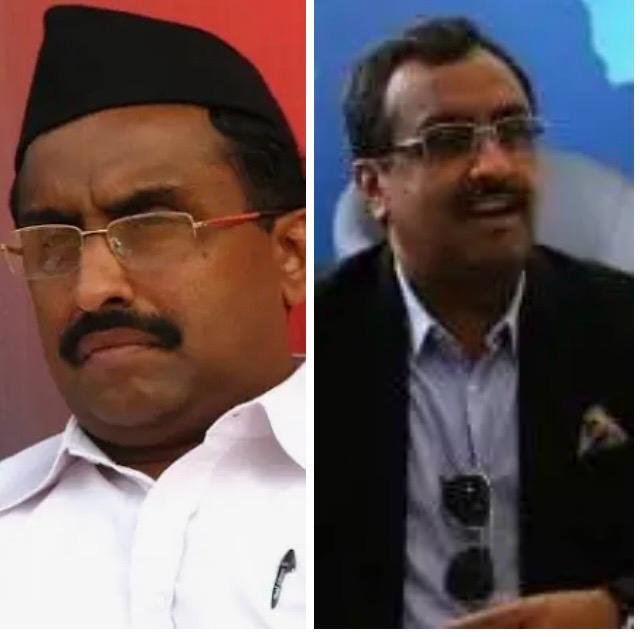
Dear Mr Ram Madhav,
Your recent Indian Express column, “On Vande Mataram, Congress hasn’t learnt from its past”, makes a provocative charge: that the Congress decision in 1937 to restrict the public singing of Vande Mataram to its first two stanzas was a grave historical mistake, and that Congress’s alleged failure to stand firm against communal forces then contributed to the political circumstances that eventually produced Partition. You go further, describing the 1937 decision as a “blunder” and arguing that Congress is repeating the same mistake today.
You are entitled to make that argument. But when a political argument is presented as history, it must submit to the discipline of historical evidence.
Your thesis risks reducing a complex and tragic history to a morality play: Congress as appeaser, the Muslim League as beneficiary, Vande Mataram as the abandoned national symbol, and Partition as the eventual price of that surrender.
That is a powerful political narrative. But is it good history?
I would like to put a few questions to you—not as rhetorical flourishes, but as questions that any serious historical argument must answer.
Where is the evidence that the 1937 decision helped cause Partition?
This is the most fundamental question.
You establish a chronology: Congress took the decision in 1937; Partition came ten years later. But chronology is not causation.
The political road to Partition passed through the Government of India Act of 1935, provincial elections, separate electorates, the evolving Congress-League relationship, the Lahore Resolution of 1940, the wartime political crisis, the failure of the Cabinet Mission Plan, Direct Action Day, the communal violence of 1946-47 and the British decision to transfer power rapidly.
Where, in this enormous chain of political developments, does the truncation of Vande Mataram become a decisive causal link?
Historian Sabyasachi Bhattacharya’s Vande Mataram: “The Biography of a Song” is particularly relevant. His study does not deny the political importance of the controversy. On the contrary, it traces how the song became a powerful nationalist symbol and, at different moments, a site of communal contestation. His work demonstrates why Vande Mataram must be understood through the changing political meanings attached to it rather than through a single, retrospective explanation of Partition.
That distinction is crucial.
If the 1937 decision was indeed a major contributor to Partition, the burden is on you to demonstrate the mechanism. How precisely did restricting the song’s public rendition to two stanzas strengthen separatism, weaken Indian nationalism and ultimately make Partition more likely?
Without such evidence, the proposition that “1937 led to 1947” remains a political inference masquerading as historical causation.
Partition was the culmination of a much wider crisis involving competing nationalisms, constitutional arrangements, communal representation, political negotiations, colonial policies and failures of political accommodation. To reduce that tragedy to the question of how many stanzas of a song Congress chose to sing is not an explanation of Partition. It is an exercise in historical compression.
Why describe the decision simply as “appeasement” when the history reveals a far more complicated debate?
Your argument appears to treat the 1937 decision as though Congress simply surrendered to communal pressure.
But who actually participated in the debate?
Rabindranath Tagore, Jawaharlal Nehru, Subhas Chandra Bose and other nationalists wrestled with the question of whether a song that had become an immensely powerful symbol of anti-colonial nationalism could simultaneously serve as an inclusive national song in a religiously plural society. The Congress committee that considered the matter included several of the movement’s leading figures; the decision was therefore hardly a unilateral concession made behind closed doors.
Tagore’s position is especially significant.
The man who had himself sung Vande Mataram at the 1896 Congress session did not reject the song. Rather, he distinguished between its opening portion and the later verses. The latter contain explicit references to Hindu religious imagery and deities. Tagore’s 1937 response, preserved and discussed by Bhattacharya, acknowledged that the complete poem, when read in its literary context, could be interpreted in ways that might wound Muslim sensibilities. At the same time, he argued that the first two stanzas could be separated from that context and serve as a national song.
That is not the language of someone casually surrendering a national symbol.
Nehru, too, cannot simply be reduced to an appeaser. His position involved a difficult distinction between resisting communal politics and recognising legitimate sensitivities surrounding religious imagery.
So why reduce a complicated debate among major nationalists to the convenient label of “appeasement”?
If Congress had wanted merely to placate the Muslim League, why did it retain Vande Mataram at all?
Why did it choose the first two stanzas, which evoke the beauty and bounty of the motherland without the explicit invocation of Hindu deities found later in the poem?
And why should an attempt to distinguish between cultural nationalism and religious symbolism automatically be described as weakness?
You may disagree with the decision. You may even argue that Congress handled the controversy badly.
But disagreement is not evidence of appeasement.
A historian may criticise a decision. A historian cannot erase the circumstances in which that decision was made.
What happens to Bankim Chandra’s original text in your argument?
This is where the politics of memory becomes particularly revealing.
There are effectively two Vande Matarams in contemporary political discourse: the two stanzas ordinarily sung as the national song and the complete literary text embedded in Anandamath.
They are not identical in meaning.
Tanika Sarkar’s influential scholarship on Vande Mataram, Anandamath and Hindu nationhood challenges the assumption that the song represents nothing more than an uncomplicated celebration of the motherland. Her work places the poem within its literary, historical and ideological context and examines the emergence of the motherland as a sacralised political figure.
That does not diminish the song’s historic role in India’s freedom struggle.
It makes its history more interesting—and more complicated.
The same is true of Anandamath. The novel cannot simply be detached from the political and religious imagination of its time. Its portrayal of eighteenth-century Bengal, its depiction of Muslim rule and its transformation of the motherland into a sacred figure are all relevant to understanding why the complete text subsequently became contested.
Partha Chatterjee’s analysis of nationalist thought similarly reminds us that Indian nationalism did not develop in an ideological vacuum. In “The Nation and Its Fragments”, he examines how anti-colonial nationalism constructed a cultural “inner” domain through which the nation could be imagined and defended.
This matters because Vande Mataram was never merely a collection of patriotic words. It acquired different meanings as it moved from literature into politics, from the pages of Anandamath into the anti-colonial movement, and eventually into the national life of independent India. Bhattacharya’s study traces precisely this remarkable transformation—from lyrical hymn and political chant to nationalist symbol and site of communal controversy.
So my question is straightforward:
If the complete text has meanings that some Indians can reasonably experience as religious rather than merely territorial, why is acknowledging that historical reality described as appeasement?
Is historical sensitivity now equivalent to historical surrender?
If 1937 was such a disastrous mistake, why did independent India arrive at a similar accommodation in 1950?
This question deserves particular attention.
India did not become independent and then declare Vande Mataram a failed or illegitimate nationalist symbol.
Quite the opposite.
On January 24, 1950, Constituent Assembly President Dr Rajendra Prasad announced that Jana Gana Mana would be the national anthem and that Vande Mataram, which had played a historic role in the struggle for Indian freedom, would be “honoured equally” and have equal status.
That settlement which was unanimously approved by the members (that also included the Hindu Mahasabha- RSS leader Dr Syama Prasad Mukherjee) of the Constituent Assembly is important because it demonstrates something your argument appears to overlook: the national movement did not have to choose between reverence for Vande Mataram and constitutional pluralism.
It could honour the song without turning every verse into a compulsory test of national loyalty.
That was not weakness.
It was statecraft.
Independent India had just emerged from Partition and its unprecedented communal violence. The Constitution was being framed in the shadow of that catastrophe. The architects of the Republic understood a principle that contemporary political discourse too often forgets: national symbols unite most effectively when citizens can identify with them freely rather than being compelled to demonstrate patriotism through ritual conformity.
If the 1937 compromise was fundamentally responsible for the communal catastrophe of 1947, why did the leaders of independent India not reverse it?
Why did the Constituent Assembly preserve Vande Mataram as an equally honoured national symbol while choosing Jana Gana Mana as the anthem?
Perhaps the answer is that the founders of the Republic understood something that partisan politics often forgets: nationalism is strongest when it persuades rather than compels.
Is today’s controversy really about Vande Mataram—or about turning patriotism into a political loyalty test?
This is perhaps the most uncomfortable question.
Your column appears amid a renewed political confrontation over the song. The Congress has reaffirmed its practice of singing the first two stanzas at its programmes, while the BJP has sought to emphasise the “full legacy” of Vande Mataram. Your argument therefore does not remain confined to historical interpretation; it directly enters the politics of contemporary nationalism.
That makes the historical accuracy of your argument all the more important.
The danger is that once a national song becomes a test of ideological loyalty, the debate ceases to be about Bankim Chandra, the freedom struggle or the evolution of Indian nationalism. It becomes a referendum on who is sufficiently patriotic.
That is a dangerous road.
A Muslim who respects Vande Mataram but has difficulty with its later religious imagery is not necessarily less Indian.
A Hindu who recognises the historical sensitivity surrounding those verses is not necessarily appeasing anyone.
A Congress supporter who prefers the first two stanzas is not thereby endorsing the Muslim League’s politics.
Equally, someone who wishes to sing the complete song is perfectly entitled to do so.
The Republic should be large enough to accommodate both.
Mr Madhav, history is not a political inheritance
Your column is right about one thing: Vande Mataram cannot be treated casually. It was one of the great cultural symbols of India’s anti-colonial struggle. It deserves to be remembered, respected and studied.
But precisely because it is so important, its history should not be reduced to a partisan charge sheet against the Congress.
The intellectual history of Vande Mataram contains patriotism, literature, anti-colonial resistance, Hindu imagery, political mobilisation, communal controversy and competing interpretations of Indian nationhood.
Sabyasachi Bhattacharya helps us understand its changing historical meanings. Tanika Sarkar compels us to confront its religious and political dimensions. Partha Chatterjee helps situate it within the larger construction of nationalist imagination.
None of these approaches requires us to insult the song.
They require us to understand it.
That is the difference between history and political mythology.
And there is another historical irony worth considering. Vande Mataram became powerful because it transcended the circumstances of its literary birth and was repeatedly reinterpreted by generations of Indians. Its very longevity is evidence that national symbols acquire meanings that cannot always be controlled by the political establishment of any one period.
To insist upon historical complexity is therefore not to diminish nationalism.
It is to rescue nationalism from partisan ownership.
So, Mr Madhav, I leave you with these questions:
Where is the evidence that the 1937 decision caused or materially contributed to Partition?
Why call a complex debate involving Tagore, Nehru, Bose and other nationalists merely “appeasement”?
Why ignore the religious and ideological dimensions of the complete text and its setting in Anandamath?
If the 1937 accommodation was historically disastrous, why did independent India preserve Vande Mataram as an equally honoured national song rather than overturning the principle behind the two-stanza compromise?
And finally, are we defending Vande Mataram today—or using it to decide who deserves to be called patriotic?
These are not questions about whether India should respect Vande Mataram.
They are questions about whether India can respect its history enough to tell the truth about it.
A national song deserves reverence.
History deserves evidence.
And neither should be sacrificed at the altar of contemporary politics.
A Concerned Citizen
~Hasnain Naqvi
(Hasnain Naqvi is a former member of the history faculty at St. Xavier’s College, Mumbai)

~Hasnain Naqvi is a former member of the history faculty at St. Xavier’s College, Mumbai….
The opinions expressed here are solely those of the author.