
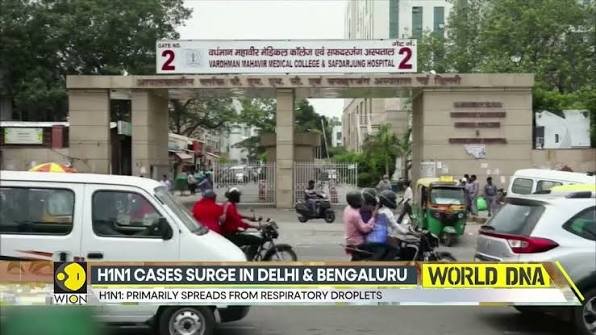
NEW DELHI: H1N1 influenza is making headlines again as cases rise in Delhi and Bengaluru. Delhi has reported 1,777 H1N1 cases up to August 20, 2026, with H1N1 accounting for most of the city’s reported Influenza A infections this year. Importantly, the Indian Council of Medical Research (ICMR) has said the circulating virus is not a new H1N1 strain and matches the vaccine strain recommended for the current Northern Hemisphere season.
Bengaluru, meanwhile, has seen notable clusters of influenza-like illness, including an outbreak at a school where more than 500 students and 21 staff members reported symptoms and two students tested positive for H1N1. Karnataka Health Minister U T Khader has assured the public that there was no need for panic over H1N1 in the state, while confirming that there are currently around 300 to 400 active cases in the state, with a majority reported in Bengaluru.
Delhi has recorded 1,777 H1N1 cases so far this year, including 114 new infections on August 20, as doctors across the capital report a sharp increase in patients with influenza and, in some cases, more complicated disease.
The rise is significant compared with the 229 H1N1 cases recorded during the corresponding period last year. H1N1 has also emerged as the predominant influenza subtype in Delhi this year. Of the 2,392 Influenza A cases reported till August 20, 1,777 were H1N1. The total number of Influenza A and B cases has reached 2,602.
The increase has raised concerns about whether a new or more dangerous strain is circulating. But the Indian Council of Medical Research has clarified that there is no new H1N1 strain in circulation and said there is no cause for panic. ICMR scientists said the H1N1 viruses currently circulating in India have been in circulation since 2025 and are well matched with the vaccine strains recommended for the Northern Hemisphere.
Doctors, however, say the sharp rise in infections is real and that the virus is finding a population that may have less immunity against the minor genetic changes that occur in influenza viruses.
‘Virus is getting the upper hand’
At AIIMS Delhi, Professor of Medicine Dr Animesh says the current surge needs to be understood through the way influenza viruses naturally evolve.
“Influenza viruses are known to undergo variations in their genetic constitution. The virus circulating two or three years ago may have been different, and people would have developed immunity against that variant. With even minor changes in the virus, however, the present population can become susceptible again,” he said.
He said the current clinical picture also appears different from what doctors were seeing a few months ago.
“There is a definite spike in cases compared with two or three months ago. I am seeing around 15 to 20 influenza cases every day in my OPD. Some patients are presenting with respiratory distress and pneumonia, while we are also seeing diarrhoea and complications such as kidney injury,” Dr Animesh said.
Doctors are also seeing secondary infections in some patients after the initial influenza infection has subsided.
“For an infection to occur and spread, there has to be a combination of the agent, the host and the environment. At present, several factors are working in favour of the virus. In that sense, the virus is getting the upper hand,” he said.
Dr Animesh stressed that this pattern is not unusual for influenza, which undergoes relatively small genetic changes over time.
“These subtle variations are a characteristic of influenza. Every few years, a larger number of people become susceptible, which is also why the composition of the influenza vaccine is changed every year,” he said.
‘Not a new or more lethal H1N1 strain’
Dr Ashish Choudhary, Professor and In-charge of Virology at AIIMS Delhi, said the virus now known as pdmH1N1 is genetically different from the H1N1 virus that circulated before the 2009 pandemic.
“The pdmH1N1 strain emerged in 2009, during the swine flu pandemic. Since then, the virus has adapted and become a seasonal influenza virus. It continues to undergo minor mutations and reappears every year,” Dr Choudhary said.
He cautioned against interpreting the current rise as evidence that the virus has become more virulent.
“It is not more virulent or more lethal than what we have seen in previous years. Influenza periodically has years when the peak is larger and the number of cases increases significantly,” he said.
This year’s pattern is also different from 2025. While H3N2 was the predominant subtype in Delhi last year, H1N1 has accounted for the largest share of Influenza A infections this year.
Dr Choudhary said most infections continue to be mild.
“Most cases are mild influenza. There have been deaths, but the proportion is not very high,” he said.
At the same time, doctors in pulmonary and critical-care units are seeing more severe patients, particularly those who already have compromised lungs or other underlying illnesses.
“The pulmonary medicine ICU has seen a higher number of patients with severe disease, particularly those whose lungs are already compromised because of co-morbidities,” Dr Choudhary said.
At AIIMS, around 40 to 50 respiratory samples are being tested each day, with positivity varying between 5 and 15 per cent, he said.

We are a multimedia news network. Website : www.7xnews.com Based in New Delhi (India)
Youtube : umakantlakheraspeaks@gmail.com