

Maharashtra’s Marathi test risks turning cultural pride into coercive exclusion
Language is an important marker of identity. Marathi, like every Indian language, deserves respect, protection and promotion. But there is a profound difference between encouraging people to learn a language and making their livelihood conditional upon passing a state-administered language test.
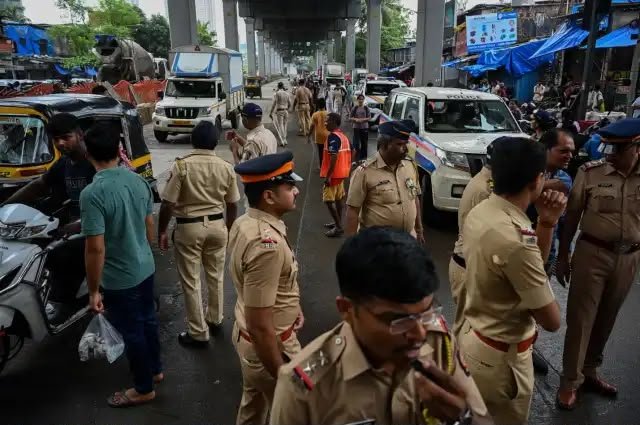
Maharashtra’s current crackdown on auto-rickshaw, taxi and app-based cab drivers who do not demonstrate a “working knowledge” of Marathi has crossed precisely that line. What began as a cultural and communication initiative has now become an enforcement exercise involving roadside tests, notices, possible suspension of driving authorisations and, for continued non-compliance, cancellation. The result is predictable: anxiety among migrant workers, protests, disruption of public transport and a fresh linguistic fault line in Mumbai’s already diverse social landscape.
The question is not whether drivers should learn Marathi. They should—and many already have. The question is whether the state should threaten the livelihood of economically vulnerable citizens to achieve that objective.
From encouragement to coercion
The legal foundation of the present policy is the Maharashtra Motor Vehicles (Third Amendment) Rules, 2026, notified on August 12. The amendment inserted “working knowledge of Marathi language” into the eligibility framework and introduced specific enforcement provisions. For motor cabs fitted with electronic meters, a driver found lacking the required knowledge is to receive one month to acquire it; failure thereafter can lead to suspension of the driving authorisation for up to three months and, in cases of continued non-compliance, revocation, subject to reasons being recorded and an opportunity of being heard. Permit holders and renewals have also been brought within the language requirement.
The government argues that this is not an anti-migrant measure but an attempt to ensure that public-facing transport workers can communicate with passengers. That objective is not unreasonable. Indeed, one legal commentator has described basic Marathi proficiency as legitimate in principle but cautioned that its implementation must be sensitive and balanced.
But proportionality matters. A communication problem cannot automatically become a licensing problem. And a licensing problem should not casually become a livelihood crisis.
A troubling legal history
There is another reason for caution: Maharashtra has been here before.
In 2017, the Bombay High Court struck down a state condition requiring knowledge of Marathi for applicants seeking autorickshaw permits. The court held that the condition was not supported by the Motor Vehicles Act, 1988, or the Maharashtra Motor Vehicles Rules, 1989. The judgment stressed that an eligibility condition imposed by the government must have statutory authority.
The court’s reasoning remains highly relevant even though the state has now amended the rules. The present government has attempted to address the earlier statutory deficiency through an explicit amendment. Yet the constitutional questions have not disappeared.
A fresh PIL filed in the Bombay High Court by four app-based cab drivers argues that the August 12 notification violates Articles 14, 19 and 21 of the Constitution and is beyond the authority granted by the Motor Vehicles Act. The petitioners have also highlighted the consequences for economically vulnerable and migrant drivers, estimating that the rule potentially affects nearly 9.65 lakh drivers across Maharashtra.
The courts will ultimately determine the legal validity of the amended rules. But the constitutional principle at stake is larger: can the State impose a linguistic qualification on a particular category of workers when the penalty for failure is the loss of their occupation?
The class question nobody wants to answer
The policy also exposes an uncomfortable class dimension.
Mumbai is filled with workers who arrive from different parts of India and gradually acquire Marathi through everyday life. Many auto and taxi drivers are first-generation migrants, older men with limited formal education who work long hours to support families. Asking them to learn a handful of functional phrases is one thing. subjecting them to an official test, potentially followed by suspension of their earning capacity, is quite another.
Why should the burden of linguistic integration fall so heavily on the working poor?
A multinational executive transferred to Mumbai is not subjected to an RTO language examination before drawing a salary. A highly paid professional in a corporate office does not risk losing employment because he cannot conduct a conversation in Marathi. Yet a driver earning his living on Mumbai’s roads can be stopped and examined by an official.
If linguistic inclusion is truly the objective, it should not become a uniquely punitive requirement for the least powerful.
When the examination itself becomes arbitrary
The government has made considerable efforts to train drivers. Reports indicate that roughly 1.65 lakh non-Marathi-speaking autorickshaw and taxi drivers participated in a 105-day training campaign, while about 1.25 lakh had completed the programme by August 15; thousands were still awaiting completion or required to reappear.
That effort deserves recognition. But the implementation has exposed serious questions.
RTO teams began roadside testing on August 20 using everyday situations: asking a driver to start the meter, state the fare, explain travel time, accept payment, identify a destination or respond to routine passenger requests. On the first day, 8,217 drivers were reportedly assessed and 1,268 received notices after failing to demonstrate sufficient Marathi.
The difficulty is that “working knowledge” can become subjective unless the assessment is standardised, transparent and independently monitored.
Some drivers who attended government-supported classes have complained that officials asked questions beyond the phrases covered in training. The local newspapers reported drivers questioning how they could be expected to sustain a full conversation when they had been trained in a limited set of practical expressions. These newspapers have similarly reported complaints of “out-of-syllabus” questions.
If the government teaches 16 practical phrases and then tests something substantially broader, the problem is not the driver. It is the examination system.
From official enforcement to street-level intimidation
The most disturbing consequence is what happens outside the RTO.
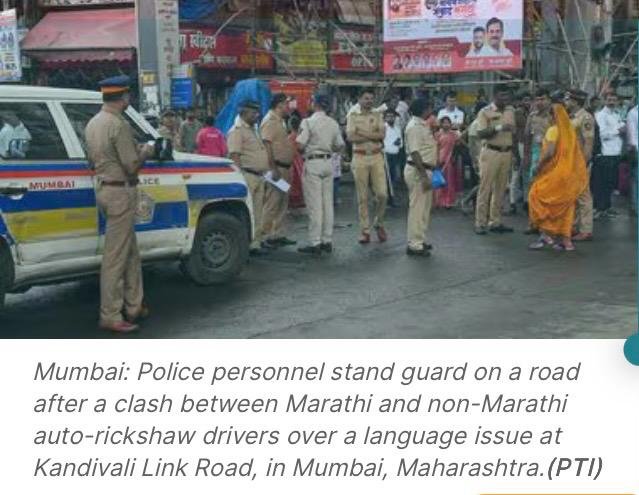
A state policy can unintentionally legitimise social vigilantism when language becomes a badge of belonging. Non-Marathi-speaking drivers in Kandivali alleged that fellow drivers were stopping and warning them to learn Marathi “by hook or by crook”. They subsequently blocked Kandivali Link Road in protest.
Such allegations must be investigated rather than dismissed. At the same time, any violence or coercion against Marathi-speaking drivers during protests is equally unacceptable. Reports and social-media claims surrounding the agitation have produced competing narratives, demonstrating precisely why the police—not linguistic groups, political organisations or rival driver factions—must enforce the law.
The State cannot simultaneously demand respect for Marathi and allow linguistic identity to become an instrument of intimidation.
Mumbai cannot afford a language war on its roads
The consequences are already being felt by commuters. A section of drivers launched a strike on August 24, with protests and a road blockade in Kandivali. Thousands of commuters reportedly faced difficulty finding autos and taxis during the morning rush, while police detained several protesters.
By August 25, RTOs had reportedly checked 35,190 vehicles and issued 4,729 notices; 331 drivers were reported to have received notices on that day alone, including 139 in the Mumbai Metropolitan Region.
This is an extraordinary administrative mobilisation for a language test—and an expensive one when measured against the social friction it has generated.
Mumbai’s public transport system depends upon the labour of people who speak Marathi, Hindi, Urdu, Gujarati, Tamil, Telugu, Bengali and several other languages. Its strength has historically been precisely this ability to absorb migrants rather than demand linguistic uniformity before allowing them to work.
Marathi deserves love, not fear
There is a compelling case for Marathi proficiency among drivers. Passengers should be able to communicate about destinations, fares, emergencies and complaints. Drivers should understand the language of the city in which they work. But proficiency grows fastest through opportunity, not intimidation.
The government should therefore pause punitive enforcement, establish a genuinely uniform and transparent test, publish the precise syllabus, provide accessible free classes, create special provisions for older and minimally educated workers, permit multiple attempts and ensure that no driver is deprived of livelihood merely because an RTO officer makes a subjective assessment.
Most importantly, the government must distinguish between refusal to learn and inability to learn quickly.
A Marathi-speaking Maharashtra does not require a Marathi-only workforce. Maharashtra’s linguistic pride is strongest when it is confident enough to welcome those who arrive from elsewhere and teach them its language without threatening their bread.
The State’s duty is not to decide who belongs by accent. It is to ensure that every citizen—local or migrant—can work with dignity, travel safely and live without fear.
Marathi can be promoted without making a licence a linguistic passport. Mumbai has always been at its best when its many languages meet at the same traffic signal. The government should be careful not to turn that traffic signal into a checkpoint of belonging.

~Hasnain Naqvi is a former member of the history faculty at St. Xavier’s College, Mumbai….
The opinions expressed here are solely those of the author.

