

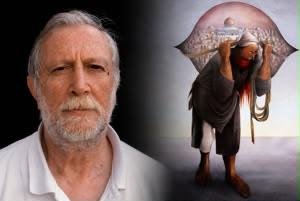
Sliman Mansour, the visual architect of Palestinian steadfastness, died in occupied East Jerusalem on 24 August 2026 at the age of 79, leaving behind a half-century of work that turned paint, mud and memory into an unbreakable language of belonging. In a landscape where even the colours of a flag could be criminalised, Mansour refused to let his people be erased from their own story.
A Life Forged on the Edge of the Nakba
Born in Birzeit in 1947, a year before the cataclysm of the Nakba, Mansour grew up in a world where displacement was not an abstraction but a lived reality. He studied at the Bezalel Academy of Arts and Design in Jerusalem in 1970, yet his true education came from the olive groves, the refugee camps and the quiet defiance of ordinary Palestinians. “Art is a form of saying that we are here,” he told Al Jazeera in 2021, articulating a creed that would guide every brushstroke.
The Camel That Carried a Nation
In 1973, at the age of 26, Mansour painted Jamal Al-Mahamil (Camel of Hardships), an oil on canvas that would become the most reproduced image in modern Palestinian art. The painting depicts an elderly porter, bent but unbowed, carrying the weight of Jerusalem on his back as he traverses an endless blue expanse. Distributed as a poster by the Palestine Liberation Organization in 1975, it hung in homes from the West Bank to Gaza, from the Galilee to refugee camps across the diaspora, becoming a secular icon of exile and endurance.
The work’s power lay in its simplicity: a single figure, a single burden, a single truth. It was not a lament but a declaration—that the land, however occupied, remained alive in the bodies and memories of those who carried it.
Banned Colours, Unbanned Spirit
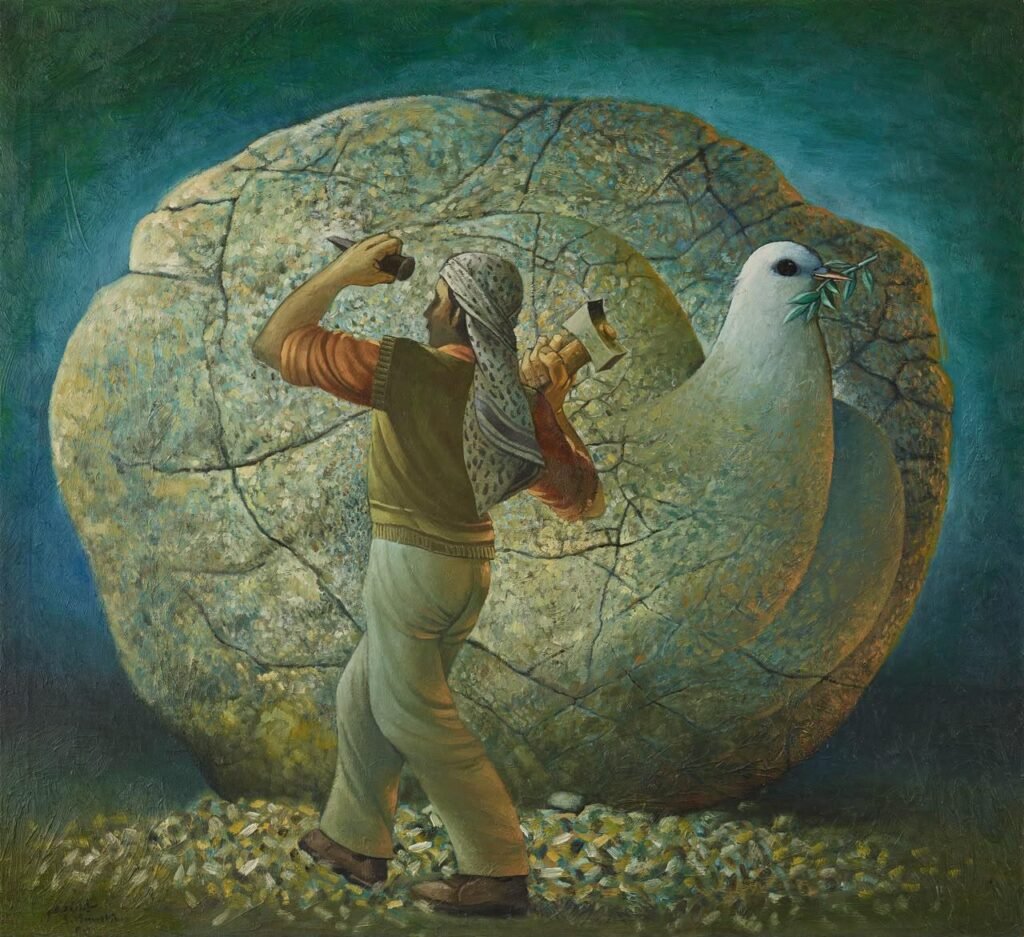
Under Israeli military rule, Palestinian cultural expression was systematically policed. Displaying the Palestinian flag was criminalised; artists were forbidden from using the four colours—red, black, white and green—together on a single canvas. Mansour’s exhibitions were raided, his paintings confiscated, and those who sold prints of his work faced imprisonment.
Yet censorship sharpened his resolve. When art supplies were restricted during the First Intifada, Mansour co-founded the “New Visions” collective in 1987, leading a boycott of Israeli suppliers and turning instead to the earth itself. The group created works using locally sourced mud, clay, straw, coffee and henna, transforming the soil of Palestine into pigment and protest. In Mansour’s hands, the land literally became the medium of its own testimony.
Women as Monuments, Land as Witness
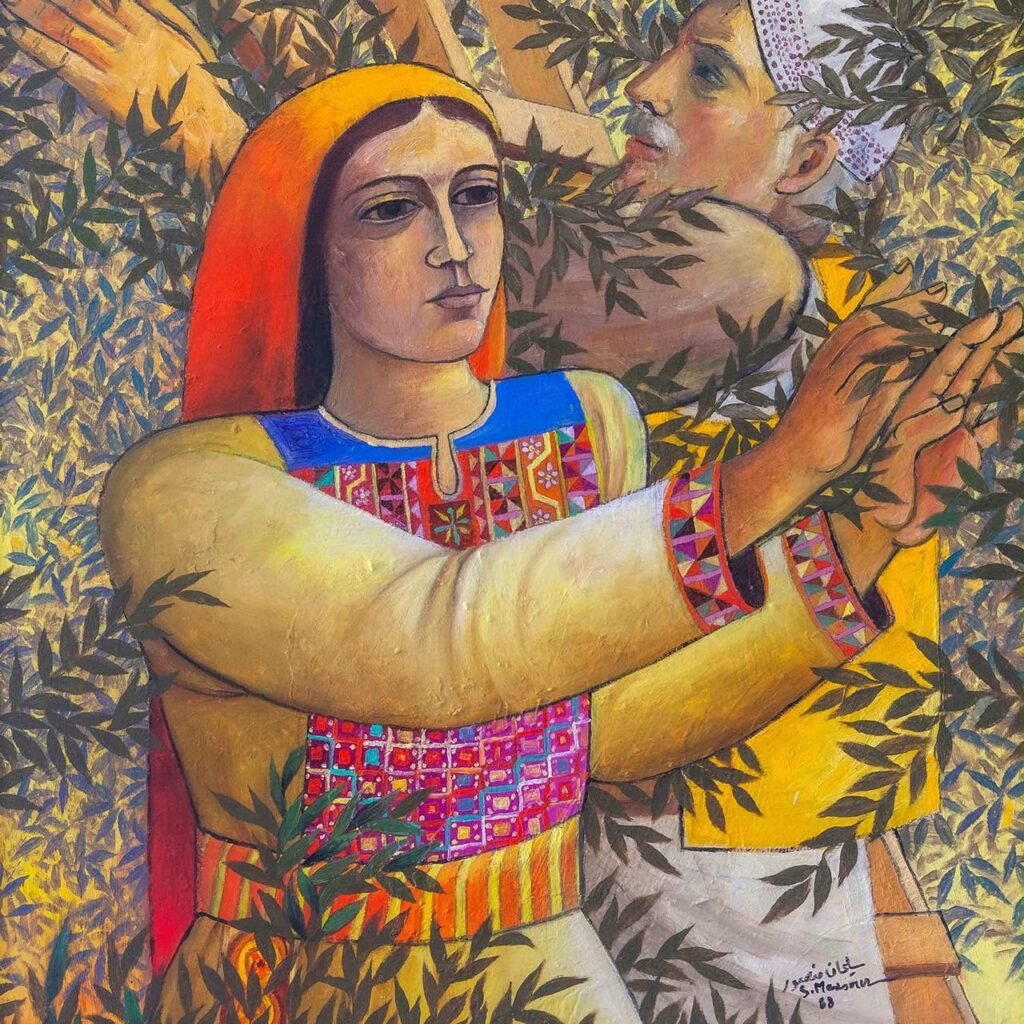
Mansour’s canvases rejected the delicate, orientalist depictions of Palestinian women common in Western art. Instead, he painted working women in traditional embroidered thobes, their hands strong and weathered, their presence monumental. They were not symbols of victimhood but of resilience—the true carriers of the land and the revolution.
His landscapes were equally defiant: lush olive harvests, orange groves, the glistening domes of Jerusalem rendered not as scenery but as evidence of an unbroken connection to place. Every brushstroke was a rebuttal to the myth of a “land without a people.”
Building the Infrastructure of Memory
Mansour’s legacy extends beyond his own work to the institutions he helped build. He served as head of the League of Palestinian Artists, co-founded the Al-Wasiti Art Center in East Jerusalem in 1994 to preserve Palestinian art and connect artists in exile with those in the homeland, and taught generations of visionaries at Al-Quds University.
These were not ancillary acts but central to his project: ensuring that Palestinian art would not depend on the goodwill of occupiers but would have its own foundations, its own schools, its own future.
A Funeral in Birzeit, a Legacy Everywhere
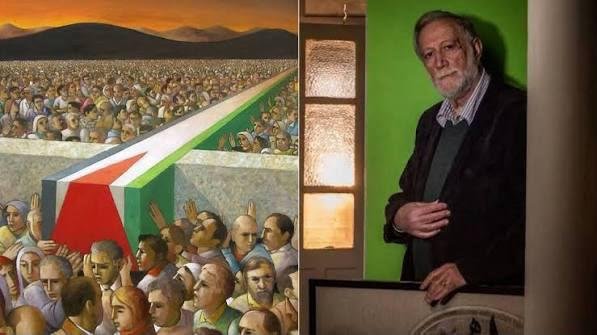
Mansour’s funeral was held on 26 August 2026 at St Peter’s Church in Birzeit, his hometown, with condolence gatherings at the Palestinian Museum and in Jerusalem. Tributes poured in from across the Arab world, hailing him as a “giant of Palestinian and Arab art” whose work had become an enduring symbol of identity, resistance and connection to the land.
He is to Palestinian visual art what Mahmoud Darwish is to its poetry: a guardian of collective memory, a maker of symbols that outlive their creators.
The Indestructible Witness
Sliman Mansour leaves the world more beautiful and more resolute than he found it. His brush may be laid to rest in the Jerusalem he so fiercely protected, but his art remains an indestructible witness to a homeland that will not disappear. In every reproduction of the Camel of Hardships, in every mural painted with mud and henna, in every young artist who picks up a brush in Birzeit or Beirut, Mansour’s voice continues: We are here. We remember. We remain.

~Hasnain Naqvi is a former member of the history faculty at St. Xavier’s College, Mumbai….
The opinions expressed here are solely those of the author.