

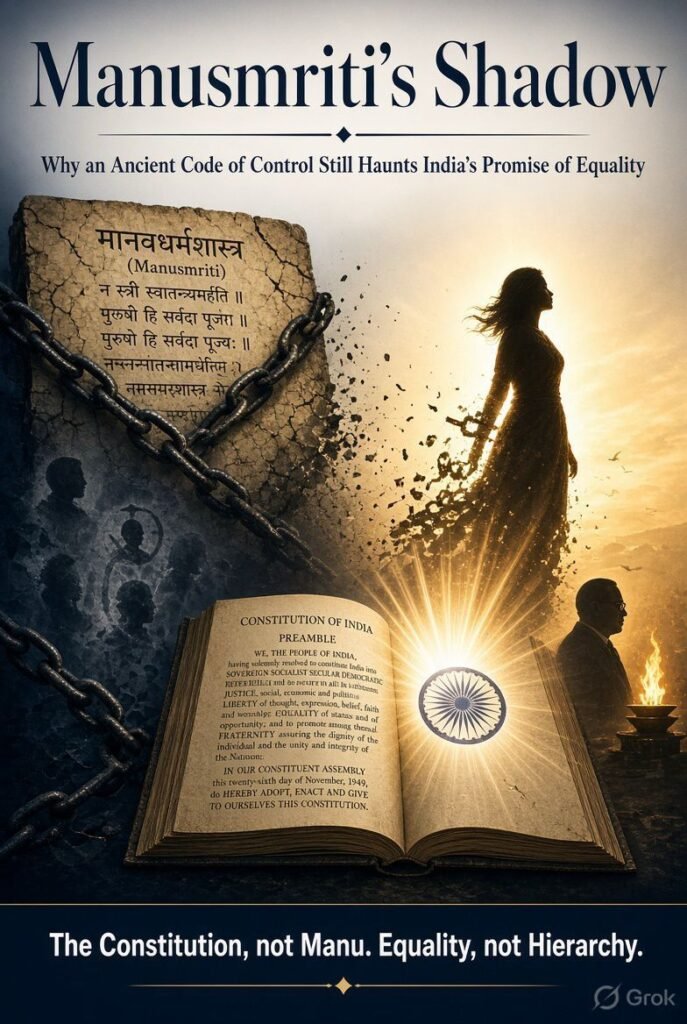
In the long arc of India’s social thought, few texts have cast a longer and darker shadow over the lives of women and the lower castes than the Manusmriti. Composed roughly between 200 BCE and 200 CE, this Dharmashastra did not merely prescribe personal conduct; it codified a hierarchical vision of society in which birth determined worth, and gender determined subordination. Its enduring power lies not in daily recitation by ordinary citizens, but in the ideological scaffolding it has provided for those who seek to naturalise inequality as dharma—and in the explicit preference some political currents have shown for it over the Constitution itself.
The Architecture of Lifelong Dependence
Central to the text’s treatment of women is the doctrine of perpetual guardianship. Verse 9.3 states that a female must remain subject to her father in childhood, her husband in youth, and her sons in old age; a woman is never fit for independence. This is not an isolated injunction. Across chapters, women are described as inherently restless, prone to seduction, and in need of constant male supervision. Their property rights are curtailed; a wife, a son and a slave are declared to have no independent wealth of their own. Corporal punishment is permitted. Even the celebrated verse that gods rejoice where women are honoured (3.55) functions, as feminist scholars such as Uma Chakravarti have shown, more as ritual idealisation than genuine autonomy. Honour is conferred on the woman who remains pure, obedient and confined within the household.
Education fares no better. Verses 2.66–67 replace the Vedic initiation (upanayana) for girls with marriage itself. The husband’s service becomes the equivalent of residence with a teacher; household duties stand in for the student’s tending of the sacred fire. Medhatithi’s classical commentary makes the exclusion explicit: without residence with a teacher there can be no study of the Veda. Women are thus denied the very knowledge that conferred ritual and intellectual status in the Brahmanical order. Their primary sacrament is matrimony; their lifelong vocation is domestic labour and the production of legitimate heirs.
Caste Purity and the Control of Women’s Bodies
The subordination of women is inseparable from the preservation of caste hierarchy. Endogamy—the rule that marriages must remain within the varna—depends on rigorous control of female sexuality and mobility. A higher-caste woman’s union with a lower-caste man (pratiloma) was treated as a near-cosmic offence precisely because it threatened to pollute the lineage. As Ambedkar argued in his early writings and as later scholars have elaborated, the regulation of women’s bodies became the mechanism for reproducing the entire graded inequality of the varna system. Child marriage, enforced widowhood and the denial of remarriage were not incidental cruelties; they were logical outcomes of a system that treated women as the biological gatekeepers of purity.
Dr B.R. Ambedkar recognised this with unmatched clarity. On 25 December 1927, during the Mahad Satyagraha, he and his followers publicly burned a copy of the Manusmriti. The act was neither impulsive nor merely symbolic theatre. Ambedkar had concluded that the text offered no foundation for social equality. It prescribed servility for Shudras, denied them education and property, and reduced women of all castes to perpetual minors. Burning it was a deliberate rejection of the ideological source of untouchability and gender slavery. He later observed that Manu was not a dead letter of the past but a “living past” that continued to shape Hindu social conduct.
Resistance to the Constitutional Order
That living past did not fade after Independence. Four days after the Constituent Assembly finalised the Indian Constitution, the RSS English mouthpiece Organiser published a sharply critical editorial on 30 November 1949 titled “Constitution.” It dismissed the document as lacking anything “Bhartiya,” charging that it merely borrowed Western models while ignoring ancient Indian principles, and explicitly praised the Manusmriti whose laws, it claimed, commanded global admiration and obedience. This stance formed part of a wider ideological pushback against B.R. Ambedkar’s secular framework: M.S. Golwalkar later dismissed the Constitution as a Western patchwork in Bunch of Thoughts, V.D. Savarkar advocated the Manusmriti as the foundational text for Hindu law, and the Organiser itself returned to the theme on 6 February 1950 with an article titled “Manu Rules our Hearts,” asserting that Hindu society continued to be governed by the Smritis.
The contrast could not have been starker. The Constitution that Ambedkar steered into existence guaranteed equality before the law, prohibited discrimination on grounds of sex and caste, and opened the door to progressive personal-law reform. The Manusmriti, by design, did the opposite. Preference for the latter over the former was never a matter of antiquarian curiosity; it was a political choice about the kind of social order India should inherit.
Echoes in Contemporary Discourse
The text’s influence has not vanished. In 2013, RSS chief Mohan Bhagwat described marriage as a social contract in which the wife manages the household while the husband earns and protects. The language of complementary duties, framed as natural order, resonates uncomfortably with Manusmriti’s assignment of roles. Defenders of the text often point to selective verses of respect or argue that it was never uniformly enforced. Yet the pattern of prescription is consistent: women are valued as mothers, wives and daughters within a male-headed household, never as independent agents with claims to education, property or self-determination equal to those of men.
Contemporary scholarship reinforces the critique. Studies examining sexual and reproductive health rights find that Manusmriti’s injunctions systematically deny bodily integrity, the right to contraception, divorce and free expression of sexuality. The text constructs women as sexually dangerous and in need of containment. Even where later commentaries or other Smritis introduced modest modifications, the foundational architecture of dependence remained intact.
Constitutional Morality versus Scriptural Hierarchy
India’s Constitution stands as the most comprehensive repudiation of this vision. Equality before the law, the prohibition of discrimination on grounds of sex and caste, the right to education, and the progressive reforms embodied in the Hindu Code Bills that Ambedkar championed as Law Minister all contradict the Manusmriti’s core assumptions. Constitutional morality demands that individuals be treated as ends in themselves, not as instruments for the preservation of lineage or ritual purity.
To defend the Manusmriti today is therefore not a neutral exercise in historical appreciation. It is to elevate a document that systematically stripped women of agency and cemented hereditary hierarchy as the organising principle of society—and to align, whether consciously or not, with those who, in the very hour of the Republic’s birth, preferred Manu’s code to Ambedkar’s Constitution. Selective quotation of honourific verses cannot erase the cumulative weight of prescriptions that denied independence, education and property. Nor can claims of misinterpretation withstand the consistent testimony of the text itself and of those who suffered under the social order it legitimised.
The proper place of the Manusmriti is the archive and the seminar room, where it can be studied as a historical artefact of Brahmanical patriarchy. It has no claim on the moral and legal imagination of a republic founded on liberty, equality and fraternity. Those who continue to idolise it reveal more about their own attachment to hierarchy than about the civilisational wisdom they claim to defend. India’s future belongs to the Constitution, not to a code that never allowed half its population to stand free.

~Hasnain Naqvi is a former member of the history faculty at St. Xavier’s College, Mumbai….
The opinions expressed here are solely those of the author.