

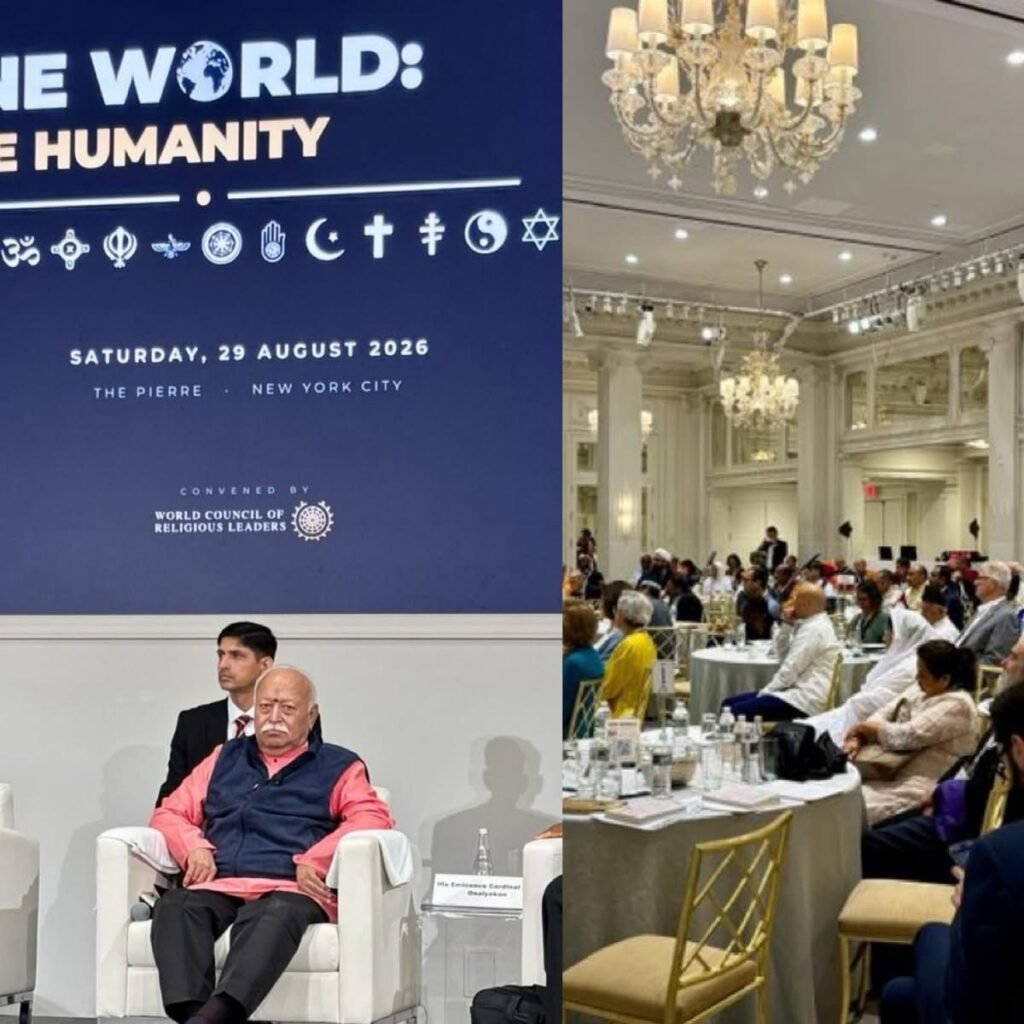
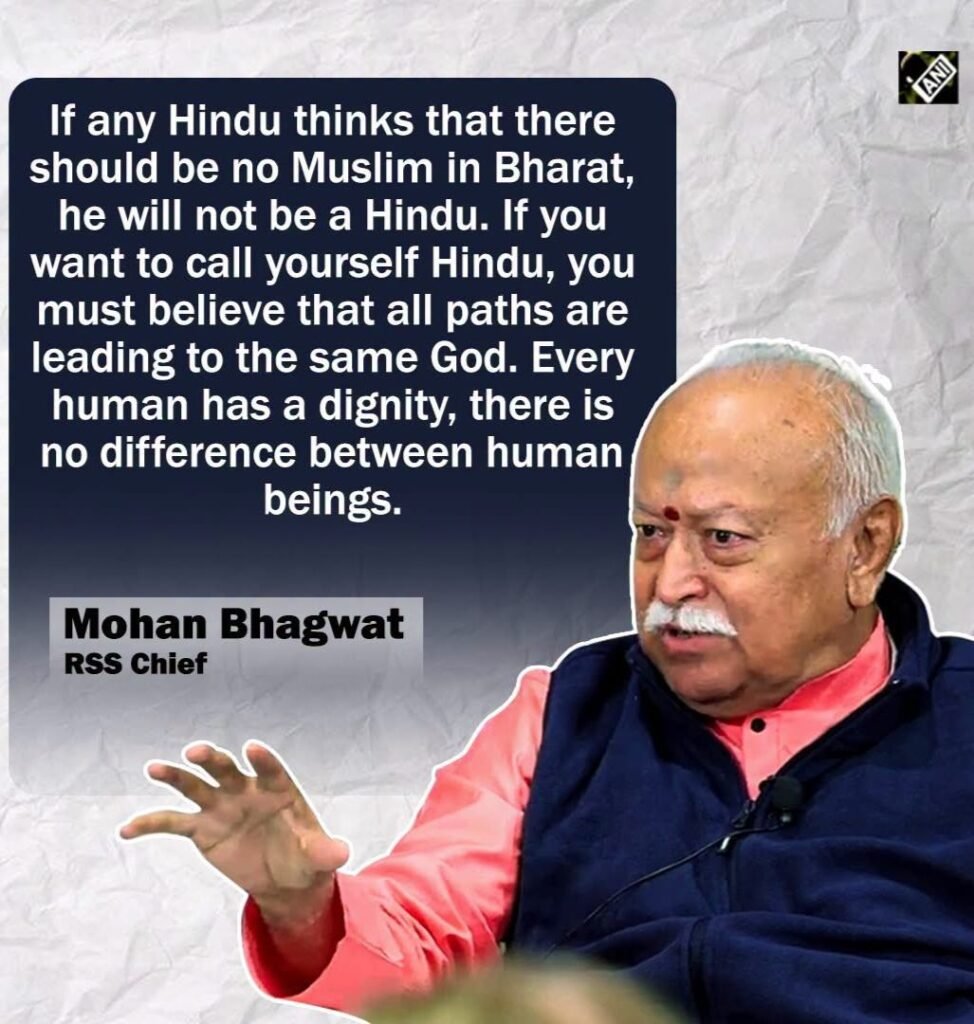
On a late-August Saturday at Madison Square Garden, RSS chief Mohan Bhagwat stood before thousands of Indian Americans to proclaim a simple, seductive truth: “Humanity is one.” He invoked Vasudhaiva Kutumbakam—“the world is one family”—and insisted that any Hindu who dreams of a Muslim-free India “ceases to be a Hindu.” It was a stirring performance of universal oneness, staged in the very arena where Prime Minister Narendra Modi made his U.S. debut in 2014. Yet for those who track the RSS’s record at home, the New York sermon read less like a moral awakening and more like a well-rehearsed act of image management.
The Script Abroad, the Subtext at Home
Bhagwat’s Madison Square lines were not new. He delivered a near-identical message in 2018, and again in 2021 when he claimed all Indians share the same DNA. Each time, the inclusive rhetoric was followed by the same old Hindutva soundtrack: “love jihad,” “population jihad,” temple-mosque disputes, and the steady drumbeat of demographic anxiety. The words change with the audience; the ecosystem does not.
At MSG, Bhagwat spoke of dialogue, dignity, and a Hindu society that “does not discriminate by religion.” Back in India, the Sangh Parivar’s political arm governs with a majoritarian confidence that often treats Muslims as cultural outsiders—“Babur’s descendants,” “children of invaders,” or at best, guests in a Hindu Rashtra. Service projects may be open to all, but the cultural narrative remains one of “us” versus “them.”
The Silence That Speaks
The most damning critique is not what Bhagwat said in New York, but what he has not said in India. When cow vigilantes lynched Muslims, when mobs attacked minorities, when hate speech flooded social media, the RSS chief’s voice was conspicuously absent. He has never issued a clear, forceful condemnation of cow-vigilante violence or mob lynchings. Instead, the RSS’s own publications and affiliates continue to frame Muslims as a demographic threat and a cultural challenge.
This selective silence is not an accident; it is a strategy. Abroad, the RSS sells itself as a cultural volunteer organisation devoted to service and spirituality. At home, it functions as the ideological parent of the BJP, shaping curricula, rewriting history, and normalising a Hindu-first worldview. The result is a classic double speak: universal brotherhood on international stages, majoritarian politics on domestic soil.
The Constitutional Reality
Indian Muslims do not need Bhagwat’s reassurance that they belong in India. They are equal citizens under the Constitution, a fact that no organisation can revise. The RSS, founded in 1925 in the aftermath of Nagpur’s communal riots, has built much of its politics on the suspicion of minorities. Its record—from the 1920s to the present—tells a different story than the one told at MSG.
The deeper problem is ideological. What India needs from the RSS is not another speech about oneness, but an honest reckoning with the hatred it has cultivated. Until the organisation names that sickness for what it is, its words will continue to ring hollow.
The American Context
The Madison Square event was organised by the AHEAD Forum, a coalition of more than 200 Hindu American groups. It was marketed as a celebration of Raksha Bandhan and the ancient Sanskrit ideal of Vasudhaiva Kutumbakam. But outside the arena, a coalition of civil rights, faith, and community organisations protested, calling the visit a “goodwill tour” for Hindu nationalism.
New York Mayor Zohran Mamdani opposed the event, and a U.S. religious freedom commissioner warned that Bhagwat was “complicit in religious freedom violations.” The commission’s statement was blunt: the RSS’s ideology and actions violate the religious freedom of minorities. This is not a fringe critique; it is a mainstream concern.
The Verdict
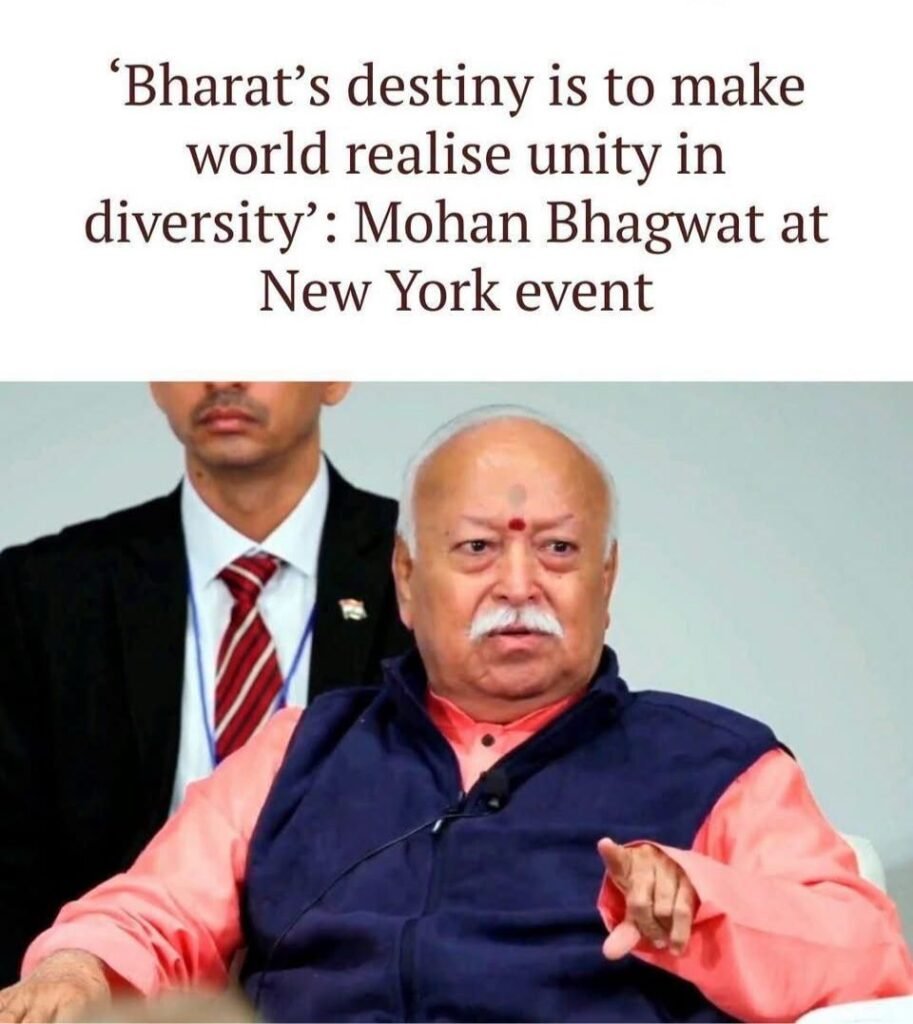
Bhagwat’s Madison Square speech was a masterclass in rhetorical finesse. He spoke of unity, diversity, and the shared destiny of India and America. He quoted the Upanishads and invoked the moral authority of ancient wisdom. But for those who know the RSS’s record, the speech was a familiar performance: inclusive words, exclusionary practice.
The truth lies in the examination of both words and actions. Until violence, hate speech, and the “us versus them” mindset reduce on the ground, statements made in New York will continue to be seen by critics as image-management rather than genuine change. The RSS’s double speak is not a bug; it is a feature. And until the organisation confronts its own contradictions, its sermons of oneness will remain just that—sermons.

~Hasnain Naqvi is a former member of the history faculty at St. Xavier’s College, Mumbai….
The opinions expressed here are solely those of the author.