

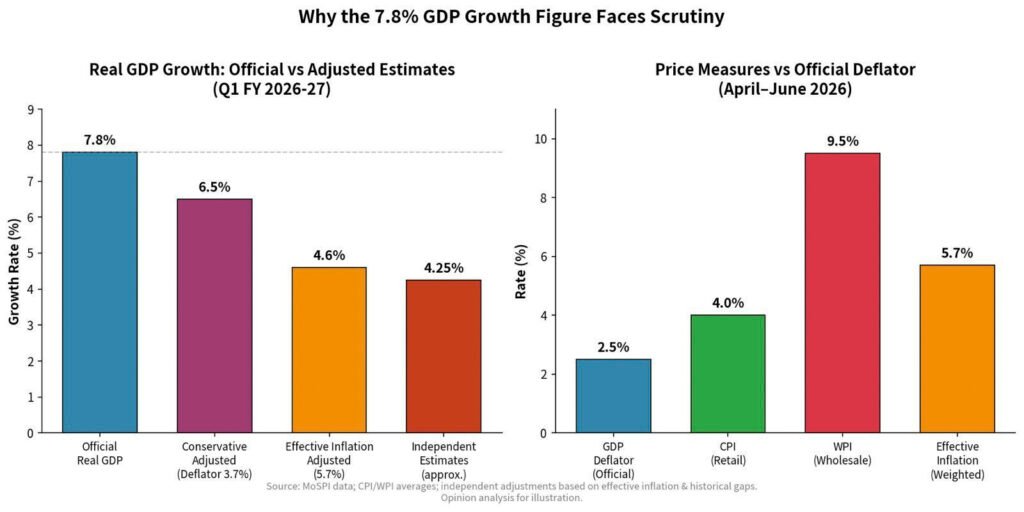
The official announcement that India’s economy expanded 7.8 per cent in the April–June quarter of 2026–27 has been greeted with predictable celebration. Manufacturing is said to have risen 9.2 per cent, financial services 12.1 per cent, and gross value added 8.2 per cent. The government has described the print as a herculean feat achieved despite oil shocks and global uncertainty. Yet a closer examination of the arithmetic, the price data and the long-standing methodological weaknesses flagged by independent economists and international assessors suggests the real expansion is considerably lower.
The Headline Number and the Deflator Puzzle
Nominal GDP grew 10.3 per cent in the same quarter. The difference between the two figures is the GDP deflator—the national accounts’ own measure of economy-wide inflation—which works out to roughly 2.3–2.5 per cent. That number sits uncomfortably with lived experience and with other official price indices. Retail inflation (CPI) averaged close to 4 per cent across the quarter, rising to 4.38 per cent in June. Wholesale price inflation (WPI) hovered near 9.4–9.9 per cent, driven by fuel, basic metals and chemicals.
If two-thirds of the economy is more closely linked to retail prices and the remainder to wholesale prices, an effective inflation rate closer to 5.5–5.7 per cent emerges. Applying that rate to the nominal growth of 10.3 per cent yields real growth nearer 4.6 per cent.
What a More Conservative Adjustment Still Shows
Even a more cautious approach produces a lower figure. Historically the gap between the official deflator and a simple weighted average of CPI and WPI has rarely exceeded two percentage points. Using the higher of those past gaps still leaves an adjusted deflator of about 3.7 per cent and real growth of roughly 6.5 per cent—well short of the headline 7.8 per cent. Analyses that examine real gross domestic income, which accounts for the terms-of-trade loss caused by expensive oil imports, place the underlying expansion even lower, in the 3–3.5 per cent range.
Long-Standing Methodological Concerns
These discrepancies are not new. The International Monetary Fund has for consecutive years assigned India’s national accounts statistics a ‘C’ grade—the second-lowest on its scale—citing methodological shortcomings that somewhat hamper surveillance. The Fund has repeatedly pointed to an outdated base year (until the recent shift), heavy reliance on single rather than double deflation, limited coverage of the informal sector, and persistent, unexplained discrepancies between production-side and expenditure-side estimates. Although the new series with 2022–23 as base year introduces double deflation for manufacturing and broader data sources, the latest quarterly print still shows a deflator far below both CPI and WPI, and sizeable statistical discrepancies remain.
What Economists and Experts Are Saying
Former Finance and Economic Affairs Secretary Subhash Chandra Garg has long argued that official real growth systematically overstates the underlying expansion. In earlier assessments he has placed true growth several percentage points below the published numbers once inflation is properly accounted for. Professor Arun Kumar of Jawaharlal Nehru University has been equally direct. He notes that the large unorganised non-agricultural sector—roughly 30 per cent of the economy—is still estimated largely by projecting organised-sector performance. When the two sectors move in opposite directions, as they have after successive shocks, the result is systematic over-estimation. Kumar’s cumulative calculations suggest that over the past decade actual GDP may be substantially lower than the official series implies, and that recent quarterly growth rates are correspondingly inflated.
Growth Without Broad-Based Gains
The quality of growth is equally telling. Headline expansion has been accompanied by limited evidence of broad-based job creation in manufacturing and formal services. Large sections of the population continue to rely on free foodgrain distributions covering roughly 800 million people. Prices of essential commodities have risen sharply, foreign travel and discretionary gold purchases have moderated, and public messaging has emphasised austerity. These are not the signatures of an economy racing ahead at nearly 8 per cent. Per capita income growth, the metric that ultimately matters for living standards, remains modest; wealth gains have been concentrated among a relatively small set of large corporate houses.
The Case for Credible Measurement
None of this is to deny that certain organised sectors have performed strongly or that government capital expenditure has provided support. The point is simpler and more fundamental: the real volume of economic activity, once price changes are measured consistently with other official indices and once the informal sector is treated with greater care, is significantly weaker than the 7.8 per cent figure suggests. Independent estimates clustering around 4–4.5 per cent, or at best the mid-6 per cent range under the most generous assumptions, better capture the economy’s underlying pulse.
Reliable statistics are the foundation of sound policy. When the official growth number rests on an unusually soft deflator, when international assessors continue to flag methodological gaps, and when independent economists using the same public data arrive at markedly lower rates, the claim of robust expansion requires far greater scrutiny than it has so far received. India’s citizens deserve an honest measure of how much their purchasing power and employment prospects are actually improving—not a statistical performance that looks impressive mainly because the inflation subtraction has been set unusually low.

~Hasnain Naqvi is a former member of the history faculty at St. Xavier’s College, Mumbai….
The opinions expressed here are solely those of the author.

