

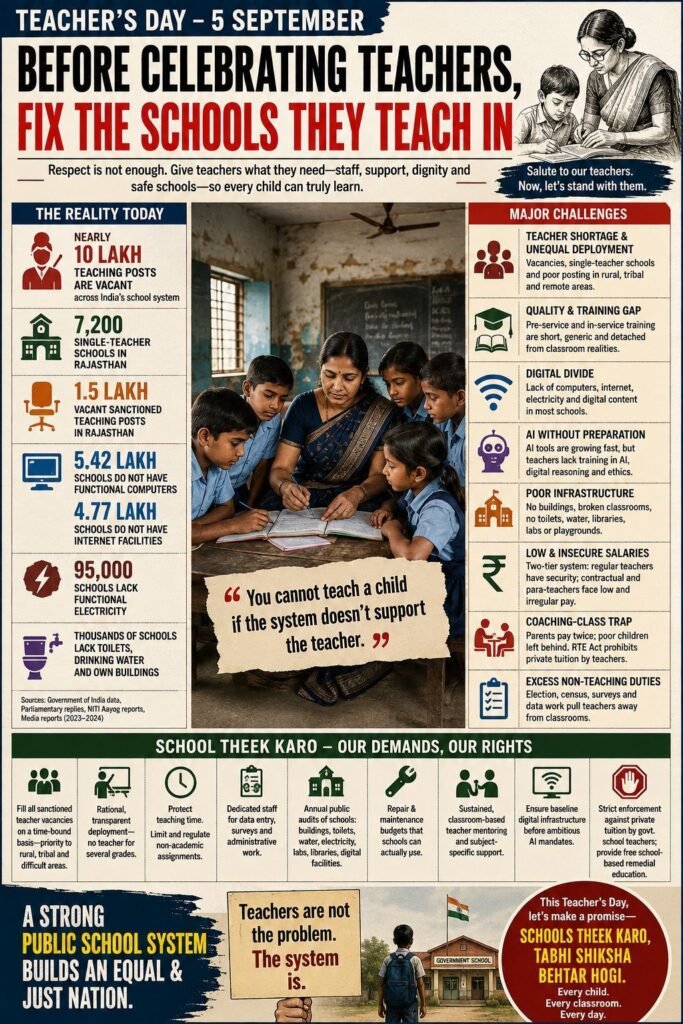
Teacher’s Day should not become an annual ritual of flowers, speeches and sentimental tributes while the Indian teacher is asked to compensate for vacant posts, crumbling classrooms, administrative overload and a rapidly changing technological world. The crisis is not merely of individual teachers; it is of a public-school system that too often makes teaching the least supported part of education.
The missing teacher
India’s education debate routinely speaks of enrolment, boards, examinations and new curricula. But every promise ultimately arrives in a classroom through a teacher—and in far too many classrooms, the teacher is either absent because the post is vacant, unavailable because of official deployment, or overwhelmed by having to teach several grades at once.
The latest evidence points to a deep staffing crisis. Government data and parliamentary material cited in recent reporting indicate that nearly 10 lakh teaching posts are vacant across the school system; NITI Aayog has separately identified teacher shortages, uneven deployment and single-teacher schools as structural obstacles to quality education. Rajasthan illustrates the severity: it reportedly has about 7,200 single-teacher schools and roughly 1.5 lakh vacant sanctioned posts.
This is not a minor administrative lapse. A single teacher handling multiple grades cannot reasonably be expected to give children individual attention, conduct assessments, meet parents, prepare lessons, maintain records and support children who are behind in reading or numeracy. Multi-grade teaching may be a pedagogic choice in a small, well-supported setting; in an understaffed Indian school, it is usually an imposed survival strategy.
Teacher deployment is also unequal. Remote rural, tribal and poorer districts frequently lose out, while the system’s better-connected urban locations find it easier to attract and retain staff. NITI Aayog’s diagnosis is therefore important: the problem is not simply the aggregate number of teachers, but where they are posted, whether they are trained for the grades and subjects they teach, and whether they receive meaningful academic support.
Quality cannot be wished into being
The usual public complaint is that teachers lack commitment. That accusation is too easy—and often unfair. A more serious question is whether the system equips teachers to do the job it demands of them.
Teacher quality depends on sound pre-service education, regular professional development, subject knowledge, mentorship, manageable class sizes, adequate materials and time to teach. Yet NITI Aayog has warned that teacher-development programmes are often short, generic and detached from classroom realities. The consequence is familiar: teachers are instructed to move from rote learning to competency-based education, from textbook delivery to experiential learning, and now towards technology-enabled instruction—without always receiving the sustained preparation, resources or institutional backing needed for that transition.
This is especially damaging at the foundational stage. Children who do not acquire reading comprehension and basic numeracy early are likely to carry that deficit across their school years. The teacher facing such a classroom needs specialist support and time for remedial work, not more portals to update, registers to fill and surveys to complete.
Professional development should not be treated as an online compliance certificate. It must involve classroom observation, peer learning, subject-specific mentoring and local-language resources. A teacher in a remote primary school needs practical help in teaching a mixed-age classroom; a secondary science teacher needs laboratory access and discipline-specific support. One-size-fits-all “training” answers neither need.
Computers without connectivity
Digital India’s education promise remains sharply unequal. Government data cited in recent reports show that 5.42 lakh of India’s 14.67 lakh schools do not have functional computers, while 4.77 lakh do not have internet facilities. In such schools, the language of smart classrooms, adaptive learning and AI tutors can sound less like reform than a reminder of exclusion.
The technology deficit has two layers. The first is physical: electricity, devices, repair arrangements, broadband, projectors and accessible digital content. The second is human: teachers need confidence in using technology not just to display a video, but to design a lesson, assess learning, protect children’s privacy and distinguish reliable knowledge from misinformation.
This is why computer skills cannot be reduced to the ability to open an app or attend a webinar. Digital competence includes data literacy, troubleshooting, content creation, cyber safety, accessibility and critical judgment. Research on teacher education in India has found that focused digital-pedagogy interventions can improve teachers’ technology attitudes, operational skills, ethics and data literacy—evidence that capacity can be built when training is structured and sustained.
Maharashtra’s plan to train more than four lakh teachers in AI literacy and digital technologies is an acknowledgment of the scale of the gap. But training must travel alongside infrastructure. It is futile to teach a teacher how to use an AI-enabled learning platform in a school where internet access is intermittent, computers are non-functional, and a classroom has no reliable fan, drinking water or usable toilet.
The AI challenge
Artificial intelligence presents both a possibility and a warning. Used responsibly, it can help teachers generate differentiated worksheets, translate material, provide administrative support, assist with feedback and identify learning gaps. Government initiatives such as SOAR aim to build AI awareness among students and educators, including responsible and inclusive classroom use.
But AI cannot be introduced as a shortcut around the teacher shortage. The NITI Aayog report warns that the rapid growth of AI tools has outpaced curriculum and teacher-preparation systems, and that teachers are rarely trained to teach foundational AI concepts or digital reasoning. That gap has consequences: children may use powerful tools without learning how to question their biases, verify outputs, protect privacy, cite sources or recognise fabricated information.
The essential principle is simple: AI should augment teachers, not substitute for them. It should reduce repetitive paperwork, not add a new reporting burden. It should support professional judgment, not turn learning into automated content consumption. And it should never deepen the divide between a well-connected private school and a government school struggling for a working computer.
Schools without basic dignity
The country’s school crisis is also a crisis of physical dignity. Recent official data cited in reporting show that 95,000 schools lack functional electricity. In Rajasthan, government data reportedly record hundreds of schools without their own buildings, thousands without toilets or drinking water, and large numbers of dilapidated classrooms and toilets requiring repair.
A school building is not an optional extra to learning. A classroom with a leaking roof, overcrowding, oppressive heat or broken furniture is an argument against concentration. The absence of safe sanitation has a direct bearing on attendance, especially for adolescent girls. Lack of water, boundary walls, ramps, libraries, laboratories and sports space affects safety, inclusion and the everyday experience of childhood.
The recent student protests over no teachers, no toilets, fans, buildings and basic facilities are therefore a powerful rebuke to official complacency. Children are articulating what policy documents often obscure: a school cannot be “transformed” by an app if it remains physically unfit for learning.
Salaries and the two-tier profession
It is misleading to speak of one Indian teacher’s salary. Regularly appointed central and many state-government teachers have formal pay scales and greater job security. But a substantial part of the school workforce—particularly in private, low-fee, contractual or para-teacher arrangements—faces low, irregular or insecure remuneration.
The salary question is not only about fairness to teachers. It affects who enters and stays in the profession. When trained teachers are poorly paid, denied stability or made to work excessive hours, the system encourages attrition and undermines professional autonomy. It also creates a two-tier teaching force: one with relative protection, another vulnerable to arbitrary contracts and low wages.
This disparity should not become an excuse to attack public-school teachers as “overpaid.” The correct response is to ensure fair, timely and transparent compensation across the profession, linked to qualifications, experience, workload and social-security protections. Better salaries must also be paired with credible accountability, professional support and a humane workload.
The coaching-class trap
The mushrooming coaching economy is perhaps the clearest sign of public distrust in regular schooling. Families who can afford it increasingly pay twice: once through taxes or school fees, and again for tuition. Those who cannot afford it are left to compete in an education culture that increasingly treats the classroom as insufficient.
The trend is socially unequal. Reporting from Odisha cited claims that private tuition had made children dependent on coaching and imposed a financial burden on economically weaker families; it also referred to estimates of extensive reliance on tuition in both rural and urban areas. The dependence grows when schools are understaffed, classes are large, examinations remain high-stakes and parents conclude that individual attention is available only for a fee.
There is an additional ethical concern when government-school teachers run private tuition. Section 28 of the Right to Education Act prohibits teachers from engaging in private tuition, and Bihar recently renewed its prohibition on government-school teachers working in coaching centres or conducting private tuition. The objective should not be punitive theatre; it should be to restore the regular classroom as the primary place where every child, not only the paying child, receives serious teaching and remedial support.
Teachers as the state’s spare workforce
Teachers are repeatedly pulled away from teaching for work that the state considers urgent: election duties, electoral-roll revision, census work, surveys, welfare documentation, data entry and other clerical assignments. Some such duties may be legally permitted. But routine dependence on teachers as the government’s default field workforce damages classroom continuity.
Section 27 of the Right of Children to Free and Compulsory Education Act, 2009, restricts teachers’ non-educational deployment, allowing exceptions for the decennial population census, disaster relief and election-related work. Even within those exceptions, the principle must be that teaching time is protected. In July, the Delhi High Court directed the Election Commission to ensure that Special Intensive Revision-related duties did not impose an “unbearable” burden on teachers.
The point is not that teachers should be insulated from every civic responsibility. It is that a state serious about education must create dedicated administrative cadres for recurring clerical functions. The teacher is not an all-purpose government employee who happens to teach between assignments. Teaching is the central public duty.
The “School Theek Karo” question
The ongoing CJP’s “School Theek Karo” programme gains urgency precisely because it directs public attention away from abstract promises and towards the lived condition of government schools: functioning classrooms, teachers in every subject, water, sanitation, electricity, libraries, computers, playgrounds, safety and accountability. The student-led demands emerging across states show that this is not a peripheral campaign; it touches the core of equal citizenship.
“School theek karo” must mean more than whitewashing a building before an inspection. It must mean repairing the system’s chain of responsibility—from sanctioned post to appointment, from budget allocation to actual construction, from digital announcement to working device, and from teacher training to better classroom learning.
A credible public programme should demand:
- Time-bound filling of all sanctioned teacher vacancies, with priority for rural, tribal, border and difficult-to-staff areas
- Rational, transparent teacher deployment that does not leave one teacher responsible for several grades
- Protected teaching time and a clear limit on non-academic assignments
- Dedicated staff for data entry, clerical work, surveys and routine administrative compliance
- Annual, publicly accessible audits of school buildings, classrooms, toilets, drinking water, electricity, libraries, laboratories and digital facilities
- Repair-and-maintenance budgets that schools can actually access without bureaucratic delay
- Sustained, classroom-based teacher mentoring rather than token online training
- Universal baseline digital infrastructure before ambitious AI mandates are imposed
- Clear rules on AI safety, privacy, bias, authorship and child protection
- Strict enforcement against commercial private tuition by government-school teachers, alongside free school-based remedial education
Beyond ceremonial respect
Teacher’s Day should be a day of gratitude, certainly. But gratitude without structural change becomes a polite substitute for justice.
India cannot build an equitable education system by demanding heroic improvisation from teachers working in schools without adequate staff, infrastructure, professional support or protected teaching hours. NITI Aayog’s own recent assessment identifies fragmented school structures, learning gaps, uneven infrastructure, teacher-workforce shortages and weak governance as interconnected problems. The answer is not another slogan about “nation builders.” It is a binding public commitment to give teachers the conditions in which they can actually build the nation.

~Hasnain Naqvi is a former member of the history faculty at St. Xavier’s College, Mumbai….
The opinions expressed here are solely those of the author.