

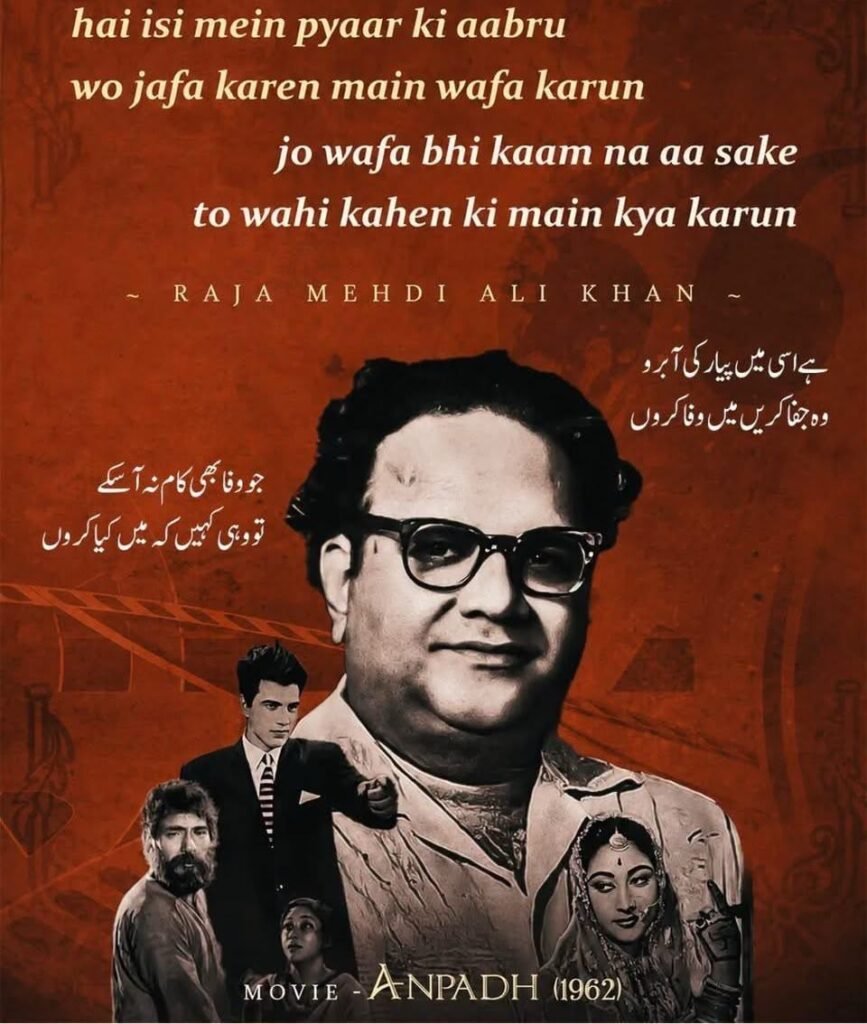
A Literary Lineage in Turbulent Times
On September 23, 1915, in Karimabad (district Gujranwala), a child was born into a family steeped in Urdu literature. Raja Mehdi Ali Khan—nephew of the prominent nationalist editor Maulana Zafar Ali Khan and son of Hubia Khanum—grew up immersed in verse. His mother was a poet of such distinction that Allama Iqbal himself had recognized her talent. That rich heritage was embedded in young Mehdi’s DNA.
Yet, tragedy struck early. Mehdi lost his father at the age of four. The struggles of a fatherless childhood and the healing warmth of words forged his deep poetic sensibility. When he entered the world of cinema, his debut song resonated with the ache of heartbreak:
“Mera sunder sapna beet gaya,
Meri zindagi ka geet gaya.”
— Do Bhai (1947)Released as Partition tore the subcontinent apart, these simple, poignant lines transcended physical borders and communal divides, uniting listeners across a fractured land in shared grief.
Choosing the Soil: A Pen for the Nation
When 1947 brought the painful choice of migration, Raja Mehdi Ali Khan and his wife, Tahira, made the conscious decision to remain in India—a choice rooted in deep ideological conviction. Amidst the horrors of communal riots, his response was to pen stirrings of unity and sacrifice for the film Shaheed (1948):
“Watan ki raah mein watan ke naujawan shaheed ho,
Chaman mein aane wali fasl-e-gul ke rangid ho.“These were not mere lyrics written for a film screen; they were solemn oaths of loyalty to his motherland. Through his pen, the poet affirmed his roots.
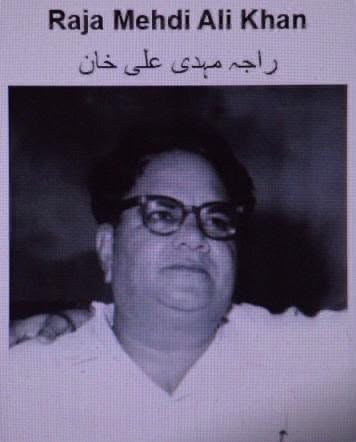
The Courtesy of Romance: Introducing Aap
Raja Mehdi Ali Khan’s true genius lay in mapping the quiet nuances of the human heart. He was a pioneer in elevating film lyrics by introducing the respectful “aap” into romantic discourse, bringing restraint and nobility to cinematic expression.
Songs like “Aap ki nazron ne samjha” (Anpadh, 1962) and “Aap ne apna banaya” (Dulhan Ek Raat Ki, 1966) radiated timeless grace. For Mehdi, linguistic courtesy was not an ornamental style; it was a cultural philosophy. In an era when cinema held up a mirror to society, his verses gently reminded lovers to romance with humility rather than conquest.
The Golden Partnership with Madan Mohan
The 1950s and 1960s witnessed one of Indian cinema’s most enduring artistic alliances: the partnership between Raja Mehdi Ali Khan and composer Madan Mohan. If Madan Mohan was the architect of haunting melodies, Mehdi was the sculptor who carved intricate emotions into every line.
Together, they delivered a catalogue of immortal classics:
- “Meri yaad mein tum na aansoo bahana” (Madhosh, 1951)
- “Jo humne dastaan apni sunai, aap kyun roye” (Woh Kaun Thi?, 1964)
- “Tu jahan jahan chalega, mera saaya saath hoga” (Mera Saaya, 1966)
Their songs were not merely commercial successes; they were poetic milestones—ghazals seamlessly woven into the fabric of popular cinema.
‘Lag Ja Gale’: Philosophy Set to Music
If one creation epitomizes Raja Mehdi Ali Khan’s mastery, it is “Lag ja gale ke phir yeh haseen raat ho na ho” (Woh Kaun Thi?, 1964). Sung with transcendent beauty by Lata Mangeshkar and composed by Madan Mohan, the song is a profound meditation on the transience of human connection:
“Lag ja gale ke phir yeh haseen raat ho na ho,
Shaayad phir is janam mein mulaqat ho na ho.”Few lyricists have rendered the fragility of life and love with such heartbreaking beauty. Today, it stands as one of the undisputed crowns of Hindi film music—a song so ubiquitous that it remains a benchmark of cultural memory.
A Pen Without Boundaries
While he is revered as a master of romantic melancholy, Raja Mehdi Ali Khan possessed a remarkably wide range. He penned the delightful nursery lullaby “Nani teri morni ko chor le gaye” (Masoom, 1960), which remains a staple of Indian childhoods. He captured festive, folk-infused energy in “Jhumka gira re Bareilly ke bazaar mein” (Mera Saaya, 1966), a track permanently etched into pop culture.
From patriotic anthems and spiritual hymns to witty parodies and delicate ghazals, his pen traversed the full spectrum of the human experience.
An Unfinished Song, An Enduring Legacy
Raja Mehdi Ali Khan’s life was cut short when he passed away in July 1966 at just 50 years of age.
In a career spanning barely two decades, he penned lyrics for over 450 songs across 126 films. He departed at the peak of his creative powers, leaving behind a legacy that continues to resonate across generations.
Why is his name sometimes spoken with less frequency than contemporaries like Sahir Ludhianvi, Majrooh Sultanpuri, or Shailendra? Perhaps because he avoided political posturing and preferred the intimacy of film lyrics over the clamor of the mushaira stage. His verses were not ideological manifestos, but intimate confessions of the heart.
He famously wrote:
“Yaad karoge, ik din humko yaad karoge,
Phir dekho ge, ye geet humko yaad aayenge.”Those lines remain prophetic. 111 years after his birth, Raja Mehdi Ali Khan lives on—in every quiet tear, every tender declaration of love, and every instance where poetry finds sanctuary in music.

~Hasnain Naqvi is a former member of the history faculty at St. Xavier’s College, Mumbai….
The opinions expressed here are solely those of the author.