

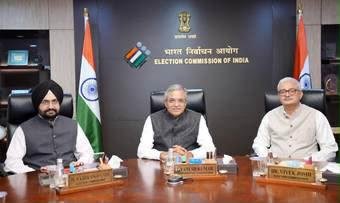
The Election Commission of India is not an administrative department of the Union government. It is a constitutional authority entrusted with the most consequential task in a democracy: deciding whether citizens can vote, whether their votes will be counted and whether political power will change hands through a credible process.
That is why the Modi government’s decision to replace the Chief Justice of India with a Union Cabinet minister on the selection panel for Election Commissioners is not a routine legislative alteration. It is a structural change in the balance of power over the institution that conducts India’s elections.
The issue has acquired new urgency after The Indian Express reported that Election Commissioners Sukhbir Singh Sandhu and Vivek Joshi recorded at least 14 formal objections over ten months concerning decisions allegedly taken without their knowledge. Their concerns reportedly included changes to Form 6 for new voters, the centralisation of electoral-roll data, voter deletions and software that prevented local officials from restoring eligible names. The report says the Special Intensive Revision process affected more than 13 crore names across 30 States and Union Territories. These allegations require a transparent, independent and time-bound investigation—not political dismissal.
The Supreme Court’s safeguard
In Anoop Baranwal v. Union of India, decided in March 2023, the Supreme Court confronted a constitutional vacuum. Article 324 provides for the appointment of the Chief Election Commissioner and Election Commissioners by the President, subject to parliamentary legislation, but Parliament had not enacted such a law.
The Court therefore prescribed an interim arrangement. Until Parliament made a law, appointments were to be recommended by a committee consisting of the Prime Minister, the Leader of the Opposition in the Lok Sabha and the Chief Justice of India. The principle was straightforward: no single branch of government should control the appointment of the institution responsible for supervising elections.
The judgment did not permanently transfer Parliament’s legislative power to the Court. It recognised Parliament’s authority to enact a law. But it also recognised that institutional independence cannot be reduced to formal constitutional language. An Election Commission may be independent in theory and yet vulnerable in practice if its appointments are controlled by the executive it is expected to scrutinise.
The Modi government’s response was revealing. Parliament enacted the Chief Election Commissioner and Other Election Commissioners (Appointment, Conditions of Service and Term of Office) Act, 2023. The new selection committee consists of the Prime Minister, a Union Cabinet minister nominated by the Prime Minister and the Leader of the Opposition. The official legislation confirms that the Prime Minister and his nominee occupy two of the three positions.
The change was therefore not merely a replacement of one individual with another. It altered the institutional arithmetic. The Chief Justice of India, an authority external to electoral politics, was removed; a member of the executive was inserted in his place. The government acquired a built-in majority on the committee.
Legality is not legitimacy
The government can argue, correctly in a narrow sense, that Parliament was entitled to legislate. But constitutional democracy asks a larger question than whether a law can be passed. It asks whether the law protects the independence of the institution it regulates.
A selection committee dominated by the government may produce appointments that are technically lawful but publicly distrusted. In a democracy, legitimacy depends not only on the final result but also on the credibility of the process. The Election Commission must be seen to be independent by voters, political parties, civil servants and the courts. A mechanism that allows the executive to select two of the three members of the appointing panel inevitably raises doubts about whether the referee has been chosen by one of the teams.
The danger is magnified because Election Commissioners are usually senior government officials. Their professional careers have often been spent within the executive machinery. That does not make them incapable of independence. But it makes the appointment process especially important. Independence must be secured through institutional design, transparent criteria and public accountability—not left to the personal virtue of an individual office-holder.
The Supreme Court itself is now reconsidering the legal framework. On September 23, 2026, a two-judge bench referred challenges to the 2023 Act to a five-judge Constitution Bench. The petitions specifically challenge the replacement of the Chief Justice with a Union minister. The reference does not establish that the law is unconstitutional. But it confirms that the constitutional question is substantial and unresolved.
The SIR warning
The controversy over the Special Intensive Revision brings the consequences from constitutional theory into the lives of ordinary citizens. Electoral-roll revision is legitimate and necessary. Dead voters, duplicate entries, migrants and ineligible names must be removed. But a process that deletes genuine voters, imposes unclear documentation requirements or shifts decision-making from local statutory officials to opaque digital systems can become an instrument of disenfranchisement.
The Indian Express investigation reports that two Election Commissioners objected to a Form 6 change that required new applicants to answer whether they or their relatives appeared in an earlier electoral roll. One Commissioner reportedly described the alteration as “unauthorised and illegal”. The investigation also reported concerns that local Electoral Registration Officers were losing proper access to voter databases and that software prevented Goa officials from restoring 97 voters whom they had found eligible after examining their documents.
These claims must be tested by records, audits and judicial scrutiny. They must not be converted into partisan conclusions before due process. Yet neither should the Election Commission hide behind the argument that its decisions were formally unanimous if internal records show repeated objections by two of its three members.
Section 18 of the 2023 Act states that the Commission’s business should, as far as possible, be conducted unanimously; where the members differ, the majority view prevails. The statutory existence of a majority does not make dissent irrelevant. On the contrary, dissent is a crucial safeguard when the majority controls decisions affecting millions of voters.
The Opposition’s responsibility
The Opposition must respond firmly, but responsibly. It should demand that all objections, minutes, orders, software-change logs and electoral-roll audit trails be placed before Parliament. It should seek an independent technical and judicial inquiry into alleged voter deletions, centralised database access and the treatment of appeals. It should insist that no eligible voter be excluded without notice, an opportunity to be heard and a prompt appeal.
A motion seeking the removal of the Chief Election Commissioner may be politically necessary if evidence establishes serious misconduct. But impeachment is not a slogan. Under the law, the Chief Election Commissioner can be removed only in the manner and on the grounds applicable to a Supreme Court judge; other Election Commissioners require the Chief Election Commissioner’s recommendation. Any removal motion must therefore be supported by documented charges, procedural compliance and evidence capable of surviving parliamentary and judicial scrutiny.
The demand for the Prime Minister’s resignation is a political judgment, not a substitute for investigation. If the executive designed a selection system that compromised the Commission and then used that vulnerability to manipulate electoral rolls, accountability must reach the political leadership. But that conclusion must be demonstrated through facts, not asserted merely because the government appointed the Commissioners.
The Opposition’s most important task is public education. Every household must understand that electoral integrity is not an abstract dispute between parties. A wrongfully deleted name is not a technical error; it is the denial of a constitutional right. A centralised voter database without transparent safeguards is not merely an IT concern; it can determine who remains visible to the democratic process.
The government may have won the power to choose two members of the selection committee. It has not won the right to choose the public’s trust. That trust can be restored only through transparency, independent scrutiny and institutional reform. Until then, the question will remain unavoidable: if the Election Commission is meant to supervise the government’s election, why should the government control the Commission’s selection?

~Hasnain Naqvi is a former member of the history faculty at St. Xavier’s College, Mumbai….
The opinions expressed here are solely those of the author.

