

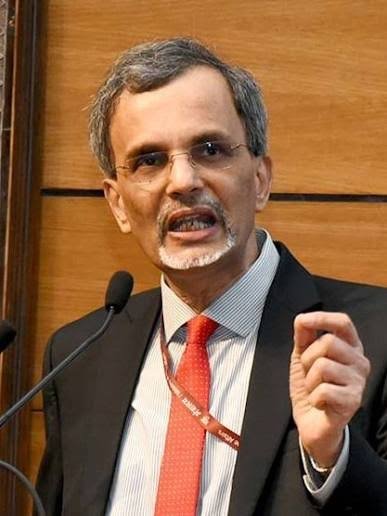
New Delhi, 25 September— In a rare expression of an independent stand away from till date a servile behaviour against the Trump Administration, India’s Chief Economic Adviser V Anantha Nageswaran today described the United States’ trade restrictions, tariffs and the Graham Act as part of a broader pattern of “sustained coercion” aimed at pushing countries to align with competing geopolitical blocs.
The CEA said the global economy could increasingly be shaped by two or three competing blocs, with geopolitics having a growing influence on trade, technology and energy.
The Indian economy is facing near-term headwinds from “unsettled relations” with the United States, global energy prices, and the absence of “AI play” in the country, Anantha Nageswaran underlined today.
While the AI lag and global energy prices are known factors, this was probably the first time an Indian government official has publicly acknowledged the bumpy ties with the US in which New Delhi has been playing an obedient partner fearing displeasure of US President Donald Trump.
“You might say that the US itself is not fighting, given the optics you are seeing with respect to the ongoing Sino-American Summit, but the truth is maybe there are two or three competing blocs, maybe two major blocs,” he said.
According to the CEA, measures such as the Graham Act and trade restrictions should be viewed in the context of growing pressure on countries to make strategic choices. The Graham Act gives the US President powers to impose tariffs of up to 100% on countries that continue to purchase Russian oil and gas.
Nageswaran said India’s geographical position, economic scale and strategic ambitions make it difficult for the country to align completely with any one geopolitical bloc.
However, he cautioned that maintaining strategic flexibility would also involve economic and policy costs.
“Given India’s geography and size and its quest to be a swing power, simply means hedging will have significant costs, and that has to be factored into our decision-making, both in the public and private sector,” Nageswaran said in an unprecedented sign of frankness reflecting his independent assessment.
The CEA said the interaction between geopolitics and economics had fundamentally altered the global economic environment. Supply disruptions, trade restrictions and vulnerabilities in critical supply chains are becoming increasingly important for policymakers.
“What we are seeing now with geopolitics mixing with economics, it is actually a supply constraint world, and it requires a different policy response,” he said.
Nageswaran said policymakers need to move beyond the economic policy framework that dominated the 1980-2020 period, when demand management was a central focus.
“It is no longer about demand management, it is about supply management,” he said.
He pointed to the experience of recent years, particularly since the pandemic, when supply-side disruptions affected production and prices across economies.
According to Nageswaran, production must be understood as an interconnected chain rather than a collection of independent components. A disruption at a critical point can therefore affect the entire production process.
The most important thing to realise in a supply threatened world is to understand that production is a chain and not a sum,” he said.
Nageswaran also said the period of global disinflation supported by globalisation and technological advances had come to an end.
“The sum and substance of all this is that global disinflation is over,” he said.
He cited several developments contributing to the changing environment, including export controls, restrictions involving semiconductors and critical technologies, supply-chain bottlenecks and controls on critical minerals.
He also highlighted the increasing importance of artificial intelligence-related products in global trade, noting that trade is increasingly being used as a strategic tool.
“Trade has been weaponised, some either as matters of no choice as a response and some on an offensive basis,” Nageswaran said.
The CEA identified three immediate challenges for the Indian economy: India’s unsettled relationship with the US, developments in global energy markets and the country’s relatively limited presence in the AI ecosystem.
While India has opportunities in artificial intelligence, Nageswaran said the country still faces a gap in intellectual property.
“It is not as if India does not have play in AI ecosystems, it is just the IP is not quite there, that is a real issue, but it will come,” he said.
He noted that Indian companies and institutions are already working on applications, including in the edge-AI segment.
Looking beyond the immediate challenges, Nageswaran said India would need to strengthen domestic manufacturing as global supply chains become more vulnerable to geopolitical disruptions.
The assumption that global markets will always provide uninterrupted access to essential goods and inputs can no longer be taken for granted, he said.
“You have to manufacture because the world won’t supply you,” Nageswaran said.
His comments underline the growing importance of domestic production, resilient supply chains and strategic diversification as India navigates an increasingly fragmented global economic and geopolitical landscape.
Nageswaran’s admission came a day after Commerce and Industry Minister Piyush Goyal said the trade pact with the US was “done and dusted” and will be executed once Washington gives India the right competitive advantage over its competitors in the American market.

Veteran Journalist and Political Commentator