

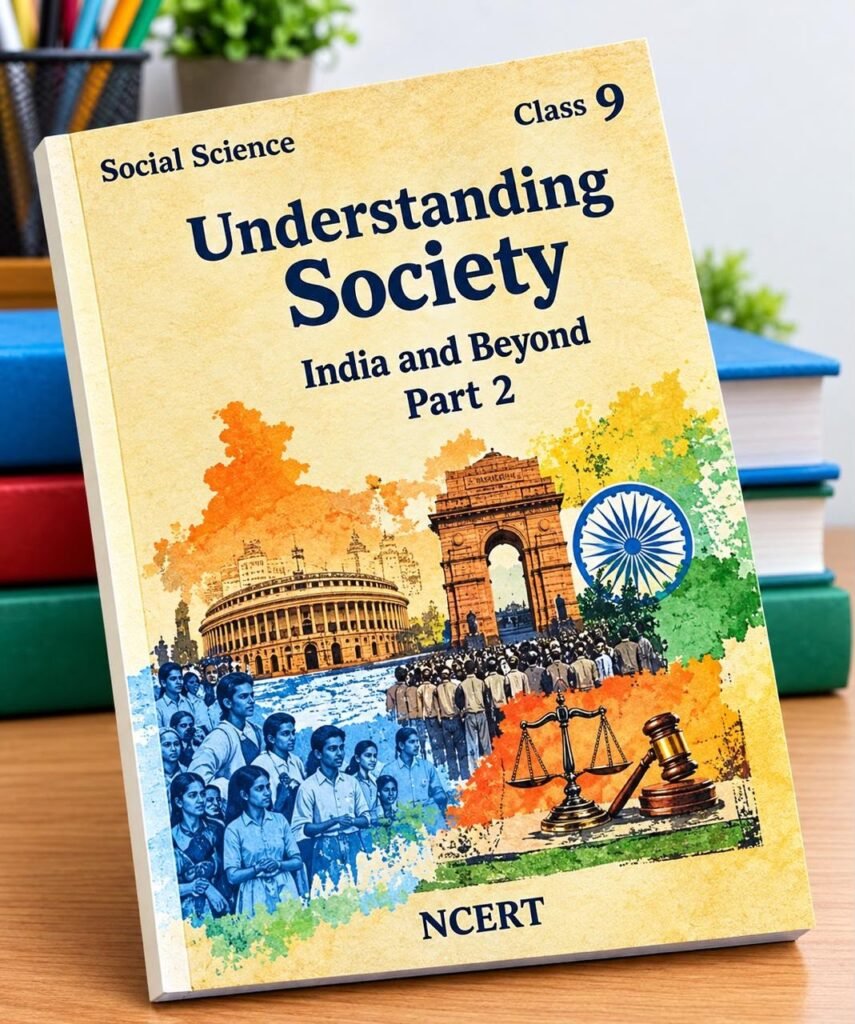
The new NCERT Class 9 Social Science textbook, Understanding Society: India and Beyond, Part 2, released on 29 September 2026, frames nearly seven centuries of medieval Indian history under the theme “Resistance and Resilience.” It presents successive invasions—Arab, Turkish, Mughal and European—as driven by territorial expansion and religious motives. It highlights military and cultural resistance by Rajputs, Ahoms, Vijayanagara, Marathas, Sikhs, Jats and others, records cycles of temple destruction and reconstruction, and asserts that Indian society defended itself from external threats while preserving its traditions. Traditional accounts of rulers receiving swords from goddesses—Annamaraja of Bastar from Manikyadevi, Kumara Kampana of Vijayanagara, and Shivaji from Tulja Bhavani—are included as part of this narrative of resistance to “religion-driven” invasions.
In the foreword, NCERT Director Dinesh Prasad Saklani writes that Social Science learning at this stage is expected “to cultivate analytical and discursive abilities, encourage critical inquiry, promote intercultural understanding, and enable learners to participate with confidence and responsibility in civic and social life.” He adds that the textbook has been conceptualised and developed in precisely this spirit. The reported contents of the history chapter stand in clear tension with these aims and, ultimately, with the internal coherence of the “Resistance and Resilience” theme itself.
Critical Inquiry Reduced to Selective Emphasis
Critical inquiry demands that students learn to separate evidence-based reconstruction from later legend, examine causation and contingency, weigh success against failure, and consider multiple perspectives. The textbook’s treatment of “goddess-given swords” places traditional beliefs inside the historical narrative of resistance without the pedagogical framing necessary to distinguish belief—historically attested in courtly and popular tradition—from verifiable military causation. Students are not invited to ask why certain campaigns succeeded while large parts of the subcontinent still fell under Sultanate and Mughal control for centuries. Serious scholarship has long treated such legends as cultural resources that legitimised authority and mobilised support, not as explanatory mechanisms. Historians such as Irfan Habib have insisted that medieval politics operated through the sword, strategy and statecraft rather than religious essentialism. Presenting legendary divine weapons without rigorous sourcing or critical distance undercuts the analytical abilities the foreword claims to cultivate.
The overarching framing compounds the problem. Resistance was historically real: Maharana Pratap’s defiance, Lachit Borphukan’s victory at Saraighat, the martyrdom of Sikh Gurus, Jat uprisings, and Vijayanagara’s southern defence are all documented. Yet the same centuries also witnessed extensive collaboration—Kachwaha–Mughal alliances receive only brief mention—administrative incorporation, economic integration and cultural synthesis. Earlier historiography that examined composite culture is largely sidelined in favour of a conflict-dominant narrative. This is not critical inquiry; it is selective emphasis that risks converting history into a usable past rather than a field of evidence and argument.
Intercultural Understanding Narrowed
Intercultural understanding requires students to grasp how communities interacted through conflict, accommodation, conversion, trade, language and shared institutions, without reducing the past to a binary of indigenous defenders versus external religious aggressors. The textbook’s repeated stress on “religion-driven invasions,” “religious discrimination and social distress,” and the “brutality of the Mughal state” against Sikh Gurus—described as having “few comparisons in history”—foregrounds one dimension while downplaying others that scholarly consensus recognises: the multi-ethnic character of Sultanate and Mughal armies and courts, the role of Hindu officers and revenue officials, the dialogue between Bhakti and Sufi traditions, and the gradual Indianisation of ruling elites. Akbar’s relatively inclusive policies and the contributions of Muslim poets such as Rahim and Raskhan appear, yet the dominant organising principle remains resistance to foreign or religious threat. Such a lens makes genuine intercultural understanding more difficult, not easier. It encourages students to read the period primarily through civilisational defence rather than as a dynamic, multi-polar subcontinent in which power, identity and culture were continuously negotiated.
The Limits of “Resistance and Resilience”
The theme of “Resistance and Resilience” itself sits uneasily with the historical record. If the central claim is that Indian society successfully defended itself and preserved its traditions, then the scale of political conquest, demographic change in certain regions, cycles of temple desecration and reconstruction, and the establishment of durable Indo-Islamic polities must be confronted rather than subordinated. Resilience is real—continuity of social structures, languages, religious practices and regional polities is well attested—but so is transformation. A narrative that privileges successful or heroic resistance while soft-pedalling the duration and depth of conquest produces an incomplete and ultimately fragile account. Students who later encounter primary sources or standard academic surveys will face a jarring discrepancy between textbook and scholarship.
The inclusion of European resistance, such as Rani Abbakka’s defence against the Portuguese, demonstrates that the category is not exclusively Indo-Islamic. Yet the rhetorical weight still falls heavily on the earlier invasions. This selective intensity risks instrumentalising history for contemporary identity formation rather than understanding the past on its own terms.
A Gap Between Promise and Practice
Saklani’s foreword correctly identifies the goals of secondary Social Science education. The reported content of Part 2, however, privileges a civilisational-resistance narrative, incorporates legendary motifs without adequate critical distance, and narrows the range of intercultural processes under study. The result is less likely to produce confident, analytically equipped citizens capable of discursive engagement with complex pasts than a cohort primed to view medieval history primarily as a story of external threat and indigenous endurance.
An evidence-based curriculum consistent with the foreword’s stated aims would treat legends of divine weapons as cultural-historical phenomena worthy of analysis rather than quasi-causal explanations. It would balance accounts of resistance with those of alliance, incorporation and synthesis, grounded in primary sources and mainstream scholarship. It would invite students to ask the hard questions the textbook appears to leave unasked: why resistance sometimes succeeded and often failed; how power and identity were negotiated; and what “resilience” actually meant in demographic, economic and cultural terms.
Only then would the textbook align with the analytical, critical and intercultural ambitions its own foreword proclaims. Until that alignment is achieved, the gap between promise and practice remains a matter of serious pedagogical concern.

~Hasnain Naqvi is a former member of the history faculty at St. Xavier’s College, Mumbai….
The opinions expressed here are solely those of the author.

