

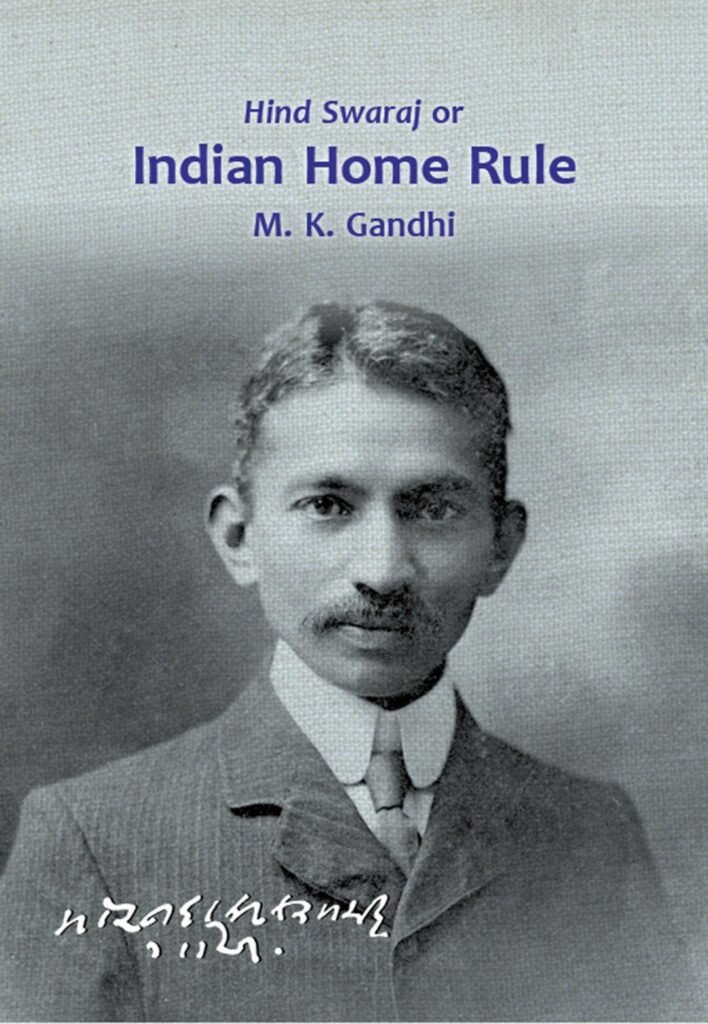
On Mahatma Gandhi’s birth anniversary, the most urgent tribute we can offer is not ceremonial homage but intellectual honesty: to revisit the text he called his “spiritual testament” and ask whether modern India has the courage to live by it. Hind Swaraj (1909) is not a relic of anti-colonial agitation; it is a diagnostic manual for civilisational malaise, written with a prescience that sharpens with every passing decade.
A Critique That Outlived Empire
Gandhi’s central provocation in Hind Swaraj is deceptively simple: freedom is not the replacement of foreign rulers with native ones while preserving the same machinery of power. “Home Rule is Self Rule,” he insists, distinguishing external political independence from the harder task of internal moral sovereignty. He warns that a civilisation organised around “bodily welfare”—material comfort, mechanical speed, and endless consumption—enslaves even those who believe themselves free.
In 1909, the target was British imperialism and the seductions of Western modernity. In 2026, the adversary is subtler: a development model that equates progress with GDP growth, urban sprawl with advancement, and technological acceleration with human flourishing. Environmental collapse, grotesque inequality, and the commodification of everyday life are not anomalies in this system; they are its logical outcomes—precisely what Gandhi foresaw when he condemned industrial civilisation’s “disease” of prioritising things over character.
Swaraj Beyond Symbolism
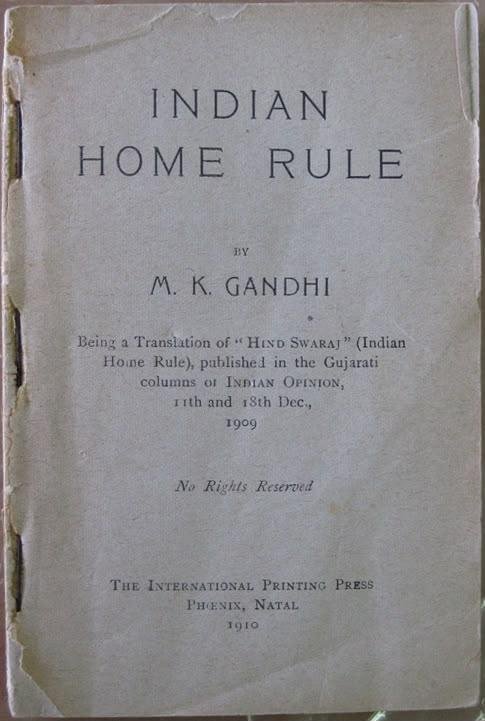
For Gandhi, Swaraj was indivisible: political decentralisation had to mirror ethical self-governance. He imagined a republic of self-restrained individuals and self-sufficient village communities, where power flowed upward from the grassroots rather than downward from a centralised state. This was not romantic nostalgia but a structural prescription: if people cannot govern their own desires, no constitution will save them from tyranny—foreign or domestic.
Contemporary India has institutionalised fragments of this vision. The 73rd and 74th Constitutional Amendments, which empowered Panchayati Raj institutions, bear the imprint of Gandhi’s insistence on local self-rule. Yet the spirit of Hind Swaraj remains unfulfilled when local bodies exist as administrative appendages rather than genuine sites of democratic agency. True Swaraj demands more than elected panchayats; it requires citizens who exercise self-control, resist the lure of populist shortcuts, and hold power accountable through everyday ethical practice.
Swadeshi in the Age of Algorithms
Gandhi’s doctrine of Swadeshi—self-reliance through local production and consumption—was never about economic autarky. It was a moral stance against dependency and exploitation, a call to rebuild village economies that could withstand external shocks. In Hind Swaraj, he links Swadeshi to dignity: when communities produce what they need, they reclaim agency over their lives.
Today, the ethos of Swadeshi resurfaces in policies like Atmanirbhar Bharat and Make in India, which seek to reduce import dependence and revitalise domestic manufacturing. But Gandhi would ask whether self-reliance is measured merely in supply chains and trade balances, or in the resilience of local communities, the sustainability of production, and the fairness of distribution. Digital self-reliance, localised renewable energy, and circular economies could be the Khadi of our time—if they serve human scale rather than corporate concentration.
Education as Ethical Formation
Perhaps Gandhi’s most uncomfortable critique in Hind Swaraj targets education. He dismissed colonial schooling as a system that produced clerks, not citizens; that valued literacy over character; and that severed knowledge from moral responsibility. His indictment extended to professions—lawyers, doctors, engineers—when they operated as mercenary trades divorced from social obligation.
The National Education Policy’s emphasis on value-based, holistic learning echoes Gandhi’s demand for education that forms ethical beings, not just skilled workers. Yet the crisis persists: commercialised healthcare, legal delays that deny justice, and technocratic governance that treats citizens as data points all testify to Gandhi’s warning that expertise without ethics corrodes society. Hind Swaraj challenges us to ask whether our institutions cultivate wisdom or merely efficiency.
The Unfinished Project of Civilisational Choice
Gandhi did not reject all machinery; he rejected machinery that mastered humans. He did not dismiss modern professions; he demanded they serve truth and non-violence. His vision was not a return to a mythical past but a reorientation of progress toward human dignity, ecological balance, and moral clarity.
In an era of climate emergency, algorithmic manipulation, and geopolitical volatility, Hind Swaraj offers not a blueprint but a compass. It asks whether India’s rise will replicate the civilisational errors Gandhi identified—or whether it will chart an alternative path where development is measured by the quality of life, not the quantity of goods; where democracy is lived in villages and neighbourhoods, not just in parliaments; where self-reliance strengthens communities rather than enriching monopolies.
A Tribute in Practice
On October 2, let us honour Gandhi not with statues and slogans but with the difficult work of self-examination. Hind Swaraj remains relevant not because it provides ready-made answers, but because it forces us to confront uncomfortable questions: What kind of civilisation are we building? Whose interests does our progress serve? Are we free in the deepest sense, or merely exchanging one form of bondage for another?
The text’s endurance lies in its refusal to comfort. It demands that we choose—between speed and sustainability, between centralisation and empowerment, between material accumulation and moral growth. That choice, Gandhi reminds us, is the essence of Swaraj. And it is one that no generation can outsource.

~Hasnain Naqvi is a former member of the history faculty at St. Xavier’s College, Mumbai….
The opinions expressed here are solely those of the author.