

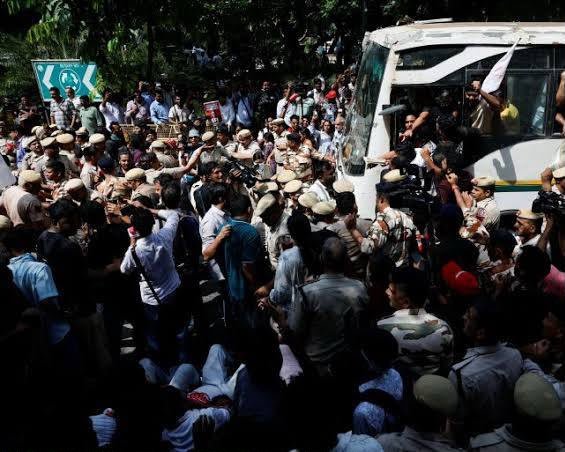
A Coordinated Cry for Democratic Accountability
On the symbolic occasion of Gandhi Jayanti, India’s financial and political capitals witnessed a significant upsurge of public unrest. Across both New Delhi and Mumbai, a broad coalition of civil society organisations, student groups, and youth leaders converged on the streets to mount a direct challenge against the leadership of the Election Commission of India. The primary catalysts for this nationwide agitation were clear: demanding the immediate resignation of Chief Election Commissioner (CEC) Gyanesh Kumar and the complete freezing of the highly controversial Special Intensive Revision (SIR) process of electoral rolls.
The friction between the state and its citizens has reached a boiling point over allegations of systematic voter-roll manipulation and gerrymandering. Critics argue that the ongoing SIR exercise serves not to clean the rolls, but rather to disproportionately disenfranchise tens of millions of legitimate voters across diverse demographics. The protests on 2 October 2026 transformed what began as a series of sharp political press statements into an active, mass-mobilised resistance on the pavement.
The Iron Curtain of Permissions: Weaponising Administrative Denial
A defining feature of the day’s events was the systematic and preemptive denial of democratic space by municipal and police authorities. In Mumbai, the Cockroach Janta Party (CJP), alongside independent civil rights groups, had scheduled a peaceful gathering at the historic Shivaji Park in Dadar—a venue synonymous with Maharashtra’s rich history of political movements. However, Mumbai Police refused to grant formal clearance, citing an array of regulatory restrictions, civic-permission technicalities, and silence-zone mandates.
A near-identical script played out in New Delhi. Activists, student outfits, and leaders from the opposition INDIA bloc sought to assemble at the capital’s designated protest site, Jantar Mantar. The Delhi Police summarily rejected the application. This coordinated administrative blockade raises a fundamental constitutional question: when the institutions tasked with safeguarding democracy are themselves the subject of public grievances, can the state use civic regulations to insulate those institutions from public scrutiny? Organisers forcefully argued that the right to assemble peacefully and register dissent cannot be contingent upon receiving a permission slip from the very apparatus under protest.
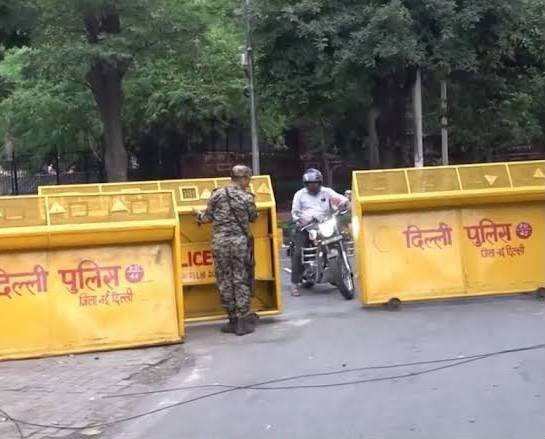
High Walls and Heavy Hands: The Repression in New Delhi
In the national capital, the administrative denial of permission quickly escalated into an overt, heavy-handed security operation. Anticipating a massive turnout of between 3,000 and 4,000 citizens, Delhi Police transformed Jantar Mantar and its surrounding avenues into a fortified zone. Multi-layered iron barricades, concertina wire, and hundreds of riot-control personnel were deployed to seal off entry points.
The state’s panic was most visible in its disruption of public transit. In a bid to physically choke the flow of arriving student groups and civil rights activists, entry and exit restrictions were abruptly slapped on 11 critical Delhi Metro stations across the central administrative zone. For those who managed to reach the vicinity on foot, the police response was unyielding. Peaceful marchers carrying banners demanding a transparent, independent process for appointing election commissioners were met with physical pushbacks, rough handling, and mass detentions. Scores of young protestors and prominent civil society voices were bundled into police buses and driven to far-flung police stations, illustrating a clear strategy of using preventative containment to break the momentum of a legitimate civilian grievance.
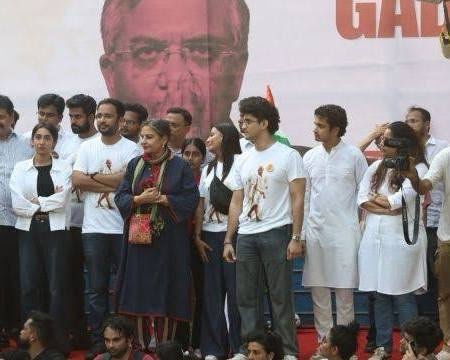
Defiance at Shivaji Park: Mumbai’s Unsanctioned Surge
Despite facing a similarly imposing police presence and a total lack of official clearance, the situation in Mumbai unfolded with a spirit of resolute defiance. Thousands of youth, activists, and first-time voters from various corners of Maharashtra bypassed the barriers to occupy parts of Shivaji Park. Holding the national tricolour aloft alongside placards declaring the CEC’s actions a betrayal of constitutional trust, the crowd transformed the park into an open-air forum of dissent.
Faced with a complete wall of bureaucratic resistance, organisers initiated a “Jail Bharo Andolan” (voluntary arrest movement). The leadership made it explicitly clear that the fight for electoral transparency would not be cowed by the threat of criminal charges or police cells. The Mumbai demonstration stood out for its high concentration of young citizens, signalling a profound shift in the political consciousness of a generation that refuses to accept the opacity of the country’s apex electoral body as the new normal.
Beyond the Pavement: Political and Institutional Ramifications
The events of 2 October are not a fleeting moment of street theatre; they mark a structural pivot in how citizens engage with institutional accountability in India. The immediate political fallout is the rapid expansion of this agitation into a nationwide campaign. Organisers have already announced plans to take the anti-CEC protests to six additional major cities across the country, explicitly vowing to proceed regardless of whether local administrations grant permission.
Institutionally, these protests have fundamentally ruptured the carefully curated aura of neutrality that the Election Commission relies upon. The demand to freeze the SIR and return to the 2025 electoral rolls challenges the very legality of the current commission’s executive actions. Furthermore, by aiming their criticisms directly at the Chief Election Commissioner and Other Election Commissioners Act of 2023, the protestors are successfully forcing a public debate on the structural flaws of an appointment mechanism that lacks genuine, independent oversight.
By clamping down on these demonstrations with transit shutdowns and barricades, the state has inadvertently amplified the protestors’ core message: that the institutions designed to protect the citizen’s vote are increasingly insulated from the citizen’s voice. The ground reports from Delhi and Mumbai reveal that while the government can temporarily clear the streets through raw force, it cannot easily suppress the growing, systemic skepticism surrounding the integrity of India’s democratic foundations.

~Hasnain Naqvi is a former member of the history faculty at St. Xavier’s College, Mumbai….
The opinions expressed here are solely those of the author.

