

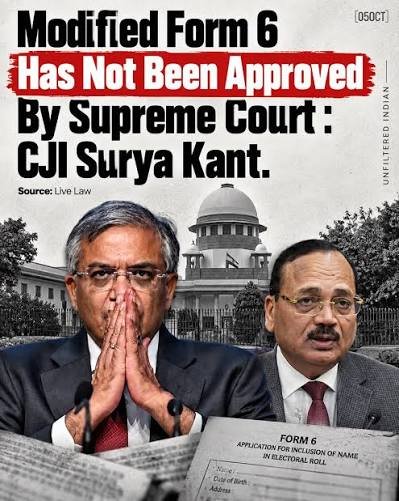
The controversy surrounding the Election Commission’s Special Intensive Revision (SIR) of electoral rolls has taken a new turn, with serious questions being raised over whether the Commission misrepresented the Supreme Court’s position on changes made to Form 6, the application form used by new voters to register themselves on the electoral rolls.
The SIR exercise in Bihar was announced by the Election Commission on June 24, 2025, and its constitutional validity was subsequently challenged before the Supreme Court. The matter was heard at length, with the hearing finally concluding on January 29, 2026, when the court reserved its judgment.
Four months later, on May 27, 2026, the Supreme Court delivered its 124-page judgment and upheld the SIR, holding that the exercise was intended to purify the electoral rolls and that the Election Commission was authorised to undertake such a revision. But, crucially, the judgment nowhere approved any alteration to Form 6, argues the author.
Paragraph 45(f) of the judgment merely stated that any new voter would have to submit Form 6 along with a declaration in the form of Annexure D referred to in the Election Commission’s June 24, 2025 notification.
The relevant portion of the judgment states: “Any new voter was required to submit Form 6 along with a Declaration Form in Annexure D of the Impugned Order.”
According to the author, however, the declaration accompanying Form 6 for a new voter did not require the applicant to establish any mapping with his or her parents, grandparents or maternal grandparents. It only specified the documents that could be submitted in support of the declaration. The list, he points out, did not include Aadhaar as an option.
The issue acquired greater significance after the SIR exercise was extended beyond Bihar to nearly a dozen states, including West Bengal. According to the author, the Election Commission subsequently altered the declaration attached to Form 6 and introduced the changes unilaterally, even before the Supreme Court delivered its May 27 judgment.
The author points specifically to developments within the Election Commission in May 2026. On May 16, Election Commissioner Vivek Joshi reportedly wrote to Chief Election Commissioner Gyanesh Kumar cautioning against changing the Form 6 application for new voters without government approval. His warning was explicit: “Don’t change Form-6 (new voter) without Govt. approval.”
Three days later, on May 19, Election Commissioner S. S. Sandhu reportedly raised the same objection. Despite these objections, the author alleges, Chief Election Commissioner Gyanesh Kumar and the Commission’s IT team, headed by DG (IT) Seema Khanna, continued with the revised form.
The controversy became particularly visible on the ECINET portal from the night of July 5, 2026. Applicants seeking to register as new voters online were presented with a revised Form 6 containing a declaration requiring them to state whether their parents, grandparents or maternal grandparents had been voters during the previous SIR. If the answer was yes, applicants were required to provide the number of the polling booth where those relatives had been registered as well as their electoral roll serial number.
There was, according to the author, an unusual contradiction in the system. While the new declaration appeared on the online application interface, downloading Form 6 from the portal continued to produce the older version of the form, which did not contain such a declaration.
The issue was subsequently reported by The Indian Express on July 12, 2026. A later report by the newspaper on September 23 brought further details into the public domain, including the alleged objections raised by Election Commissioners Sandhu and Joshi in May.
According to that report, the two Election Commissioners had objected to the implementation of the new Form 6 without government approval and had described the move as “unauthorized and illegal”, stating that it “must be removed immediately”.
The Election Commission’s subsequent position, however, became the centre of a fresh controversy.
On September 26, 2026, the Commission issued a press note which stated that it had been issued pursuant to the decisions taken at the meeting of the Commission held that day and had the approval of the full Commission.
More significantly, paragraph 1(iii) of the press note stated: “The declaration attached to Form 6 for SIR has been upheld by the Hon’ble Supreme Court.”
It is this assertion that has now come under intense scrutiny.
During the Supreme Court hearing on October 5, 2026, the Chief Justice of India reportedly made it clear that the court had never upheld the new Form 6. If so, the Election Commission’s September 26 assertion that the declaration had been upheld by the Supreme Court becomes a matter of considerable constitutional significance.
The author argues that the Supreme Court’s May 27 judgment nowhere approved the declaration subsequently added to Form 6 by the Election Commission. He further argues that the Supreme Court could not have pre-emptively approved an alteration whose statutory authority lay with the government or Parliament.
The central question, therefore, is straightforward: if the Supreme Court did not approve the alteration to Form 6, on what basis did the full Election Commission state that the declaration had been upheld by the court?
The question becomes even more serious because, according to the author, both Election Commissioners Sandhu and Joshi had themselves objected to the alteration in May on the ground that government approval was necessary. If they subsequently participated in a full Commission meeting in September that endorsed the claim that the Supreme Court had approved the declaration, the contradiction demands an explanation.
The author goes further, arguing that the three Election Commissioners collectively made a false and unlawful claim and that such conduct could amount not only to criminal wrongdoing but also to contempt of the Supreme Court.
He argues that constitutional office cannot provide immunity from accountability when the office-holder is alleged to have acted illegally, without authority or in violation of constitutional obligations. The issue becomes particularly grave, he says, because the SIR exercise allegedly resulted in the deletion of the names of more than 13 crore voters from electoral rolls.
According to the author, the law requires due notice and an opportunity of hearing before a voter’s name can be removed from the electoral roll. Any departure from that process, he argues, cannot simply be dismissed as an administrative error but may attract legal consequences.
The September 26 press note, in the author’s assessment, therefore assumes particular importance. He describes it as an acknowledgment by the full Commission that the new Form 6 was being justified by invoking the Supreme Court’s supposed approval.
This, he argues, raises questions about the conduct of all three Election Commissioners. While Sandhu and Joshi had reportedly objected to the revised Form 6 in May, why, he asks, did they remain silent when the change was allegedly implemented? Why did they not independently distance themselves from the decision after the issue was reported publicly in July? And why did they subsequently join the September 26 position stating that the Supreme Court had upheld the declaration?
For the author, these questions go to the heart of the institutional credibility of the Election Commission.
What happens now?
The Supreme Court has sought an explanation from the Election Commission over its claim concerning the court’s position. That, the author argues, is consistent with the principle of natural justice, under which an accused must be given an opportunity to explain and defend its conduct.
But an explanation alone, he argues, cannot resolve the larger question of what should happen if the Commission’s actions are ultimately found to have been unlawful.
The first requirement, in his view, should be to correct what has gone wrong. The manner in which the SIR was conducted in states following Bihar should be declared illegal if it is found to have violated the applicable law and constitutional requirements. Elections conducted on the basis of an unlawful electoral-roll revision should, he argues, also be declared invalid, with the governments formed through such elections dissolved and fresh elections held.
The electoral rolls should then be revised afresh on the basis of the rolls that existed before the SIR, following the earlier procedure for electoral-roll purification. Names of deceased voters should be removed, newly eligible voters should be added through the original Form 6 process, and duplicate entries and changes of residence should be corrected through the established procedure.
The author also calls for the Election Commission to be removed from office, arguing that the institution responsible for conducting elections cannot itself be permitted to undermine the democratic process through an allegedly unlawful revision of electoral rolls.
He invokes Article 142 of the Constitution, under which the Supreme Court has wide powers to pass orders necessary to do complete justice. He argues that the court should direct all three Election Commissioners to resign, drawing a comparison with the Supreme Court’s intervention in the matter concerning former Delhi High Court judge Yashwant Varma.
The author further demands that the three Election Commissioners be sent to jail and prosecuted for sedition, arguing that the constitutional privileges attached to their offices cannot serve as a shield against criminal liability for alleged wrongdoing.
At the same time, he acknowledges that the formal removal of Election Commissioners is governed by the constitutional and parliamentary process. Even so, he argues that, given the seriousness of the allegations, the Supreme Court should direct the Commissioners to resign.
At the heart of the controversy is therefore a question larger than the Form 6 itself: whether a constitutional institution entrusted with maintaining the integrity of the electoral process can alter the rules governing voter registration without the approval required by law, and then attribute that alteration to the Supreme Court when the court itself says it never approved it.
If the Election Commission’s September 26 claim is found to be inconsistent with the Supreme Court’s actual judgment and subsequent observations, the consequences could extend well beyond the disputed form. They could raise fundamental questions about institutional accountability, the independence of the electoral machinery and the constitutional safeguards surrounding the right to participate in elections.
For now, the Supreme Court has sought an explanation. The Election Commission must answer.
The larger question is whether that answer will be sufficient to resolve the constitutional and democratic questions raised by the SIR controversy.
Mukesh Kumar Singh is a Senior Journalist and writer whose work focuses on public affairs, politics and contemporary constitutional issues