

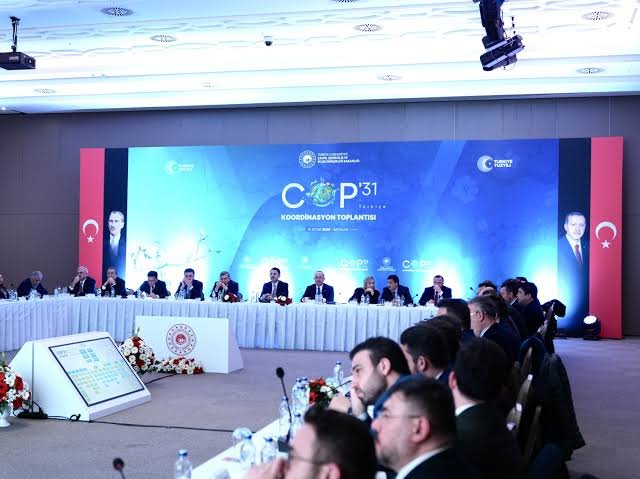
The upcoming COP 31 in Türkiye, to be held in Antalya from November 9 to 20, 2026, will be historic amid global climate catastrophes in recent years. Last year was one of the hottest on record, with nations around the world disrupted by extreme heat, heavy rainfall, forest fires, floods, and tropical cyclones. Financing for adaptation remains far below what is most needed. According to a UNEP report, developing countries need $310–365 billion to close the current funding gap through 2035. Getting funds to where they can do the good is a major challenge, as institutions struggle to identify adaptation investments that are ready to implement and whose risks can be properly assessed and priced.
Given this gap, Murat Kurum, Türkiye’s Minister of Environment, Urbanization and Climate Change and COP 31 President-designate, has outlined the importance of the summit agenda based on “dialogue, consensus and action.” The focus will be on implementation rather than pledges. There will be a 10-point agenda covering clean energy and electrification, zero waste and methane reduction, climate-resilient cities, green industrialization, youth and education, food security, oceans, health systems, biodiversity and land-use synergies, and implementation of national climate plans. Other targets include cutting energy-use intensity in buildings by at least 25% and increasing the global circular-material-use rate to at least 15% by 2035.
These targets could reduce global emissions by 8.5–10 gigatons of CO₂ by 2035. Kurum has stated that “implementation is not simply announcing more commitments but turning existing commitments into measurable results on the ground.” “We must facilitate access to finance, strengthen capacity, bring technology and investment together with real needs, and strengthen cooperation in a way that accelerates implementation,” said Kurum. The plan to roll out a Green Industrialization Facilitation Mechanism for the Least Developed Countries (LDC-GIF) is in the offing. It would connect the industrialization needs and project opportunities identified by LDC-GIF with existing technology, technical expertise, and financing. The objective is not to create a new financing structure; rather, it is to help move projects from concept to technology and finance, and from there to investment and production capacity.
The Climate Issue Is the Real Security Issue
It is time for COP 31 participants to emphasize that much more must be spent on climate than on defense in order to attain true security. It is estimated on a provisional basis that at least 35,000 excess deaths occurred across Europe during this summer’s severe back-to-back heat waves. Despite reasonably well-developed welfare systems, the absence of climate-adapted physical infrastructure and coordinated services contributed to this excess mortality. Floods and wildfires displaced families and separated caregivers from the people who depend on them. Family caregivers are left to shoulder the burdens, face injury, and suffer burnout during prolonged emergencies.
Kurum, the President-designate of COP 31, has said that wealthy nations should spend far more on dealing with the climate crisis than the 5 percent of GDP promised by NATO members for defense because “the climate issue is the security issue.” The transition away from fossil fuels must be strictly pursued. At the pre-COP preparatory meeting in Fiji, 4,000 attendees and about 30 ministers from different countries discussed at length the precarious condition of the world. Geopolitical turmoil caused by wars, an unprecedented energy crisis, and a climate-denying Trump administration are matters of serious concern for the world. A delegation from the pre-COP assembly visited Tuvalu, a low-lying atoll country of about 10,000 people experiencing the highest climate risk from storm surges, rising seas, and extreme weather, which poses an accelerating threat to its survival. During an interaction with locals, a 13-year-old, Melelusi Sokotia, told the delegation that her friends’ dreams of becoming “teachers, doctors and builders” were being subsumed by the question of whether they could grow up safely here in Tuvalu.
This is a wake-up call to world leaders. According to a recent UNEP report, global heating will reach at least 1.8°C, well beyond the 1.5°C ceiling of the Paris Climate Agreement. It calls for immediate emissions cuts and says that every fraction of a degree of heating avoided would save lives and prevent economic losses. The call is to “keep 1.5°C alive.” Climate finance must be made easily accessible to poor and vulnerable countries that have not caused the problem.
Australia’s climate change minister, Chris Bowen, said that only 0.2% of global climate finance was spent helping small island developing countries adapt, and that the countries that need it most get it least. The climate issue is the security issue. Kurum has rightly said, “If you do not spend one unit of money before a disaster, you are left in a position where you have to spend ten units after the disaster. It is cheaper pre-disaster.”
Both Australian and Turkish ministers reiterated that at COP 31 they would argue for a global goal that 35% of the energy needed to run homes, businesses, factories, and vehicles come from electricity by 2035. At present, it is only about 21%. But the question of what direct action the global community should agree to in order to phase out fossil fuels remains to be seen.
The way to stop using fossil fuels is not to cut the supply of dirty fuel but to build enough renewable energy so that there is no need for fossil-fuel power plants. You cannot phase out fossil fuels by building more fossil-fuel infrastructure. The crucial COP 31 in Antalya will be a test: can it save the world from impending climate disaster? How far it will truly treat climate as a security issue in the face of the Colby defense strategy of the US which urges all wealthy partner countries to spend more on defense remains uncertain.
The writer holds a Master’s in Public Administration–Environmental Science and Policy from Columbia University, New York.