

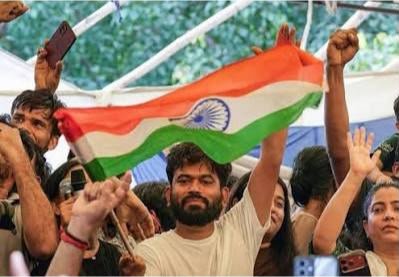
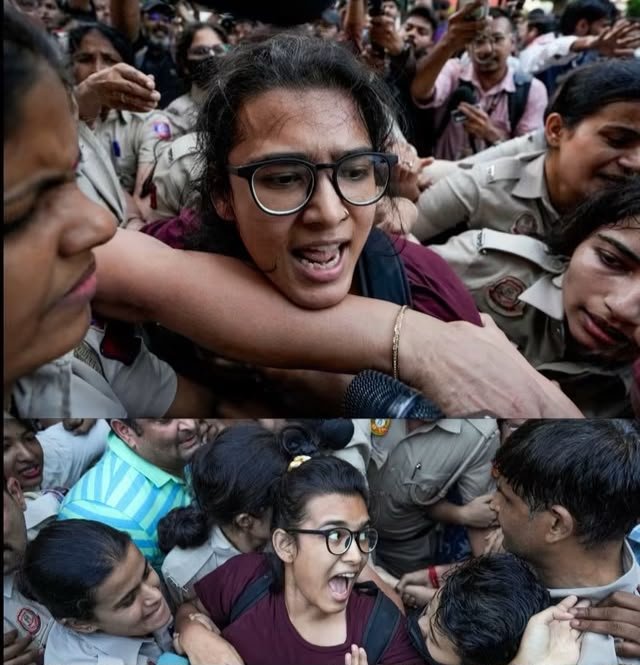
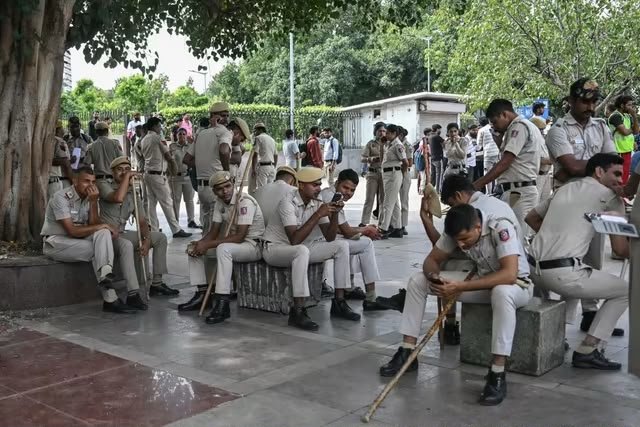
The scenes unfolding at Connaught Place on October 16, 2026, offered a stark, paradoxical vignette of contemporary Indian statecraft. Thousands of security personnel, reinforced by paramilitary units, transformed the beating heart of New Delhi into a grid of iron barricades and prohibitory orders. Their singular objective: to intercept, derail, and dismantle the “Lehra Do Tiranga” (Wave the Tricolour) march. As student leaders like Neha Bora were dragged into police vehicles and organizers like Cockroach Janta Party (CJP) founder Abhijit Dipke were detained, an unsettling truth became manifest. In modern India, the simple act of a citizen holding the national flag without state choreography has been reclassified as an act of subversion.
This aggressive clampdown reveals a deeper, structural anxiety within the ruling establishment. By weaponizing the saffron, white, and green banner against state overreach, the youth-led demonstrators did not merely protest local administrative failures; they staged a direct assault on the historical revisionism of the ruling elite. The panic in the capital’s streets exposes a profound ideological discomfort with the flag’s egalitarian origins—a friction that traces its roots directly back to the foundational philosophy of the Rashtriya Swayamsevak Sangh (RSS).
The Historical Aversion: A 52-Year Boycott
To understand why a flag-waving assembly triggers such a hostile state response, one must look past current political rhetoric and examine the institutional history of the Hindu nationalist movement. For over half a century following India’s independence, the RSS maintained a strict, unambiguous boycott of the tricolour. From 1947 until 2002, the national flag was famously never hoisted at its headquarters in Reshimbagh, Nagpur, or at any of its prominent offices across New Delhi.
This half-century omission was not a matter of bureaucratic oversight; it was a deliberate ideological rejection rooted in text and philosophy. On the eve of Independence in August 1947, the RSS mouthpiece, Organiser, published a scathing editorial declaring that the tricolour would never be respected or owned by Hindus. The publication argued that the number three was inherently inauspicious and that a flag featuring three colours would produce psychological damage and prove deeply injurious to the nation.
Instead of the tricolour, the early architects of Hindutva championed the Bhagwa Dhwaj (the saffron flag) as the sole authentic emblem of the Indian nation. M.S. Golwalkar, the second Sarsanghchalak (chief) of the RSS, explicitly criticized the constituent assembly’s choice in his foundational writings, Bunch of Thoughts. Golwalkar argued that India’s leaders had merely copied a revolutionary symbol from western contexts instead of choosing a flag that represented the ancient, pure essence of a singular cultural nation. For the RSS, the tricolour represented a dangerous compromise—a symbol of composite culture, secularism, and communal accommodation that stood at odds with their vision of a majoritarian state.
The rigidity of this stance was demonstrated in January 2001, when three secular activists from a youth organisation entered the RSS headquarters in Nagpur and forcibly hoisted the tricolour on Republic Day. Rather than celebrating the flag, the RSS leadership filed criminal charges against the youths, dragging them through a protracted legal battle that lasted for over a decade. It was only in 2002, facing intense public scrutiny and strict legal mandates under the newly amended Flag Code of India, that the RSS finally permitted the tricolour to fly over its Nagpur headquarters.
From Rejection to Co-optation: The Politics of Mandatory Nationalism
In recent years, the descendants of this philosophy have engineered a radical pivot. Realizing that explicit aversion was politically unsustainable, the ruling establishment shifted toward aggressive co-optation, culminating in initiatives like the “Har Ghar Tiranga” (Tricolour in Every Home) campaign. This state-sponsored push mandates that every citizen display the flag, effectively transforming a bottom-up symbol of anti-colonial resistance into a top-down instrument of state surveillance and mandatory compliance.
The “Har Ghar Tiranga” phenomenon serves a dual political purpose. First, it actively overwrites the RSS’s historical opt-out from the freedom movement, superimposing a narrative of foundational patriotism where none existed. Second, it weaponizes the flag to test the loyalty of citizens, particularly minority communities and dissidents. By shifting the flag from a symbol of citizen empowerment to a tool of state-mandated loyalty, the regime has attempted to colonize the visual vocabulary of Indian patriotism.
The Contradiction of the Monopolized Flag
The heavy security presence in central Delhi on October 16 exposes the fundamental hypocrisy of this selective nationalism. Under the current political climate, the tricolour is celebrated only when it serves as a banner for state power or majoritarian triumphalism. The moment the national flag is claimed by the youth, the working class, or opposition forces to demand civic rights and structural accountability, it is treated as contraband.
By occupying central Delhi with banners of saffron, white, and green, the “Lehra Do Tiranga” movement sought to rescue the tricolour from the grip of state-mandated choreography. The mass detentions of student leaders and activists emphasize a stark reality: the ruling establishment remains intensely uncomfortable with the flag’s original, secular promise. The capital’s heavily guarded streets indicate that while the state can compel a flag onto every roof through top-down mandates, it remains deeply terrified of what happens when that same flag is carried into the streets by citizens demanding structural accountability.

~Hasnain Naqvi is a former member of the history faculty at St. Xavier’s College, Mumbai….
The opinions expressed here are solely those of the author.