

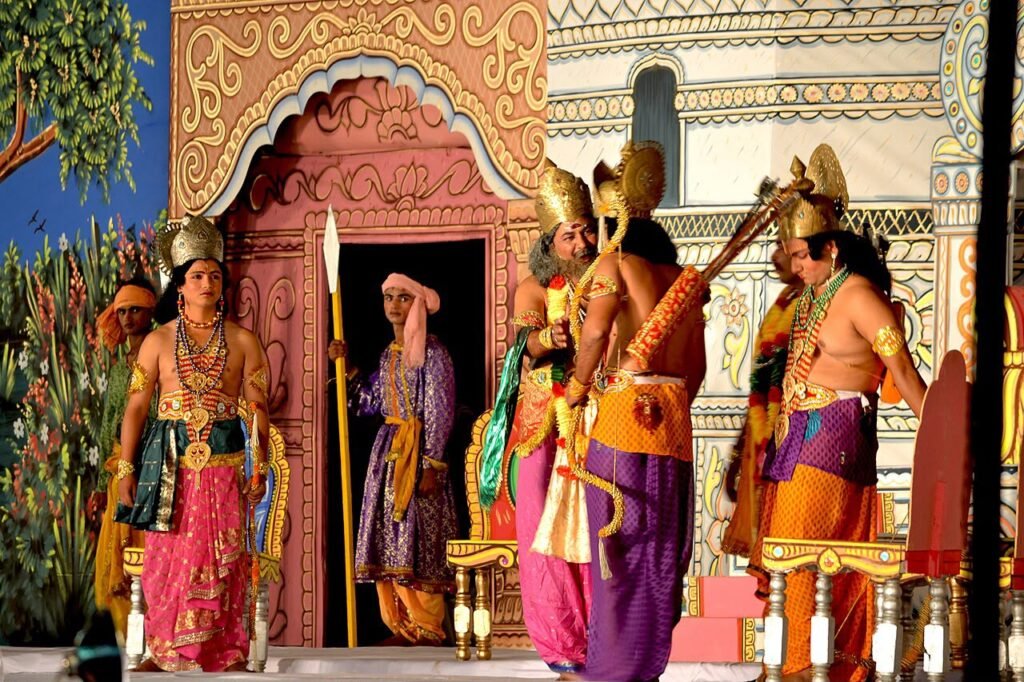
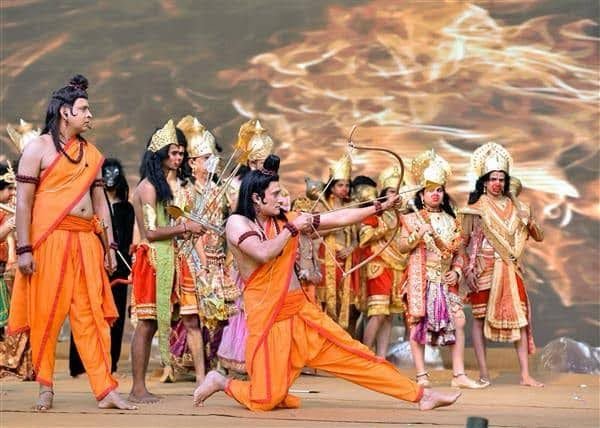
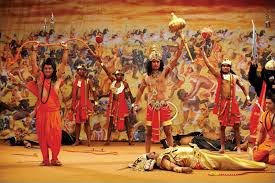
Every autumn, as the nights grow longer and the air turns crisp across the plains of northern India, makeshift stages rise in village squares, temple courtyards and city parks. Bamboo frames are lashed together, cloth backdrops painted with forests and palaces, and loudspeakers crackle into life. For ten days or more, ordinary people become gods, demons and devoted soldiers. This is Ram Leela, the traditional dramatic enactment of the Ramayana that reaches its fiery climax on Dussehra with the burning of Ravana’s towering effigy. More than a seasonal performance, it remains one of the most resilient and participatory cultural forms in the Indian public sphere.
Roots in Devotion and Community
The tradition of staging the story of Rama, Sita, Lakshmana and Hanuman in open-air performances has deep folk origins. Long before formal theatre halls existed, wandering storytellers and village actors kept the epic alive through dialogue, song and improvised action. Over centuries these informal enactments crystallised into organised Ram Leelas, especially in the Hindi-speaking heartland. In towns and cities the performances often stretch across the entire period of Navratri, building scene by scene towards the final victory of Rama over the ten-headed king of Lanka.
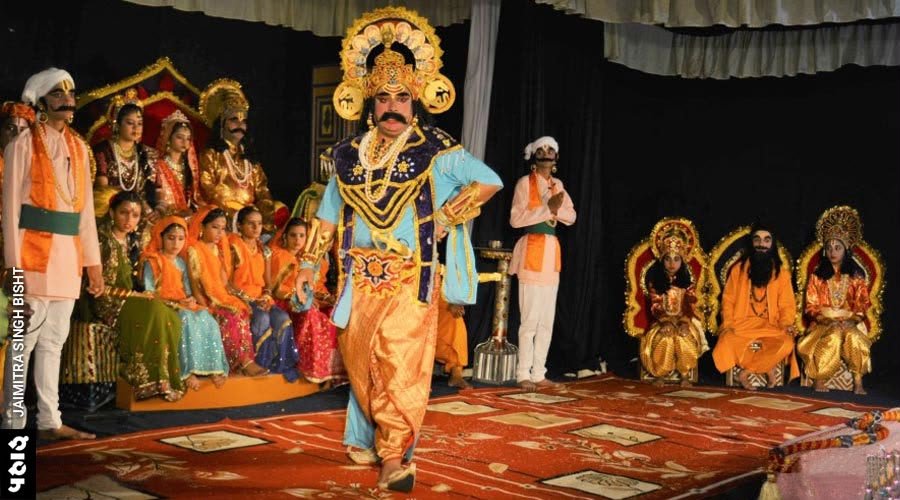
What distinguishes Ram Leela is its democratic character. Professional troupes may take the lead roles, yet the supporting cast is frequently drawn from the local community. Shopkeepers, teachers, students and labourers rehearse for weeks. Children play young Rama or the monkey army. Women increasingly appear in prominent roles once reserved for men. The stage itself is temporary and accessible: no tickets are required in most places, and spectators sit on the ground, on plastic chairs or on rooftops overlooking the maidan. The boundary between actor and audience remains porous. Spectators shout encouragement, boo the villains and sometimes even join the procession when the triumphant army returns.
The Ritual of Victory
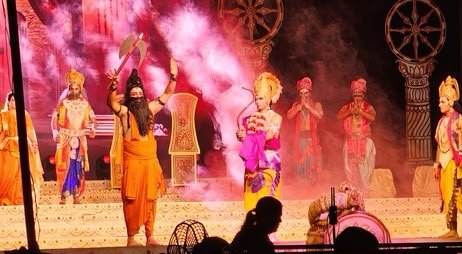
Dussehra, the tenth day, transforms the theatrical narrative into public ritual. The large effigy of Ravana, often stuffed with firecrackers and standing several storeys high, is set ablaze as Rama’s arrow is released. The flames, the explosions and the collective cheer mark the symbolic destruction of arrogance, deceit and tyranny. In many places the burning is accompanied by fireworks, processions and the distribution of prasad. The moment is both celebratory and didactic. It reaffirms the moral universe of the Ramayana in a language that requires no literacy: good ultimately prevails, but only after exile, loss, loyalty and sacrifice.
The visual power of the burning effigy has made Dussehra one of the most photogenic and widely reported festivals in the country. Yet the real strength of the tradition lies less in the final spectacle than in the days of storytelling that precede it. Night after night, audiences return to hear the same episodes—Rama’s banishment, the abduction of Sita, the building of the bridge to Lanka, the death of Indrajit—rendered with local colour, contemporary jokes and regional musical styles. The familiarity does not breed boredom; it creates a shared emotional vocabulary.
Cultural Influence Beyond the Stage
Ram Leela has shaped popular imagination far beyond the ten days of performance. Its language, gestures and character types have seeped into cinema, television serials, political rhetoric and everyday speech. Phrases drawn from the epic circulate in ordinary conversation. The ideal of Maryada Purushottam, the perfect man who places duty above personal desire, continues to serve as a cultural reference point even for those who never attend a performance. At the same time, the figure of Ravana has acquired complex afterlives—sometimes as pure villain, sometimes as a learned but flawed king whose destruction invites reflection on the costs of power.
The tradition has also functioned as a vehicle for social cohesion and, at times, quiet contestation. In mixed neighbourhoods the organising committees often cut across caste and community lines. Local businesses sponsor the stage and lighting. Schools encourage students to participate. For migrant workers in large cities, attending or acting in a Ram Leela can become a way of reclaiming a sense of home. In some regions the performances have adapted to include regional languages, folk instruments and contemporary social themes without abandoning the core narrative arc.
Cinema and later television amplified the reach of these stories, yet they never fully replaced the live form. The open-air Ram Leela retains an immediacy that recorded media cannot match. When Hanuman leaps across the stage or when Sita’s sorrow is sung in a high, unbroken note, the audience experiences the emotion collectively. The shared witnessing creates a temporary community bound by the same moral drama.
Continuity and Change
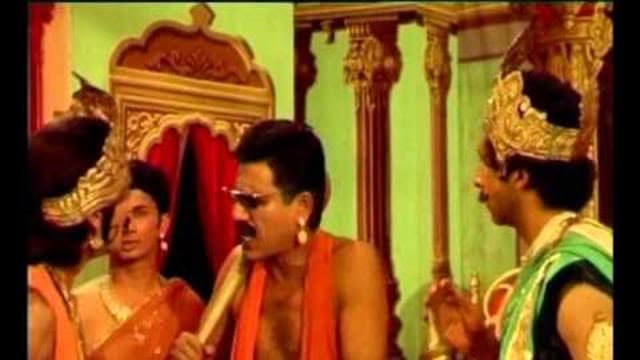
Like any living tradition, Ram Leela has had to negotiate modernity. Urban space is scarce, sponsorships fluctuate, and younger audiences are pulled towards other entertainments. Some troupes have shortened the cycle, introduced microphones and LED screens, or experimented with more naturalistic acting. Others have clung to older conventions—stylised movement, verse dialogue and male actors in female roles—as markers of authenticity. Both approaches coexist. The essential structure endures: the progressive unfolding of the epic, the ethical clarity of the climax, and the public nature of the event.
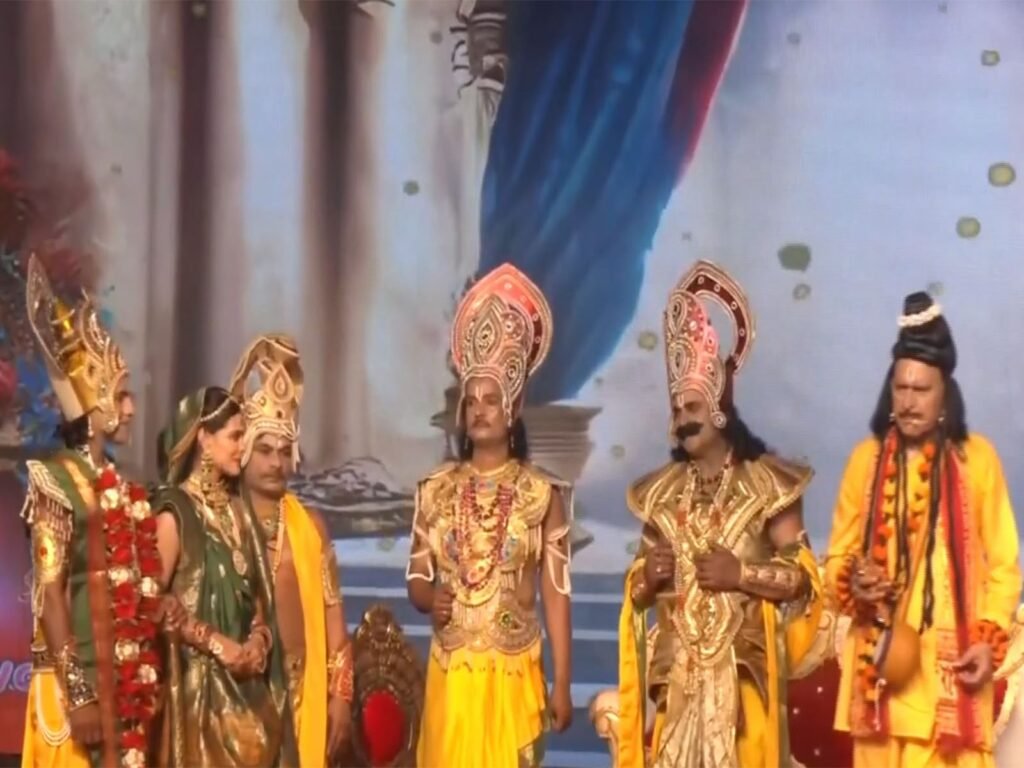
In rural areas the performances often retain a stronger ritual character, linked to local temples and agricultural cycles. In metropolitan centres they may become more theatrical and tourist-oriented, yet even there the core emotional contract with the audience remains. The appearance of political leaders or film celebrities at high-profile Dussehra events in Delhi or elsewhere only underlines how deeply the symbolism has entered the national conversation.
A Mirror Held Up to Society
The enduring significance of Ram Leela lies in its capacity to hold a mirror to society while remaining rooted in a classical narrative. It teaches through repetition and spectacle rather than through abstract argument. Children absorb the values of loyalty, courage and restraint by watching them enacted. Adults find in the familiar story a language for discussing power, exile, justice and the proper limits of ambition. The annual return of the performances creates a rhythm of cultural memory that outlasts individual lifetimes.
At a time when public culture is increasingly fragmented by digital platforms and commercial entertainment, the open-air Ram Leela continues to gather large numbers of people in physical space for a shared aesthetic and moral experience. It requires no advanced technology, only collective will, modest resources and a willingness to inhabit an ancient story for a few nights each year. In that sense it remains one of the most successful examples of living heritage in contemporary India—neither frozen in the past nor entirely surrendered to the present.
The flames that consume Ravana’s effigy each Dussehra do more than end a play. They renew a covenant between an epic and the people who still find meaning in its telling. As long as stages continue to rise in the autumn dark and ordinary voices continue to speak the lines of gods and kings, the tradition of Ram Leela will keep performing its quiet work of cultural transmission, one night at a time.

~Hasnain Naqvi is a former member of the history faculty at St. Xavier’s College, Mumbai….
The opinions expressed here are solely those of the author.