

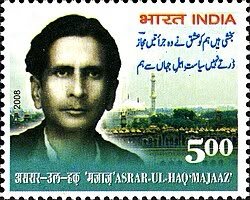
“Bakhshi hain hum ko ishq ne woh jurratein Majaz,
Darte nahi siyasat-e-ahl-e-jahan se hum.”
(“Love has endowed me with such courage,
O Majaz,
That I hold no fear of the politics of the people of this world.”)
Every year on October 19, the realm of South Asian literature turns its gaze toward the enduring legacy of Asrar-ul-Haq ‘Majaz’ Lakhnavi—a poet who brought an unparalleled blend of ethereal romance, burning angst, and revolutionary vigour to modern Indian verse. Popularly hailed as the “Keats of Urdu” for his intense lyricism, tragic brevity of life, and heightened sensitivity to both beauty and sorrow, Majaz remains one of the most captivating figures of twentieth-century poetry. Writing during an era charged with anti-colonial fervour and socio-political awakening, he moved seamlessly between intimate heartbreak and sweeping calls for social change. Decades after his untimely departure, his voice continues to resonate with profound intensity, capturing both the tender fragility of love and the defiant spirit of youth.
“Yeh mera chaman hai, mera chaman hai, main apne chaman ka bulbul hoon”
(This is my garden, my garden; I am the nightingale of my garden)
Born on October 19, 1911, in Rudauli, a town in Uttar Pradesh’s Barabanki district celebrated for its rich Sufi traditions, Majaz inherited literary sensibility as a birthright. His distinguished lineage included eminent poets such as Muztar Khairabadi. Though belonging to a zamindar (landowning) background, his household was notably progressive. His father, Sirajul Haq, was an exceptional figure among contemporary landowners—highly educated himself and employed in government service, he placed immense value on modern education in an era when many peers dismissed it.
Majaz’s academic journey took him from the Makhdumia School in Rudauli to Aminabad Inter College in Lucknow and St. John’s College in Agra. However, it was his relocation to Aligarh Muslim University (AMU) that truly forged his poetic destiny. Living in the hostel away from strict maternal oversight, the young Majaz tasted independence for the first time. The sudden freedom initially led him astray; he spent his pocket money freely, neglected his studies, and failed his examinations. Yet this period of youthful unruliness paved the way for a deeper artistic awakening. Surrounded by the vibrant intellectual milieu of Aligarh during the mid-1930s, Majaz came under the influence of the burgeoning Progressive Writers’ Movement and began composing serious poetry under the mentorship of the master poet Fani Badayuni. It was during these foundational years that he penned AMU’s iconic anthem—”Yeh mera chaman hai…”—a soaring ode that remains the eternal musical soul of the university to this day. Graduating in 1935, Majaz emerged from Aligarh not merely with a degree, but as a defining voice of a new generation.
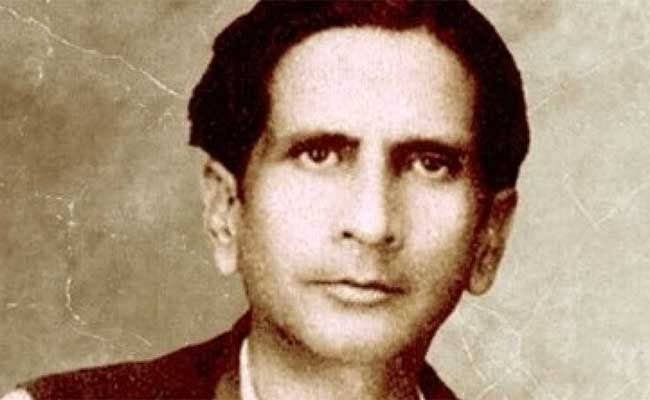
“Jo saaz se nikli hai woh naghma hai sabhi ka”
(The melody that springs from the instrument belongs to everyone)
Majaz entered the literary landscape at a time when Urdu poetry was experiencing a remarkable golden age. His contemporaries were not merely peers but lifelong soulmates: Faiz Ahmad Faiz, Ali Sardar Jafri, Makhdoom Mohiuddin, and Asrar-ul-Haq Jazbi. Their bond transcended literary rivalry. When Majaz published his debut poetry collection, Aahang, in 1938, he dedicated it to Faiz and Jazbi, referring to them as his “dil-o-jigar” (heart and soul). Faiz himself wrote the preface to the collection, cementing a fraternity that defined progressive Urdu literature. His camaraderie extended to Sahir Ludhianvi, who, despite initial reservations about Majaz’s heavy drinking, grew deeply devoted to him after witnessing the magnetic power of his verse.
Financial constraints eventually forced Majaz to leave his Master’s studies at AMU incomplete. He relocated to Delhi, taking up a position as sub-editor for Aawaz, the official Urdu journal of All India Radio. However, his devotion to the Progressive Writers’ Movement soon led him to relinquish his job so he could immerse himself completely in literary activism. Returning to Lucknow, he became the pulse of the city’s intellectual life and a cherished presence at the legendary Coffee House in Hazratganj.
Majaz’s literary portfolio expanded with celebrated volumes like Shab-e-taab and Saaz-e-Nau, along with landmark poems such as Nazr-e-Aligarh, Nora, and his masterpiece, Awara(The Wanderer). Awara captured the disillusionment, urban alienation, and romantic yearning of an entire era. His fame reached far beyond literary circles; during a visit to Lucknow, the legendary cinema star Nargis Dutt famously sought an audience with him, eager to meet the celebrated poet whose verses had captured the imagination of the nation.
“Shahr ki raat aur main naashad-o-naakaara phiroon”
(The night in the city, and I wander helpless and wretched)
While Majaz wrote passionately about social transformation, his internal world was deeply anchored in emotional vulnerability. Though aligned with the progressive movement, his true artistic inclination leaned toward love, beauty, and an acute, lingering loneliness. Unrequited romantic longing, coupled with an intense personal grief, cast a dark shadow over his existence. To numb his mounting despair, Majaz turned increasingly to alcohol—a habit that evolved into a severe, destructive addiction.
His emotional suffering eventually led to severe breakdowns, requiring treatment in a mental hospital. Yet, amidst this personal turmoil, Majaz remained connected to a rich cultural legacy. His sister Safia married the renowned poet Jan Nisar Akhtar, creating a family tree that would later produce the famous poet-lyricist Javed Akhtar (Majaz’s maternal nephew) and filmmaker Farhan Akhtar (his grand-nephew).
“Ik shama bujhi aur bazm-e-sukun maddham hai”
(A flame has gone out, and the gathering of peace grows dim)
The tragic climax of Majaz’s life arrived on a freezing night in December 1955. While Lucknow was hosting the first Students’ Urdu Convention, Majaz gathered with friends on the open rooftop of a tavern in the city’s Lalbagh area. As the night wore on and the temperature plummeted, his companions departed one by one, leaving Majaz behind—intoxicated, vulnerable, and exposed to the biting winter chill.
When the shop owner arrived the next morning, he found the poet lying on the rooftop in a critical, near-death state. He was rushed to the hospital, but recovery was beyond reach. On December 5, 1955, at the age of just forty-four, Asrar-ul-Haq ‘Majaz’ passed away. On December 7, a historic condolence assembly was convened at Lucknow’s Rifa-e-Aam Hall, drawing grieving writers and artists from across India to pay homage to a legend lost too soon.
The poet who died in cold solitude left behind a body of work that continues to radiate warmth and emotion. Generations of vocalists, most notably the ghazal maestro Jagjit Singh, have rendered his verses into timeless melodies, while his dramatic life inspired the 2017 biographical film Majaz: Ae Gham-e-Dil Kya Karoon, featuring Priyanshu Chatterjee.
On his birth anniversary, remembering Majaz Lakhnavi is a tribute to a poet who transformed personal sorrow into eternal music, leaving an indelible mark on the soul of Indian literature.

~Hasnain Naqvi is a former member of the history faculty at St. Xavier’s College, Mumbai….
The opinions expressed here are solely those of the author.