

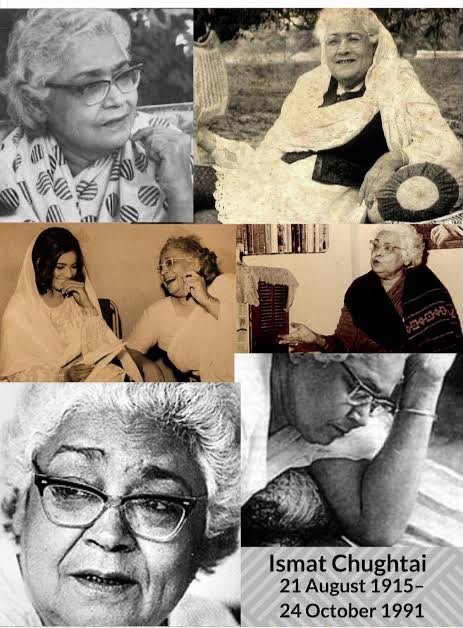
Thirty-five years after she left us on 24 October 1991, Ismat Chughtai remains a living presence in Urdu literature and in the wider cultural conscience of the subcontinent. She was not merely a writer; she was a force of nature who refused to let silence dictate the terms of human experience. On this anniversary, we remember not only the woman who wrote with searing honesty but the trailblazer who expanded the very possibilities of what literature could dare to say.
A Childhood Forged in Restlessness
Born into a large family in Budaun, Ismat grew up largely in the company of her brothers. Her sisters married early, leaving her free to roam, question, and absorb the rough-and-tumble world of boys. That early freedom shaped a temperament that would never accept the confines of the zenana or the polite evasions of middle-class respectability. Her father, a civil servant, moved the family across cities — Jodhpur, Agra, Aligarh — exposing her to varied social textures. Education became her chosen rebellion. She pursued higher studies at a time when few Muslim girls did, earning degrees and briefly working as a teacher and school inspectress before literature claimed her fully.
The Progressive Fire and the Shock of “Lihaaf”
Associated with the Progressive Writers’ Movement, Ismat absorbed its commitment to social realism and justice, yet she never allowed ideology to flatten her characters into types. She wrote about the women she knew — middle-class Muslim households, their hypocrisies, their suppressed hungers, their quiet acts of survival. When “Lihaaf” (Quilt) appeared in 1942, it detonated. The story of a neglected begum and her intimate relationship with a female attendant refused the comfortable silences around female desire. Charges of obscenity followed. Summoned to court in Lahore, Ismat stood her ground. The case collapsed because her accusers could not point to a single explicitly vulgar word. She emerged not chastened but confirmed in her conviction that truth, however uncomfortable, must be told.
That single story made her both infamous and indispensable. It also threatened to overshadow everything else she produced. Yet her range was extraordinary. Collections such as @Kaliyan” and “Choten” revealed a sharp eye for the everyday and a gift for colloquial, living speech that captured the cadences of women’s conversation with unmatched fidelity. Her novel “Terhi Lakeer” remains a landmark — a coming-of-age narrative that traces a young woman’s psychological and emotional journey with rare depth and candour, confronting nationalism, gender, and the crooked lines society draws around female lives.
Beyond the Page: Cinema and Continuity
Marriage to filmmaker Shaheed Latif opened another chapter. Together they moved through the world of Bombay cinema. Ismat wrote stories and dialogues for films including “Ziddi”, “Arzoo”, and “Sone Ki Chidiya”. She later contributed the original story for “Garam Hawa”, a film that remains one of the most humane portrayals of the Partition’s human cost. Even after Latif’s death she continued to engage with cinema, always bringing the same clear-eyed realism that defined her fiction.
Her later years brought formal recognition. The Padma Shri in 1976, the Ghalib Award, the Iqbal Samman — these were official acknowledgements of a body of work that had already changed the literary landscape. Yet she never became an establishment figure. She retained her irreverence, her humour, and her impatience with pretension until the end.
The Enduring Gift
What makes Ismat Chughtai indispensable is not simply that she wrote about taboo subjects. Many writers have done that. It is the quality of her attention — the way she listened to the unspoken, the half-said, the ordinary moments charged with tension and longing. Her prose moves with the speed and vitality of lived speech. Characters do not lecture; they breathe, quarrel, desire, compromise, and endure. She understood that the personal is political long before the phrase became fashionable, and she rendered that understanding in stories that still feel startlingly contemporary.
Thirty-five years after her death, translations continue to introduce her to new generations. Stage adaptations keep her words alive in performance. Young writers, especially women, still look to her as proof that one can write without apology, without softening the edges of experience. In an age that often prefers curated vulnerability to genuine risk, her example remains bracing.
Ismat Chughtai did not seek to be liked. She sought to be true. That commitment cost her comfort and earned her a place among the indispensable voices of modern Indian letters. On this anniversary we do not mourn a loss so much as celebrate a presence that refuses to fade. The quilt she once spread over uncomfortable truths still covers us, still warms us, still forces us to look beneath its folds. Her voice, once considered too bold, now feels essential — a reminder that literature’s highest duty is not to soothe but to awaken.

~Hasnain Naqvi is a former member of the history faculty at St. Xavier’s College, Mumbai….
The opinions expressed here are solely those of the author.