

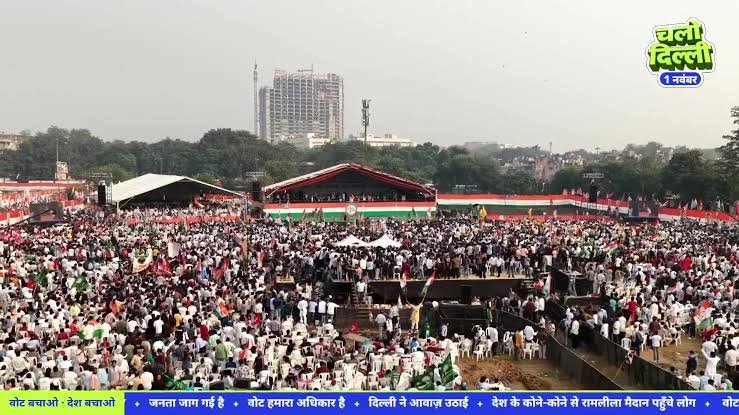
Though the full political impact of the massive opposition rally led by the Congress may take some time to unfold on the Modi government, one immediate outcome is already clear: the atmosphere of fear and apprehension gripping various sections of society and a segment of the liberal public is beginning to shatter. Those who had slowly started believing that autocratic rule had become an inescapable reality can finally breathe a sigh of relief.
For a long time, a large section of people connected with secular political ideologies, social activists, professionals, and intellectuals had begun feeling that there was no end in sight to the authoritarian rule of the RSS-BJP establishment. They feared that, having mastered the art of influencing elections and tightening their grip on power, removing the BJP from office would become nearly impossible.
It is somewhat surprising that they failed to recognize the true nature of the RSS-BJP from the very beginning. Anyone even slightly familiar with the ideological background of the RSS and its leaders—whether founder K.B. Hedgewar or M.S. Golwalkar—could easily understand the kind of governance a government inspired by RSS ideology would impose upon coming to power in Delhi.
Perhaps Atal Bihari Vajpayee’s relatively liberal and inclusive personality, alongside his open-door political style, created the impression that the RSS was not as villainous as its political opponents made it out to be. A poet at heart and a product of India’s composite culture (Ganga-Jamuni tehzeeb), Vajpayee was committed to RSS ideology, yet he was neither as intolerant nor as arrogant as Narendra Modi. He possessed a self-assurance that historian Wells Hangen aptly described as a kind of Brahminical self-confidence. However, this self-assurance did not lead him to view everyone who disagreed with him as an enemy. Moreover, unlike Modi, he did not appear to harbor a personal agenda to promote a select group of powerful corporate friends.
When Modi claims that India made no significant progress in the 70 years prior to his coming to power, he cleverly includes the six years during which a leader from his own party’s foundational lineage led the country’s government. In fact, it was Vajpayee’s relatively soft and diplomatic style of governance that created the political space allowing Modi to eventually reach the pinnacle of power without facing serious resistance.
Modi’s governance style stood in stark contrast to India’s liberal and democratic political traditions. These traditions have continuously reflected a spirit of resistance inherited from the freedom struggle and a politics that challenges authority. Non-violent mass movements, a fearless and critical attitude toward those in the highest positions of power, and the freedom to question political authority have never been taboo in independent India. Over the decades, these tendencies have become an integral part of the country’s evolving democratic culture.
During the freedom struggle, many leaders from affluent and elite families sacrificed their privileges and wealth to participate in the independence movement. Their example, combined with the Indian cultural tradition that honors sages and seers above kings, taught generations of Indians not to be intimidated or swayed by wealth and political power.
This cultural heritage was fundamentally different from the disciplined and rigid ideology of the RSS. Despite claiming loyalty to ancient Indian culture, the organization drew considerable inspiration from fascist movements that emerged in Europe before World War II. In some RSS circles, Hitler’s Germany was occasionally mentioned in an appreciative tone. The underlying argument was that Hindus—allegedly having suffered centuries of slavery and oppression—needed to be organized as a disciplined and militant force to protect themselves against perceived Muslim tyranny.
This mindset reflected a distorted understanding of Indian society and history. Yet, it gained support among certain sections of Hindus, particularly those who experienced the tragedy of Partition and displacement from Pakistan. The Bharatiya Jana Sangh was founded in 1951, later becoming the predecessor to the BJP. However, the broader ideological agenda of the RSS has continued to center on preserving traditional social and power structures that historically granted privileges to upper-caste Hindus—structures that existed long before the advent of Islam and Muslim rulers in India.
While Modi may not have fully grasped all the deep ideological currents operating within the RSS, he pursued its majoritarian and anti-minority agenda with extraordinary zeal. His corporate supporters provided financial resources, management expertise, and access to influential media platforms. His limited understanding of India’s complex social history also prevented him from appreciating the country’s exceptional cultural and social diversity.
Dissenting voices within and outside the BJP were systematically suppressed through the combined use of political power, financial might, and government machinery. A sympathetic bureaucracy and a compliant media helped shape an image of Modi that made his personality appear far larger than reality. Emboldened by this cult of personality, he increasingly began to act like an autocrat, seemingly forgetting that even the most powerful government in a democracy operates within constitutional and institutional boundaries.
As the initial euphoria surrounding the purported revival of Hindu rule after a thousand years gradually faded, economic realities set in, and cracks began to show in the BJP’s electoral performance. Despite this, opposition parties, liberal think tanks, middle-class professionals, and intellectuals largely failed to grasp the significance of these developments. Many of them had accepted living under what they termed a neo-fascist regime as their destiny.
The persistent efforts of a handful of opposition leaders—including Rahul Gandhi, Mamata Banerjee, Akhilesh Yadav, and the aging and ailing Lalu Prasad Yadav—were frequently dismissed as futile. The resistance put up by certain journalists, intellectuals, and social activists was likewise viewed as an endeavor with very little chance of shifting the political landscape.
Yet, those who had surrendered to an autocratic and heavily disciplined system proved to be equally mistaken. There is no doubt that under Modi’s rule, dissenting voices were curtailed and public protests were made increasingly difficult and risky. However, despite allegations of electoral manipulation, this was never the ultimate truth of India’s political future.
India is far too complex and diverse a country to be permanently held under the control of a narrow, sectarian ideology. The nation also has a long-standing tradition of questioning authority and resisting oppressive rulers. Seventy-five years of democratic governance, 12 Lok Sabha elections, and around 500 state assembly elections have only served to strengthen these democratic tendencies and institutions.
The RSS-BJP leadership—particularly Modi and his associates from Gujarat—was wrong to believe that their near-total control over the political system could last indefinitely. Similarly, those members of the opposition and civil society who began treating autocratic rule as an unchangeable reality were also mistaken.
While the November 1 rally may not in itself signal a decisive turning point in Indian politics, its broader significance lies in restoring the confidence of those who believe in democracy, secularism, pluralism, and constitutional values. The rally has reminded them that resistance is possible and that the prospect of political change has not come to an end.
The idea of an inclusive, secular, and liberal India has once again returned to the center of the national political landscape.

(The author is a senior journalist and media guru. Prof. Pradeep Mathur is the head of Media Map News Network and president of the voluntary organization MBKM Foundation.)