

A wave, not merely a win
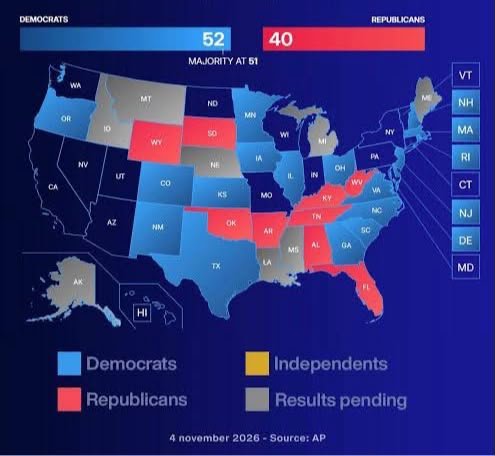
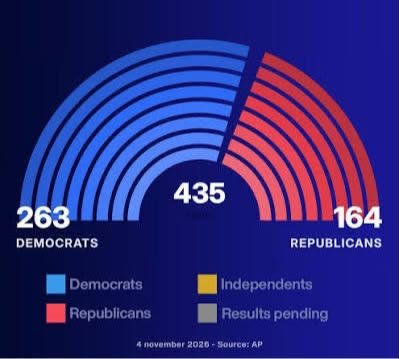
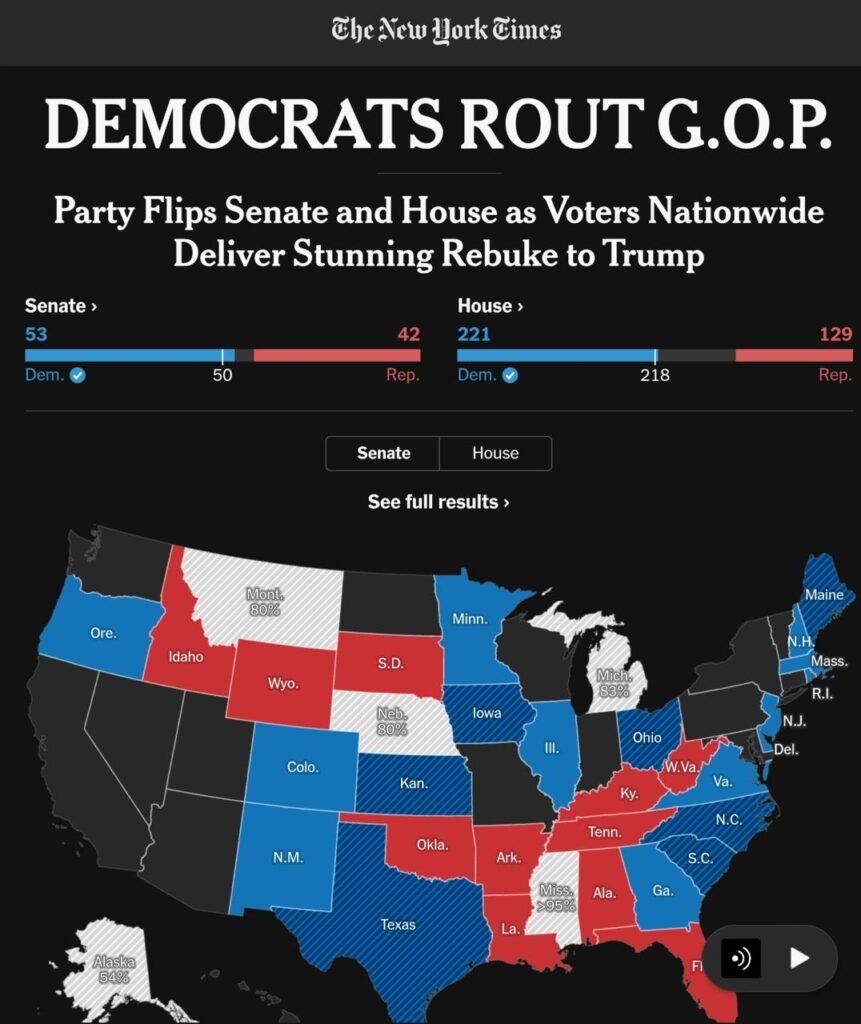
The 2026 midterms were not a routine correction; they were a sweeping political repudiation. Democrats flipped control of both the House and Senate, gaining more than 20 House seats and at least seven Senate seats—including in Texas, Kansas, Ohio, Iowa, Maine, North Carolina and South Carolina—while reclaiming a majority of governorships for the first time in two decades.
The scale matters. This was not simply an anti-incumbent protest confined to suburbs or swing states. Democrats broke through in states long treated as Republican fortresses, including Kansas, which had not elected a Democratic senator in nearly a century, and South Carolina. The result suggests that discontent with President Donald Trump’s second term has become broad enough to overcome partisan geography, gerrymandering and the usual midterm penalty faced by the party out of power.
Why voters rebelled
The central message was economic. Roughly two-thirds of voters told pollsters that Trump’s policies had made the economy worse, while inflation—an issue Trump had promised to tame—had worsened rather than eased. For many households, the election was less about abstract ideology than about grocery bills, housing costs, tariffs and the feeling that promised prosperity had failed to arrive.
There was also a constitutional dimension. About seven in 10 voters said Congress was not doing enough to check the president. That sentiment gave Democrats a mandate that goes beyond policy: voters appear to have sought a restoration of institutional balance after two years of unified Republican control in Washington.
The Democratic coalition, however, should not be mistaken for an enthusiastic endorsement. The party’s advantage on economic issues was described as slim, and its victory owes as much to Republican collapse as to Democratic persuasion. If Democrats interpret this as approval for a maximalist agenda, they may squander the very opportunity voters have handed them.
Washington enters divided government
For the final two years of Trump’s term, legislative gridlock is now the default. Democrats can block or reshape legislation, control committee investigations, subpoena administration officials and use the power of the purse. Trump, meanwhile, retains the veto pen and the bully pulpit.
That produces a familiar but volatile arrangement: divided government can restrain excess, yet it can also harden polarization. The likeliest near-term battles will concern spending, tariffs, healthcare, immigration enforcement and oversight of the executive branch. Democrats may pursue investigations and even talk of impeachment, but such moves risk being read by voters as partisan retaliation unless tied tightly to concrete evidence and tangible economic relief.
The more consequential test is whether divided government produces negotiation rather than paralysis. Trump has publicly signalled willingness to work with Democrats, but his record suggests that cooperation will be conditional, transactional and easily disrupted. Democrats, for their part, must decide whether they are governing a resistance or attempting to repair a country whose trust in institutions has been badly eroded.
The economy: tariffs meet reality
The election was, in effect, a referendum on the price of Trumpism. Tariffs imposed on dozens of countries raised consumer prices and became a visible symbol of a trade policy that promised leverage but delivered household pain.
Democrats cannot simply repeal tariffs by legislation alone, especially where executive authority and legal battles are involved. But Congress can constrain further escalation, investigate the economic consequences, and force a more public accounting of who benefits and who pays. The practical question is whether Washington can move from tariff theatre to a coherent strategy that protects strategic industries without treating consumers as collateral damage.
The deeper danger is stagnation. If both parties treat the economy as a battlefield for retaliation rather than a shared emergency, inflation, debt, housing shortages and industrial decline will remain unsolved. The midterm verdict gives Democrats leverage; it does not give them an economic programme that voters have yet fully endorsed.
Society: representation and resentment
The results also reshaped American political representation. Voters elected a record number of women governors, with at least 17 set to serve as state chief executives. For the first time in U.S. history, multiple Black governors will serve simultaneously, including Democrats Keisha Lance Bottoms in Georgia and David Crowley in Wisconsin, alongside Republican Byron Donalds in Florida.
These milestones are meaningful in a country still wrestling with racial and gender inequality. Yet representation alone will not resolve the social tensions that defined the campaign. The Democratic sweep included victories in culturally conservative regions, indicating that voters there were not necessarily embracing progressive social politics wholesale; many were rejecting economic insecurity and executive overreach.
That distinction should temper triumphalism. The country has not become uniformly liberal. It has demanded competence, affordability and restraint. A Democratic Party that reads the result as a mandate for cultural confrontation may find its coalition fragile by 2028.
Foreign policy: limits of congressional power
Abroad, the Democratic victory will complicate Trump’s agenda but not control it. The president retains broad unilateral authority in foreign affairs, and much of his policy toward Iran, Venezuela and trade has advanced through executive action. Congress can restrict funding, block appointments and conduct oversight, but it cannot easily prevent every sudden presidential move.
Still, the new Congress changes the diplomatic weather. Democrats are likely to press for stronger support for Ukraine, more scrutiny of escalation with Iran, and a less erratic approach to allies. Trump’s veto power may blunt legislation, but the threat of funding restrictions, investigations and political resistance can alter the president’s calculations.
The most important shift may be psychological. Allies no longer need to assume that Trump speaks for a compliant Congress. Adversaries, likewise, can no longer assume that American policy will remain wholly unconstrained by domestic institutions. That restores a measure of predictability—but also creates the risk of contradictory signals if the White House and Congress publicly divide over war, sanctions or alliances.
Geopolitics: a more contested American promise
Geopolitically, the midterms signal that American power remains immense but its coherence is increasingly uncertain. European capitals, Asian allies and Middle Eastern governments will now calculate not only what Trump wants, but what Congress will fund, investigate or resist. That can be healthy: it makes rash military adventures and unilateral tariff shocks harder to sustain. It can also be destabilising if foreign leaders conclude that Washington’s commitments expire with every election.
For Ukraine, Democratic control creates an opening to revive assistance and oversight, though presidential veto power remains a major obstacle. For Iran and Venezuela, Congress may restrain escalation through funding and scrutiny, but it cannot fully neutralise executive military or diplomatic action. For trade, the result challenges the idea that tariff confrontation is politically cost-free; the electoral backlash suggests that economic coercion abroad can become economic punishment at home.
The verdict ahead
The 2026 midterms have delivered a forceful correction, not a settled settlement. Voters have chosen checks on Trump, relief from economic strain and a Congress capable of saying no. Whether that becomes durable governance depends on whether Democrats use their new power to lower prices, restore institutional credibility and offer a credible alternative—rather than merely to prosecute the previous two years.
America has rejected unchecked power. The harder task now is to replace it with something better than gridlock.

~Hasnain Naqvi is a former member of the history faculty at St. Xavier’s College, Mumbai….
The opinions expressed here are solely those of the author.