
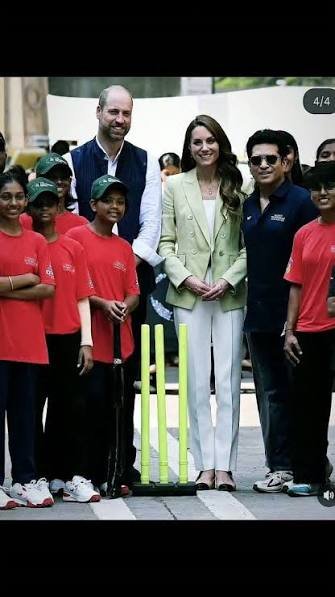
It wasn’t exactly “gali cricket” as played on the streets in India and many former colonies. On November 19, Catherine, Princess of Wales, played cricket with Prince William, the future king, and Sachin Tendulkar, at Mumbai’s Ballard Estate, with imposing colonial-era buildings nearby. It was the perfect setting for the latest India-Britain interaction.
Whoever thought of cricket, brought by the British, must have had in mind India’s current, prominent role in promoting the game. While providing a sense of continuity, it contrasted with William’s father (King Charles III) and grandparents, Queen Elizabeth II and Prince Philip, who rode elephants and were hosted at royal palaces during their Indian visits.
The Indo-British relations today defy a clear definition. History plays a role, but the present is hugely different and diverse. Once the “Jewel in the Crown”, India has overtaken the British economy and sits at the high table in the world forums on its own merit and heft. It is not a fledgling nation tied to the apron strings of the erstwhile ruler. The ties are between two equals on most counts.
The path has been uneven, though. India’s anti-colonial and anti-British rhetoric is confined to history, literature and cinema. It does not overshadow its ties with the world. It is mentioned, like Shashi Tharoor looking Britain’s elite in the eye at Oxford, reminding them of the sins their ancestors committed, but without rancour. India has gone well beyond the industrial revolution that it had missed during the colonial era.
A high level of political understanding has evolved, although India has had a single prime minister in the last decade, while Britain has seen seven. One point of tension is the diaspora. India sees two million British Indians as a potential ally and asset. But it also sees sections of it, like illegal migrants and the separatist Kashmiri and the Khalistan movements, as a possible threat and liability. They are among the few, but serious, irritants.
“Money makes the mare go” is an English proverb that explains that economic ties are key to the relationship. Both know it well, being currently buffeted by Donald Trump’s tariff terrorism and Vladimir Putin’s oil diplomacy. Britain watches India, once an important in its “Great Game”, engaging Russia, China and other Europeans without rancour.
The bilateral trade agreement took a long time to conclude, after considerable give-and-take, but without any favours or largesse. The agreement is expected to increase bilateral trade by £25.5bn ($33bn) annually in the long term, according to British government estimates, by reducing tariffs and removing barriers across a range of industries. Trade had already reached nearly £48bn ($63bn) in 2025, reflecting the growing economic stakes for both sides.
According to a paper published in July 2026 by New Delhi-based PHD Chamber of Commerce, there has been no significant impact of Brexit on any sector of the Indian economy. The issue would be irrelevant if Britain decides to exit Brexit.
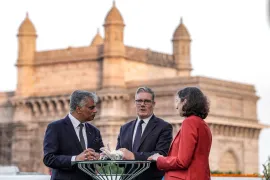
Beyond trade, India and Britain have also increased cooperation in defence and security, and emerging technologies and clean energy. In October 2025, they signed a $465m deal to supply India with UK-manufactured lightweight multirole missiles.
Simultaneously, India announced that the two sides had agreed to establish centres for connectivity, innovation and artificial intelligence, alongside a critical minerals industry group which aims at strengthening supply chains and advancing green technologies.
India and Britain share a Comprehensive Strategic Partnership guided by Roadmap 2030 and Vision 2035, anchored by the Comprehensive Economic and Trade Agreement (CETA) that entered into force in July 2026.
As for British ‘goodies’, the talk in the drawing-rooms of India’s elite is about Scotch whisky becoming cheaper. But India imports from elsewhere, and also exports alcohol. That makes the Scotch’s presence in India’s bars no more than, “eh, well, glad you are here.”
India makes and markets beer. Its big ‘export’ to Britain, by the way, is Lord Karan Bilimoria, who makes Cobra beer in England.
British prime ministers in recent years have acknowledged the Indian ‘invasion’, from Tata Tea (Tetley) to Jaguar and steel and have included Indian settlers as ministers. And by the way, Rishi Sunak led Britain for nearly two years.
George Bernard Shaw once wrote that the English language “simply disappears in America.” If he were alive, he could coin a different description of what has happened to the language in India, its largest user today.
Nearly eighty years since it became free from the British, India has ‘colonised’ the English language, perhaps, to greater advantage than any other erstwhile colony – and Britain itself. Using it as an effective tool of communication and commerce, it has pushed its own development and sought to earn a place in the global economy. One testimony to this heft is that it attracts resentment in the US, the global superpower, even making it a political issue in American elections. Six Indian Americans won this month’s midterm polls.
The language has seeped in an India that speaks numerous languages, a score of them officially. While English remains the language in higher courts in India, the laws have Sanskrit-based names. But the provisions, albeit with numerous amendments, remain wedded to the Anglo-Saxon law.
The strident demand to remove the English language has softened over time. Socialists and nationalists alike send their wards to English-medium schools and colleges and to the West for higher studies. Note the rise of English-medium private schools in Indian cities that flaunt fictitious names of ‘Saint’, ‘Mother’ and ‘Convent’ and collaborate with English-language institutions abroad to set up their campuses in India.
The ‘nationalist’ political rhetoric in the last decade has been strident. But the targets are not Britain, things British or the British legacy. They are “Macaulay’s Children”, named after the British officer who introduced English-language education in colonial India. The ‘children’ are accused of dominating the discourse under Nehru and the Gandhis. They are also called the “Khan Market Gang”, after a market in New Delhi frequented by the elite – not that the powerful new ‘non-elite’ is keeping away from it. This new elite is chasing the same English language, nursing the same dreams, and seeking to emulate the ‘gangsters’ to push their way up.
Amitabh Bachchan’s famous lines about the English language, rendered in his own inimitable style, from the 1982 film Namak Halaal, carry India’s overall relations, too, beyond the language: “I can talk English, I can walk English, I can laugh English, because English is a very funny language.”

Mahendra Ved is a veteran Journalist and an Expert on international affairs.