

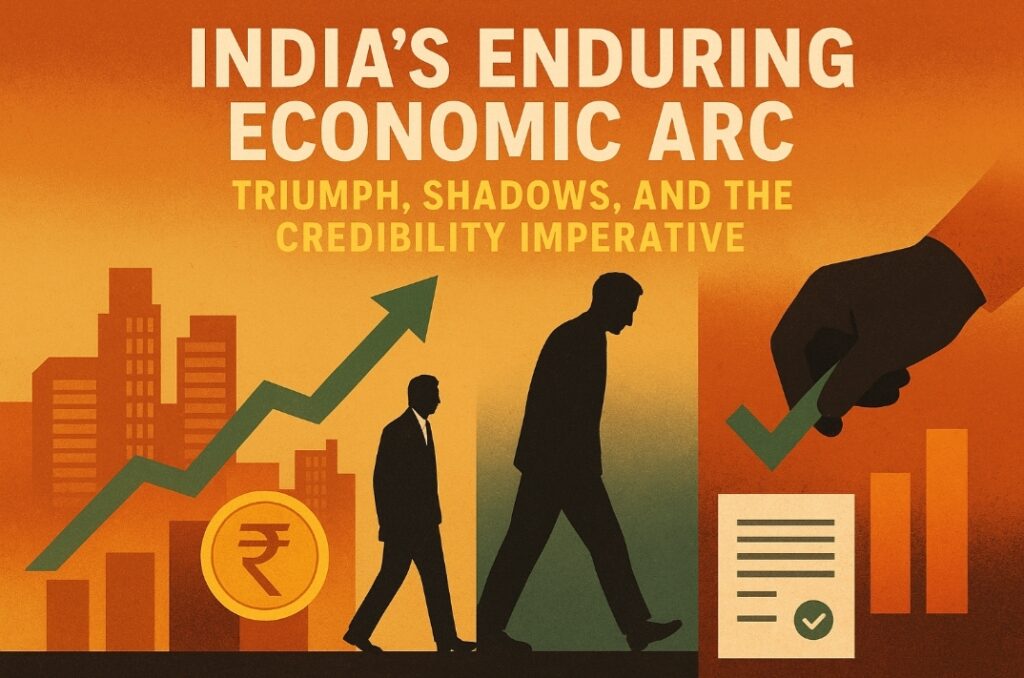
India’s economic saga spans ancient pre-eminence, colonial devastation, and a modern resurgence that positions it as the world’s fourth-largest economy in nominal terms and third in purchasing power parity, with nominal GDP at $4.19 trillion. Recent data from the National Accounts Statistics reveal an 8.2 percent real GDP growth in the July-September 2025 quarter—a six-quarter high fuelled by 9.1 percent manufacturing expansion and 9.2 percent services growth—lifting half-year figures to 8 percent and affirming India’s status as the fastest-growing major economy. Yet this momentum collides with a stark caution from the International Monetary Fund, which in its 2025 Article IV consultation retained a “C” grade for India’s national accounts, deeming GDP data “not fully credible” due to methodological flaws, an outdated 2011-12 base year, informal sector gaps, and delayed revisions—a first-time formal downgrade signalling urgency ahead of the promised February 2026 series overhaul.
Ancient and Mughal Peaks
Centuries ago, the Maurya Empire in the 4th century BCE and the Gupta era (4th-6th centuries CE) each commanded nearly one-third of global GDP, driven by fertile Gangetic agriculture, advanced irrigation, mathematics, metallurgy, and bustling ports like Tamralipti linking to Roman and Southeast Asian trade. By 1600, Mughal India sustained a 24 percent global share—outpacing Europe—with a diversified economy blending 52 percent agriculture, 18 percent industry via textiles and shipbuilding, and 29 percent services, bolstered by the Grand Trunk Road and inclusive taxation that forged a vast continental market.
Colonial Plunder and Post-Independence Foundations
British rule eroded this dominance, slashing India’s world GDP share from 16 percent in 1820 to 4 percent by 1947 through deindustrialization, raw material extraction, and famines like Bengal’s 1943 tragedy, leaving independence with a $30 billion GDP and $250 per capita income. Nehru’s socialist plans built heavy industry—Bhilai steel, Rourkela plants, IITs—and the 1960s Green Revolution doubled food grains, yielding 3.5 percent annual growth over three decades despite the licence-raj’s stifling grip.
Liberalization’s Leap Forward
The 1991 crisis sparked reforms that slashed tariffs, deregulated sectors, and invited FDI, propelling growth to 8-9 percent in the 2000s via IT, pharma, and autos; GDP surged from $320 billion then to $1.8 trillion by 2010 and $4.19 trillion now, with per capita income at $2,900—over eleven times 1947 levels. Services now dominate over shrinking agriculture, though manufacturing lags ambitions, while initiatives like Make in India and digital infrastructure draw $100 billion annual FDI, integrating 1.4 billion into formal finance.
Persistent Gaps Amid Headline Gains
High growth masks fractures: unemployment at 5.2 percent (October 2025) hides youth underemployment; roughly 800 million rely on public food rations amid nutrition shortfalls; and inequality endures despite poverty’s retreat. The IMF’s “C” grade underscores these tensions, as outdated metrics and census delays question if 8.2 percent truly captures informal realities or policy impacts. Structural shifts—from agrarian majorities to service-led output—demand credible tracking to bridge macro triumphs and micro struggles.
India’s path from millennia of wealth to $5 trillion ambitions by 2027 evokes resilience, but history warns that resurgence endures only through transparent data, equitable policies, and human capital investments ensuring growth reaches every household.
Hasnain Naqvi is a former member of the history faculty at St. Xavier’s College, Mumbai

~Hasnain Naqvi is a former member of the history faculty at St. Xavier’s College, Mumbai….
The opinions expressed here are solely those of the author.