

“Vo gaya to saath hi le gaya sabhi rang utaar ke shehar kaKoi shakhs tha mere shehar me kisi door-paar ke shehar ka
Kisi aur des ki aur ko suna hai, ‘Faraz’ chala gaya
Sabhi dukh samait ke shehar ka, sabhi qarz utaar ke shehar ka”
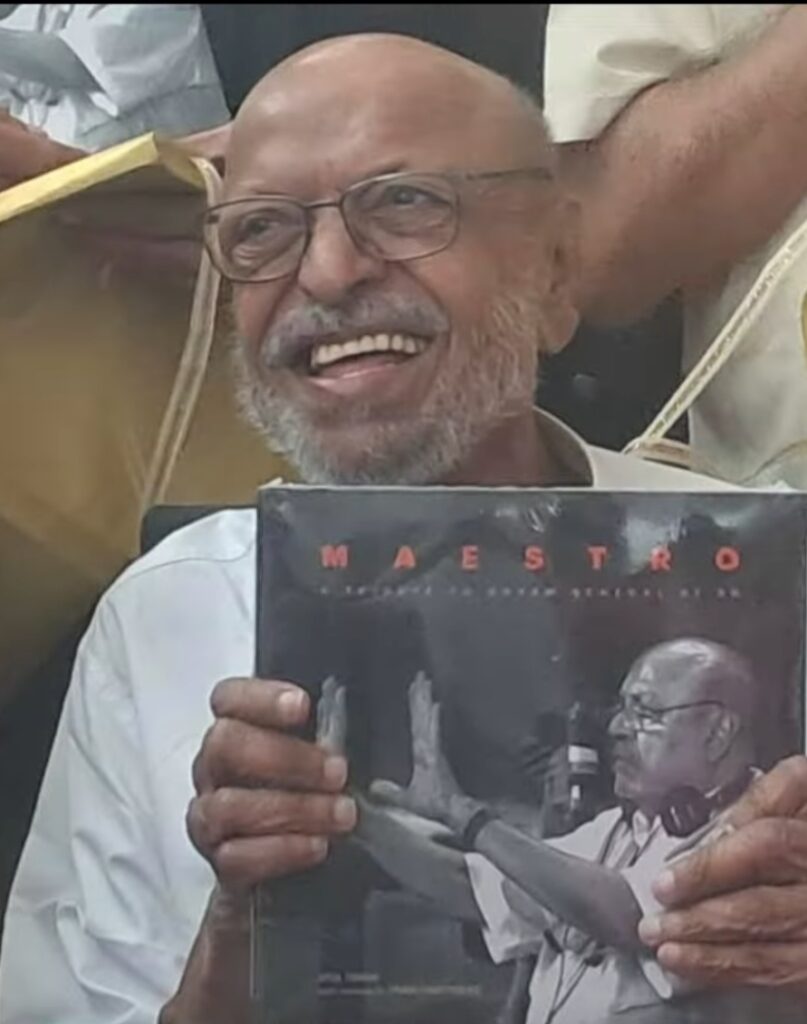
Shyam Benegal: The Enduring Light of Parallel Cinema
On the first anniversary of his passing on December 23, we honour Shyam Benegal, India’s unparalleled pioneer of parallel cinema, whose five-decade legacy reshaped the nation’s cinematic soul.
From Hyderabad Roots to Cinematic Awakening
Born on December 14, 1934, in Tirumalagiri, Hyderabad, into a Konkani-speaking Chitrapur Saraswat Brahmin family, Benegal grew up amid visual artistry. His father, Sridhar B. Benegal, excelled in photography, and his paternal grandmother linked him to Guru Dutt’s lineage. At twelve, a father’s gift of a camera sparked his first film, igniting a lifelong passion.
Benegal earned an M.A. in Economics from Osmania University, where he founded the Hyderabad Film Society. In 1959, he joined Lintas Advertising in Mumbai, rising to creative head while directing his debut documentary, *Gher Betha Ganga* (1962), in Gujarati.
Pioneering Parallel Cinema’s Golden Wave
Teaching at the Film and Television Institute of India (FTII) from 1966 to 1973, Benegal crafted the acclaimed *A Child of the Streets* (1967). A 1970 Homi J. Bhabha Fellowship took him to New York’s Children’s Television Workshop and Boston’s WGBH-TV.
His 1974 debut feature, *Ankur*, starring Shabana Azmi and Anant Nag, shattered conventions, probing feudalism, social injustice, and human bonds. *Nishant* (1975), with Girish Karnad, Azmi, Anant Nag, and Amrish Puri, exposed power’s corruption, earning a Cannes Palme d’Or nomination and the National Film Award for Best Feature Film in Hindi.
*Bhumika* (1977), inspired by Hansa Wadkar’s life and starring Smita Patil, Amol Palekar, and Anant Nag, won the Filmfare Best Movie Award and Patil the National Film Award for Best Actress. These four—*Ankur*, *Nishant*, *Manthan*, and *Bhumika*—ignited parallel cinema’s second wave alongside Gulzar, Mani Kaul, and Govind Nihalani.
*Manthan* (1976), crowdfunded by 500,000 farmers, chronicled the White Revolution with Girish Karnad, Smita Patil, and Naseeruddin Shah. Benegal’s rigorous research, including collaboration with Dr. Verghese Kurien, ensured authenticity.
Blending History, Satire, and Women’s Voices
Collaborations with Shashi Kapoor yielded *Junoon* (1978), an interracial love saga amid the 1857 Rebellion, and *Kalyug* (1981), a Mahabharata retelling in corporate shadows—both securing top National Film Awards. *Mandi* (1983), adapting Ghulam Abbas’s “Aanandi,” satirized societal hypocrisies through a clan’s relocation.
The 1980s-90s brought *Arohan* (1982), *Trikaal* (1985), *Susman* (1985), *Antarnaad* (1991), *Suraj Ka Satvan Ghoda* (1993)—a Rashomon-esque take on Dharamvir Bharti’s novel—*Samar* (1999), and *Hari-Bhari* (2000). His 1985 documentary on Satyajit Ray remains a gem.
Khalid Mohamed’s women-centric trilogy shone: *Mammo* (1994) on Partition’s emotional scars; *Sardari Begum* (1996), earning the National Film Award for Best Feature Film in Urdu, tracing a singer’s patriarchal battles; and *Zubeidaa* (2001), a National Award winner for Best Feature Film in Hindi, charting one woman’s quest for autonomy.
Later triumphs included *The Making of the Mahatma* (1996), *Netaji Subhas Chandra Bose: The Forgotten Hero* (2005), *Welcome to Sajjanpur* (2008), *Well Done Abba* (2008), and *Mujib: The Making of a Nation* (2023). Television milestones: *Yatra* (1986), the 53-episode *Bharat Ek Khoj* (1988) from Nehru’s *Discovery of India*, and *Samvidhaan* (2014).
Champion of Justice, Nuance, and Transformation
Benegal wielded cinema against patriarchy, caste exploitation, power abuses, and rural-urban divides. *Ankur* indicted upper-caste predation on Dalit lives; *Nishant* rural elites’ tyranny. Strong women—via Patil, Azmi, Naseeruddin Shah, Om Puri—embodied resilience.
He mastered history (*Junoon*, *Bose*, *Bharat Ek Khoj*) and grassroots change, as in *Manthan*’s cooperatives or *Susman*’s weavers versus industrialization. His philosophical lens critiqued hegemonies, amplifying the marginalized while celebrating ordinary heroism.
A Legacy of Accolades and Influence
Seven National Film Awards for Best Feature Film in Hindi, Padma Shri (1976), Padma Bhushan (1991), and the 2005 Dadasaheb Phalke Award crowned his genius. Global retrospectives, festival juries, and prolific writing affirmed his voice for reason.
Married to Nira Benegal, he leaves daughter Pia, a costume designer. Benegal’s films endure, urging equity and humanity.
*Hasnain Naqvi is a former member of the history faculty at St. Xavier’s College, Mumbai.*

~Hasnain Naqvi is a former member of the history faculty at St. Xavier’s College, Mumbai….
The opinions expressed here are solely those of the author.