
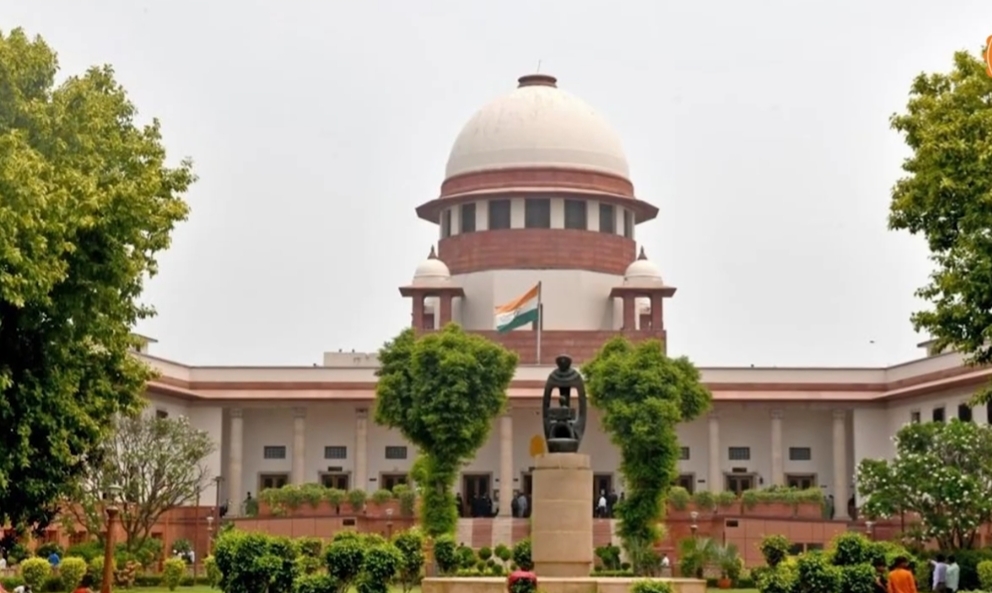
NEW DELHI,16 Jan 2026 : The Supreme Court has reserved its judgment on a plea filed by a father seeking permission to withdraw life-sustaining treatment for his 31-year-old son, who has remained in a comatose state for more than 12 years after falling from a fourth floor of a building in Noida, resulting in a severe head injury.
The Bench of Justice J.B. Pardiwala and Justice K.V. Viswanathan on Thursday reserved its order after hearing arguments from Additional Solicitor General Aishwarya Bhati, appearing for the Central government, and advocate Rashmi Nandakumar, representing the petitioner-father, Ashok Rana. The hearing lasted for about an hour.
The patient, Harish Rana, suffered serious head injuries in 2013 after falling from the fourth floor of a building. Since then, he has remained completely bed-ridden and dependent on life support systems for survival.
Passive euthanasia refers to allowing a patient to die by withdrawing or withholding medical treatment or life-support measures that sustain life. The father has come to the court for the passive euthanasia.
During the hearing, the Court underscored the need for the family to arrive at a “consistent and well-considered” decision in such cases. Counsel for the father submitted that hospitals should designate doctors who could serve on medical boards tasked with examining requests for withdrawal of life support. His lawyer Rashmi Nandakumar also urged the Court to avoid using the expression “passive euthanasia” and instead employ the phrase “withdrawing/withholding life-sustaining treatment” in its judgment.
Earlier, on December 26, 2025 and on January 7, 2026, Justice Pardiwala and Justice Viswanathan personally interacted with Harish Rana’s parents and younger brother. Recording its impressions from the meeting, the Court had observed:
“What they tried to convey, in their own way, was that the medical treatment imparted over a period of almost two years be discontinued and nature be allowed to take its own course. According to them, if the medical treatment is not making any difference, there is no point in continuing with such treatment and making Harish suffer for no good reason. They believe that Harish is suffering like anything, and he should be relieved of all further pain and suffering.”
Ashok Rana – father of Harish Rana told the judges that “…the family has been caring for our son continuously for more than thirteen years and that they have done everything within their human capacity during this period. He said that their son no longer has a voice of his own, and therefore they feel it is their moral responsibility to speak for him. He also expressed gratitude that their concerns have been heard by this Hon’ble Court.”
He also said that his son “Cannot speak, hear, see, recognise anyone, or eat on his own” and “He is entirely dependent on artificial life support, including a feeding tube.”
The Court had earlier examined a medical report submitted by a secondary medical board from AIIMS, Delhi, describing it as “sad.” The primary medical board had also indicated that the chances of recovery were negligible. On December 11, the Bench noted that Harish was in a “pathetic condition.”
“… the condition of ‘Harish Rana’ has gone from bad to worst. He is in a pathetic condition. It is not in dispute that Harish Rana is in a persistent vegetative state. He is suffering from 100% disability with Quadriplegia” the court had noted in its December 11, 2025, order.
As per the Supreme Court’s 2023 guidelines, both a primary and a secondary medical board must be constituted to provide expert opinion before withdrawal of life support in cases involving patients in a vegetative state.
This is the second occasion in recent years when Harish Rana’s parents have approached the apex court seeking permission for passive euthanasia. In November 2024, the Court had considered a report from the Union Health Ministry suggesting home-based care with State support, or alternatively, shifting the patient to a district hospital in Noida.
Earlier, both the Supreme Court and Delhi High Court had declined to constitute a medical board, noting that Harish was not on mechanical ventilation but was being sustained through feeding tubes. At the same time, the Court acknowledged the prolonged vegetative state, the emotional toll on the family, and the financial hardship faced by the ageing parents, who had reportedly sold their house to meet medical expenses.

We are a multimedia news network. Website : www.7xnews.com
Based in New Delhi (India) Youtube : umakantlakheraspeaks@gmail.com