

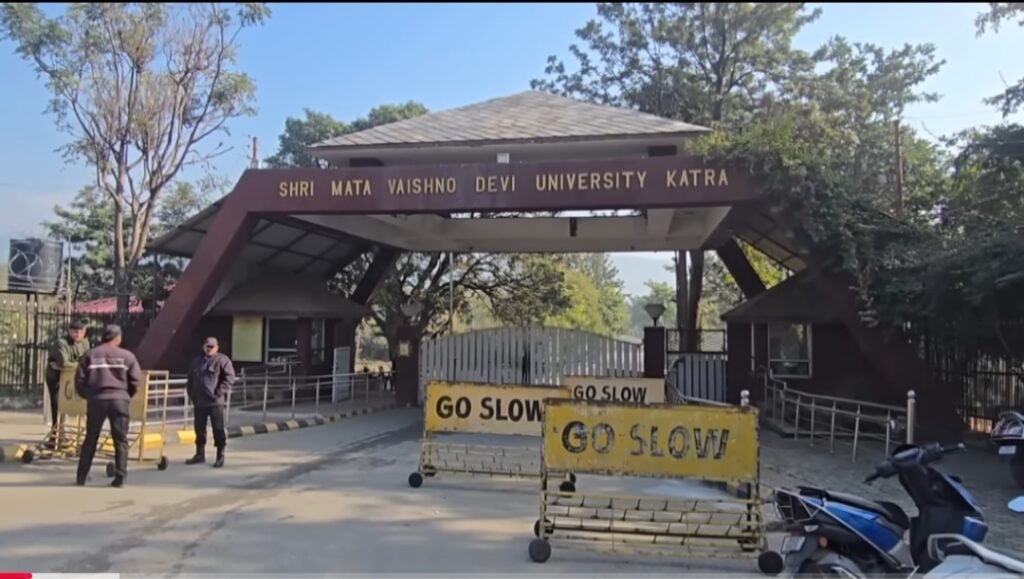
Celebrating Educational Sabotage: The Communal Hijacking of Vaishno Devi Medical College
In a bizarre spectacle that underscores the perilous intersection of politics and education in contemporary India, members of the Shri Vaishno Devi Sangarsh Samiti in Jammu distributed sweets and blared triumphant music to hail the cancellation of the MBBS course at the Shri Mata Vaishno Devi Institute of Medical Excellence (SMVDIME). This “victory,” as they dubbed it, followed an agitation that erupted on November 22, 2025, ostensibly over local grievances but laced with a far more insidious agenda: the exclusion of Muslim students who had secured seats on merit. Far from a triumph, this episode reveals the creeping saffronization of India’s educational institutions, where communal bigotry trumps the pursuit of knowledge and national progress.
The Protests’ Thin Veil of Localism
At first glance, the protests appeared rooted in regional discontent. Out of the 50 MBBS seats allocated through the National Eligibility cum Entrance Test (NEET), only seven went to students from Jammu, with a significant number—reportedly 42—awarded to Muslim candidates, many from Kashmir. Protesters, backed by outfits like the Vishwa Hindu Parishad (VHP) and the Bharatiya Janata Party (BJP), decried this as an injustice, arguing that the college, funded by the Shri Mata Vaishno Devi Shrine Board, should prioritize “locals” or, more explicitly, Hindus. Slogans like “Hindu money for Hindu cause” echoed through the streets, transforming a merit-based admission process into a communal battlefield.
This rhetoric exposes a hidden agenda: not genuine concern for Jammu’s youth, but a calculated effort to communalize education. The shrine board, sustained by donations from Hindu pilgrims, was weaponized as a tool for exclusion, implying that public institutions tied to religious bodies should discriminate along faith lines. Such demands fly in the face of India’s constitutional ethos of equality and secularism, reducing higher education to a zero-sum game of religious entitlement.
The Suspicious Timing of Regulatory Scrutiny
The National Medical Commission (NMC) revoked the college’s Letter of Permission on grounds of infrastructural and faculty deficiencies, following multiple complaints and a surprise inspection.
Yet, the chronology raises eyebrows. The agitation preceded the NMC’s action, with protesters explicitly linking their demands to the admission list. As Jammu and Kashmir Chief Minister Omar Abdullah astutely questioned, why celebrate the shutdown of a medical college in a region starved of healthcare facilities? And who bears responsibility for these alleged deficiencies, if not the very administration that greenlit the course initially?
Critics, including Abdullah and PDP leader Iltija Mufti, have labeled this a “farce” orchestrated under political pressure, a predetermined outcome to appease saffron forces. The BJP’s open endorsement of the revocation further erodes faith in regulatory independence, suggesting that bodies like the NMC are susceptible to ideological interference. This is not mere coincidence; it is a symptom of a broader pattern where educational decisions are swayed by electoral calculus rather than academic merit.
The Broader Spectre of Saffronization
Under the current dispensation, the saffronization of education has accelerated, with curricula revised to emphasize Hindu nationalist narratives, institutions renamed to invoke religious symbolism, and now, admissions tainted by communal vetoes. The Vaishno Devi case is emblematic: a shrine board-run college becomes a flashpoint for Hindutva politics, mirroring attempts elsewhere to impose religious quotas or preferences in secular spaces.
This trend undermines India’s pluralistic fabric. Education, meant to be a great equalizer, is instead being balkanized along religious lines, fostering division rather than unity. In a nation grappling with doctor shortages—particularly in underserved areas like Jammu—the closure deprives aspiring medics of opportunities and exacerbates healthcare inequities. The affected students, now promised relocation to other institutes, face unnecessary disruption, their futures collateral damage in this communal theater.
A Call to Safeguard Merit and Secularism
The jubilation over SMVDIME’s closure is not a victory for justice but a defeat for enlightenment. It signals a dangerous precedent where protests fuelled by bigotry can derail educational progress, emboldening similar campaigns nationwide. India must reject this trajectory. Policymakers should reinforce merit-based systems, insulate regulators from political meddling, and reaffirm education’s role as a bridge across divides.
As Abdullah poignantly noted, elsewhere people fight to establish medical colleges; here, they rejoice in their demise. This inversion of priorities demands introspection: Are we building a knowledge society, or one mired in medieval prejudices? The answer will define our nation’s future.
~Hasnain Naqvi is a former member of the history faculty at St. Xavier’s College, Mumbai

~Hasnain Naqvi is a former member of the history faculty at St. Xavier’s College, Mumbai….
The opinions expressed here are solely those of the author.

