
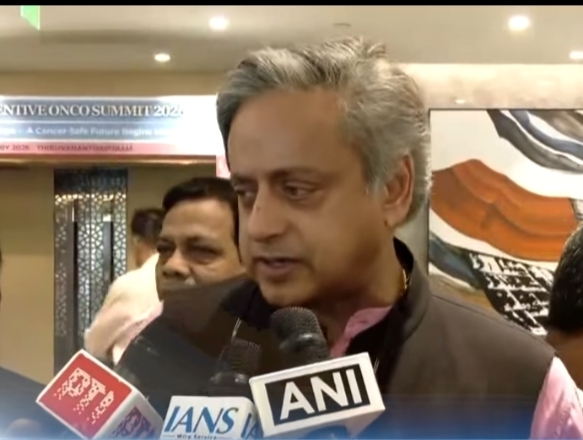
NEW DELHI,24 Jan 2026 : Congress MP Shashi Tharoor on Saturday suggested that India should copy the Canadian Prime Minister’s call for survival in the current economic situation.
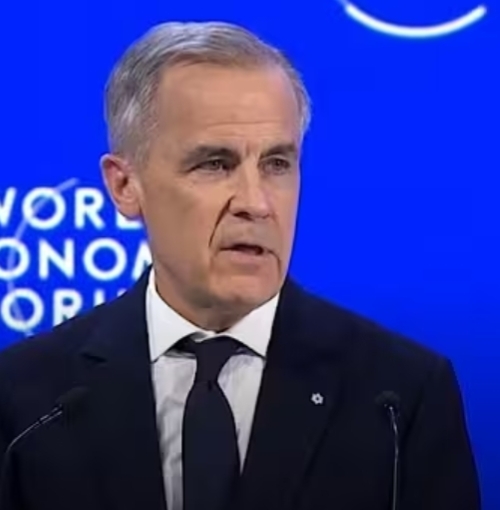
He said: “In the frost-bitten landscape of Davos this week, Canadian Prime Minister Mark Carney delivered a speech that was less diplomatic routine and more clarion call. In essence, he outlined a manual for survival that resonated around the world.”
Addressing the World Economic Forum, Carney – a man who transitioned from the central banking boardrooms of London and Ottawa to the helm of a G7 nation – spoke of a rupture in the global system rather than a mere transition. Tharoor pointed out that Carney announced the death of the rules-based international order, warning that the grim reality where, in Thucydides’ classic formulation, “the strong do what they can while the weak suffer what they must”, is no longer a historical footnote, but our current lived experience.
PRESCRIPTION FOR INDIA
For an Indian audience, Tharoor said Carney’s analysis should ring with a familiar, if unsettling, clarity. “As we navigate 2026, the global architecture we once relied upon for trade and security, and served to define our place in the world, is being systematically dismantled by President Trump’s great-power transactionalism. We need to be as honest with ourselves about the situation as Carney was in his speech,” the Congress MP said.
Carney’s prescription for Canada – building strength at home, diversifying abroad, and forming issue-by-issue coalitions – offers a compelling mirror for India’s own journey, Tharoor said, noting that he has been stressing these very elements in his columns and speeches over the past one year.
However, he said for a subcontinental giant like India, the path forward requires a delicate balance between Carney’s approach and our own aspirations: endorsing the middle-power solidarity Carney suggests while carving out a unique trajectory rooted in our own strategic autonomy.
Whether through aggressive tariffs or the weaponisation of financial chokepoints, the era of trade as mutual benefit is being replaced by an ethos of coercion.
Tharoor said India has long sensed this shift. From our refusal to join the RCEP to our Atmanirbhar Bharat mission, New Delhi has proactively moved toward “de-risking” long before the term became a Brussels buzzword. We must endorse the Canadian call for clarity; we cannot live within the lie that global institutions like the World Trade Organization (WTO) or the UN Security Council will protect our interests in their current paralysed states. Resilience today is not about isolation, but about a sovereignty anchored in the ability to withstand external pressure.
This leads directly to the power of the “middle”. One of the most actionable parts of the Carney Doctrine is the call for middle powers to band together, arguing that while hegemons can go it alone, everyone else is on the menu if they aren’t at the table (a phrase Tharoor says he has used himself for two decades, but which has never seemed as apposite as now).
Tharoor argues that India finds itself in a unique position here. “While we often view ourselves as a leading power rather than a middle power, the tactical benefits of Carney’s approach are immense. There is a natural common cause to be made with nations like Canada, the UK, Japan, ASEAN and the EU (and maybe even Russia). For instance, Canada’s massive investment in minerals and energy is a direct opportunity for India’s electric vehicle and green-tech ambitions,” he said.
By joining “buyers’ clubs” with the G7 and Canada, India can secure supply chains that are currently choked by a single-source monopoly, Tharoor argued. Similarly, in the realms of AI and quantum computing, he said India and Japan can lead the way in creating open-source democratic standards, instead of being trapped under a digital iron curtain that seems to be falling between the US and China.
Much like Canada’s decision to join European defence procurement initiatives, Tharoor stressed that India can deepen its Indo-European security ties with Germany and France, without giving up its first-mover advantage with Russia, to hedge against a potentially inward-looking United States. “By collaborating with these powers, India avoids the vassalage of the re-emerging bipolar world. As a “multi-aligned” power, we aren’t choosing a side, we are building a network,” Tharoor added.
pictures credit social media

We are a multimedia news network. Website : www.7xnews.com
Based in New Delhi (India) Youtube : umakantlakheraspeaks@gmail.com