

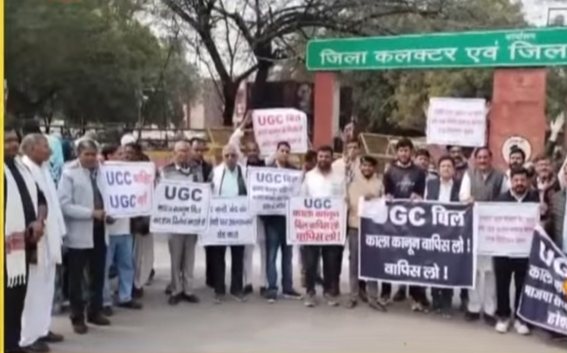
The Equity Paradox: Why the UGC Regulations 2026 have Set the Republic on Edge—–A New Charter for Campuses, A New Fault Line for Politics Husnain Naqvi In the cold January of 2026, what began as a technocratic update to campus governance has metastasized into a nationwide political and constitutional crisis. The notification of the UGC (Promotion of Equity in Higher Education Institutions) Regulations, 2026, on January 13, was intended to be a milestone for the National Education Policy (NEP) 2020. Instead, it has triggered a firestorm of protests, a string of high-profile resignations, and—most significantly—a dramatic intervention by the Supreme Court of India.A bench led by Chief Justice Surya Kant placed the regulations in abeyance, effectively staying their implementation. The court’s move follows a fortnight of chaos where the ruling Bharatiya Janata Party (BJP) found itself in the rare position of facing a rebellion from its own ideological core.
The Architecture of Inclusion:
The 2026 Regulations were framed as a necessary “statutory upgrade” to the aging 2012 guidelines. For the first time, the state sought to move beyond mere advisories, creating a legally enforceable framework for campus dignity.
*The OBC Milestone*: By explicitly including Other Backward Classes (OBCs) under the anti-discrimination umbrella, the UGC sought to address a long-standing grievance of the “Mandal” block, providing them with the same grievance mechanisms as SC/ST students.
*Institutional Teeth*: The rules mandate “Equity Committees” with a 24-hour response time for complaints. By making the heads of institutions personally accountable, the UGC aimed to dismantle the systemic apathy that has historically characterized campus bias.
*Broadened Protection*: The regulations extended to faculty, non-teaching staff, and even online learners, recognizing that the modern university is a complex ecosystem of power dynamics.
*The “Rule 3(c)” Contention*:
The backlash centers on a perceived “procedural asymmetry.” Critics argue the regulations have traded equity for a new form of exclusion.
*The Exclusionary Definition*: At the heart of the PILs in the Supreme Court is Rule 3(c), which defines “discrimination” strictly through the lens of reserved categories (SC, ST, OBC, EWS). By failing to provide a mechanism for “General Category” students to report harassment based on their own identities, the law has been labeled as “state-sponsored reverse-discrimination.”
*The Surveillance State on Campus*: The creation of mandatory “Equity Squads” and 24/7 monitoring has led to fears of a “regulatory panopticon,” where academic freedom is stifled by the fear of summary proceedings.
*The Missing Safeguards*: Unlike almost every other modern grievance framework, the 2026 rules lack any penalty for malicious or false complaints, a vacuum that critics say invites campus vendettas and political targeting.
A Saffron Divided: The Political Fallout
Perhaps the most striking development is the “Saffron Split.” In Uttar Pradesh, the heartland of the BJP’s electoral strength, the party’s own members have led the charge against the “Black Law.”
The resignation of Bareilly City Magistrate Alankar Agnihotri—who alleged he was “held hostage” by administrative pressure—sent shockwaves through the bureaucracy. He was followed by a wave of party resignations, including Shashi Tomar (BJP Mahila Morcha) and Raju Pandit (BJYM), who claimed the rules treat the general category as “perpetual perpetrators.”
In a poetic irony, protesters in Lucknow and Gonda have turned the party’s own slogans—”Bantenge Toh Katenge” (Divided we fall) and “Ek Hain Toh Safe Hain” (United we are safe)—against the government, arguing that the UGC is the one dividing the Hindu fold.
The Judicial Brake: What Now?
The Supreme Court’s stay marks a tactical retreat for the government. CJI Surya Kant’s suggestion to form a “committee of eminent jurists and scholars” to align the regulations with “social values and ethos” signals that the court views this as more than just a legal technicality; it is a question of social fabric.
A Lesson in Consensus
The UGC Regulations 2026 have proven that in a hyper-polarized Republic, social justice cannot be enforced through exclusionary math. While the protection of marginalized students is a constitutional imperative, the omission of a vast section of the student population from the same protective umbrella has created a “victimhood competition” that no university can survive.
As the jurist committee begins its work, the government must find a way to balance the historical necessity of Dalit and OBC protection with the modern requirement of universal campus safety. Until then, the “Equity Paradox” remains the most volatile lesson on the Indian campus.
~Hasnain Naqvi is a former member of the history faculty at St. Xavier’s College, Mumbai

~Hasnain Naqvi is a former member of the history faculty at St. Xavier’s College, Mumbai….
The opinions expressed here are solely those of the author.