

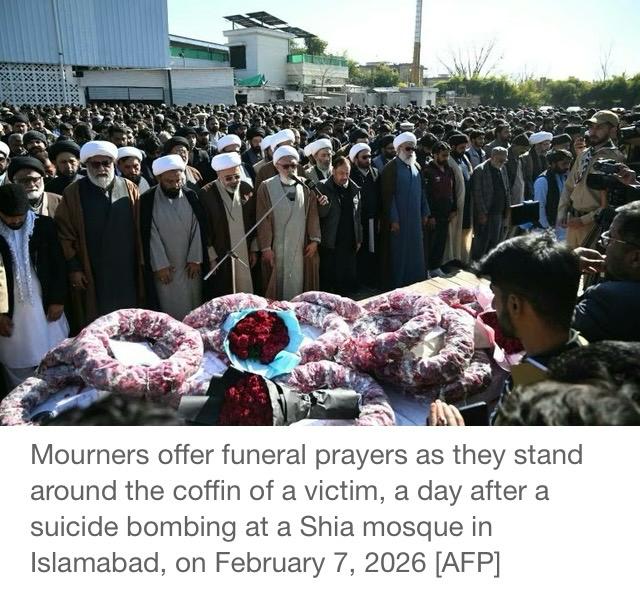
Blood on Friday Prayers: The Islamabad Mosque Massacre Another Chapter in Pakistan’s Sectarian Shame In the shadow of Pakistan’s gleaming capital, where diplomats convene and power brokers plot, a suicide bomber shattered the sanctity of Friday prayers on February 6, 2026. The blast at Khadijah al Kubra mosque-cum-Imambargah in Islamabad’s Tarlai area claimed at least 31 lives and left over 169 wounded, many critically. This brazen assault on a Shia congregation underscores a grim reality: in Pakistan, sectarian hatred continues to thrive, unchecked and unyielding. As the nation grapples with yet another atrocity, one truth demands urgent reckoning—Shia lives matter, no less than any other.
The Horror Unfolds in Tarlai
The explosion ripped through the mosque during the height of Jumu’ah (Friday) prayers, transforming a place of worship into a scene of carnage. Worshippers, gathered in devotion, were met with shrapnel and chaos as the bomber detonated amid the crowd. Bloodied bodies lay strewn across the carpeted floor, surrounded by debris and the cries of the injured. Among the dead were children and a police officer, DSP Bahadur Ali, whose funeral in Skardu drew thousands in mournful solidarity. Hospitals in Islamabad and Rawalpindi overflowed with victims, some clinging to life in critical condition.
Initial investigations point to a suicide attack, with security forces arresting three suspects in Peshawar, including relatives of the bomber. The Islamic State (ISIS) claimed responsibility in one report, though authorities continue forensic analysis to confirm links. Condemnations flooded in from the US, UK, China, Iran, and the EU, but such international outrage rings hollow against the backdrop of Pakistan’s recurring failures to protect its minorities. Security has been heightened around mosques and Imambargahs, yet this reactive measure exposes the state’s chronic unpreparedness for threats that have long simmered.
A Legacy of Targeted Terror
This is no isolated tragedy but a continuation of a bloody saga where Shia mosques, Imambargahs, and processions serve as killing fields for anti-Shia extremists. Over the past two decades, more than 4,000 Shias have been slain in sectarian violence, often by groups wielding ideology as a weapon. Organizations like Sipah-e-Sahaba Pakistan (SSP, now rebranded as Ahl-e-Sunnat-Wal-Jamaat), Lashkar-e-Jhangvi (LeJ), Tehrik-i-Taliban Pakistan (TTP), and the Islamic State Khorasan Province (ISKP) have orchestrated these horrors, fueled by a toxic brew of sectarian bigotry and state complacency.
History is littered with such massacres. In 2003, gunmen stormed a Shia mosque in Quetta, killing 53 during prayers. A decade later, in 2013, LeJ bombed a snooker club and a market in Quetta’s Hazara Town, claiming over 180 lives in two separate attacks. The 2015 suicide bombing at a Shia mosque in Shikarpur, Sindh, left dead amid Friday congregations. ISKP’s 2022 assault on a Peshawar mosque during prayers killed 67, marking one of the deadliest in recent memory.
Muharram processions and other religious festivals amplify the peril. In 2012, a bombing during a Shia procession in Rawalpindi claimed 20 lives. More recently, in 2024, gunmen ambushed a procession in Parachinar, Khyber Pakhtunkhwa, killing 44, including women and children.
These attacks, often unclaimed or denied by perpetrators like TTP, reveal a pattern: Shias are dehumanized, their faith weaponized against them by militants who exploit divisions sown during Zia-ul-Haq’s era of Islamization.
Shia Lives Matter: A Call for Justice
In a nation founded on the promise of equality, the persistent targeting of Shias mocks that ideal. These are not mere statistics—they are families shattered, communities scarred, and a minority enduring erasure. Shia lives matter, not as a slogan but as a fundamental truth demanding action. The state’s reliance on extrajudicial measures and fleeting crackdowns has failed; what is needed is a comprehensive strategy rooted in intelligence, deradicalization, and accountability for hate-mongers.
Political parties, the judiciary, and the military must dismantle the platforms that amplify sectarian venom, from madrasas to militant networks. Ignoring this violence risks further instability, as seen in the spread of hatred beyond traditional Deobandi groups to Barelvi extremists like Tehreek-e-Labaik Pakistan. Pakistan cannot afford to let bigotry define its future. The blood in Tarlai calls for more than condolences—it demands an end to the cycle of terror, ensuring every citizen, Shia or otherwise, can pray without fear.
To say “Shia lives matter” is to demand that the Pakistani state stops treating sectarian violence as a peripheral issue. It is a demand for a country where a man can go to prostrate before his God without wondering if he will return in a casket.
Until the state confronts the ideological roots of the groups—be it the LeJ, ISPP, or their sympathizers—the floor of Khadijah al-Kubra will not be the last one stained red.
~Hasnain Naqvi is a former member of the history faculty at St. Xavier’s College, Mumbai
Picture credit social media

~Hasnain Naqvi is a former member of the history faculty at St. Xavier’s College, Mumbai….
The opinions expressed here are solely those of the author.